
A World Built for House Sparrows
by Tom Scocca
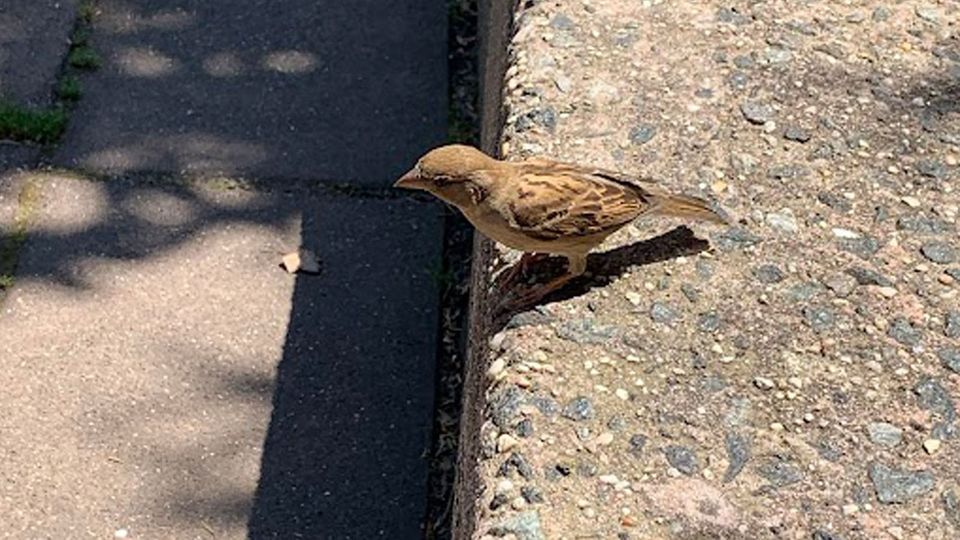
The house sparrow is not an interesting bird. That may have been what finally caught my attention: how hard it was to pay attention to them. Their little drab forms are everywhere—I started phone-typing this paragraph walking down a cross street, and a half-dozen of them immediately darted out from around a tree box to splash in a puddle in the roadway—but the eye and brain quickly edit them out. (Out on Broadway, another one picked up a hunk of bread, flew veering back and forth over the sidewalk struggling with the weight of it, and dropped it again.)
There was a time, long ago, when I thought a house sparrow might be something notable—the male, anyway. The gray cap, black mask, and chestnut temples, down by the city pavement, looked nothing like the striped heads of the countless white-throated sparrows in our backyard in the woods. But now I live in the city and a white-throated sparrow in the park is like an old friend from home. The house sparrow, Passer domesticus, registers no more than the grime on the sidewalk does, unless I glimpse one scurrying by the trash at the curb and briefly mistake it for a mouse or rat.
“[D]o I love the house sparrow? That I find difficult to answer,” the British ornithologist and engineer J.D. Summers-Smith wrote in his 1963 monograph The House Sparrow, the first of five books he would write about the bird and its relatives. “I do know that I should find life extremely dull without them as my constant neighbours,” he added. According to his obituary in the Guardian, he had started studying the species in 1947 because, with postwar gas rationing in effect, he didn’t have to travel anywhere to see them.
And Summers-Smith was equivocating about them on their native territory. Here in the New World, the house sparrow is a vicious invader, known for stealing nest sites from the lovely native bluebird, often murdering the bluebirds in the process. And not just bluebirds, either. The sparrows (“English sparrows,” at the time) were released around the United States in the second half of the 19th century by people who thought they were charming—or, in Brooklyn, who hoped they would kill off a plague of inchworms. Edward Howe Forbush, writing in his Birds of Massachusetts and Other New England States in the 1920s, described the aftermath:
Most of the House Wrens, Purple Martins and Cliff Swallows, which had been abundant in southern New England, disappeared, the Sparrows having taken their nests. For example, Mr. B. H. Newell, of City Point, Maine, wrote to me that one female Sparrow took nearly every egg out of thirty-five Cliff Swallows’ nests at his place, by merely driving her bill into them and letting them drop from the nests. The interlopers tore down the nests of other birds to get material with which to build their own nests, and in their eager search for linings for their clumsy domiciles they have been known to snatch hair from the back of a live dog. By attacking in numbers the Sparrows were able to kill birds as large as the Robin or the Northern Flicker.
Then again, in fairness, no bluebird or cliff swallow would have been trying to eat discarded bread off the ground on Broadway, even if their populations had never been molested. The house sparrows are here because the house sparrows go where human beings go, across six continents and all four hemispheres. Summers-Smith wrote that they “spread along railway lines during their construction, by living on scraps at the railhead camps,” and that they followed troops into the previously uninhabitable Sinai desert during the First World War; when people move off of islands, the house sparrow population dies off behind them. Their most visible absences on the map are from the Arctic tundra, the jungles and rainforests of the tropics, and East Asia, where the Eurasian tree sparrow occupies their role.
Whatever else there is to say about the house sparrow’s morals or manners, it is a civilized bird. It moved into human territory millennia ago—not as a friend like the dog, nor an outright enemy like the rat or bedbug, but as a creature that saw its chance and took it, evolving into a new way of life in parallel to human activity. House sparrows hunt insect pests in the fields to feed to their nestlings; the nestlings grow up and fly off to steal ripe grain from the fields. Mostly, outside the cycles of earth’s bounty, they enjoy what Summers-Smith called “a remarkably short working day compared with most passerine species.” In winter, he wrote, “house sparrows appear to have little difficulty in finding sufficient food and in fact spend a considerable time in other activities such as social singing.”
Our lives are inscribed on their lives. A 1991 census of house sparrow nests in the Polish cities of Bydgoszcz and Torun found that the most common height for their nests was between 4 and 4.99 meters off the ground—and the second most common height, by far, was not 3 meters or 5 meters, but 12 to 12.99 meters: the height of the roof vents in the three-story buildings that dominated the urban environments there. The skyline was in the data. In Delhi, in 2020, researchers found that house sparrows’ favorite nesting sites were inside the roll-up shutters on storefronts, but that they were also trying air conditioner exhausts, “hanging lamp holders,” and “bridges under construction.” Summers-Smith wrote about a collection of house sparrows nesting “in the sails of a house-boat on the Nile...flying to the banks of the river from time to time to forage for food but always rejoining the boat before it got out of range.” In the winter of 1970–71, a zoologist saw “a dozen or more” of them roosting in a “subterranean transformer vault” in Tarkio, Missouri, descending through an iron grate to get into a space that began a meter underground.
In New York, many of them nest 25 feet 8 inches off the ground—that is, inside the 3 1/2 inch steel pipe of the cross arm that helps support the mast arm of the standard M-2A traffic signal pole. I might never have been aware the cross pipes existed if I hadn’t heard a sparrow calling from an open end. I’ve also seen them nesting inside the rectangular space where I-beams overlap in a sidewalk scaffold, having evidently learned to see through the city’s administrative fiction that the scaffolding is temporary. The shaggy nests trailing down from the LED lights in the underpasses in Central Park must be their work, too.
The house sparrow belongs to the weaver finch family, and it builds domed structures to fill the available space wherever it’s decided to nest. In Coimbatore, India, construction materials retrieved from a survey of nests included paper scraps, plastic scraps, fine plastic rope, cotton thread, coconut fiber, jute, hair, and chicken feathers. In Mexico City, the sparrows included cigarette butts in the nests, and the nicotine may have helped repel parasites. In New York I see them dragging around filthy plastic twine, a kind of garbage so ordinary and anonymous I can’t properly picture it in use, in its pre-garbage state.
If God’s eye is on the sparrow, the house sparrow’s eye is lower still, on the opportunity in the detritus of human activity. Summers-Smith noted that house sparrows have been seen “feeding their young long after dark by catching moths and other insects attracted to electric lights and neon signs,” and harvesting “from parked cars the dead insects trapped in the radiator grilles.” Before the automobile, they feasted on horse manure. At the cafe on the pier in the Hudson at 70th Street, they lurk around and under the tables, waiting to dart in and steal food.
I thought it would be easy to snap a picture of one, once I’d decided to try—by the cathedral, say, while they eyed the pastry I was eating. But as soon as I started looking at them in return, they scooted a little further off. Summers-Smith wrote that his neighborhood birds, in his daily observations, “did not, as might have been expected, come to accept and ignore me. The effect of watching was to make this already wary bird even more wary...[D]uring the breeding season their behavior at the nest was different when I was watching them through field glasses from what it was when I was gardening and only casting surreptitious glances toward them.”
The house sparrows live in and around us, yet not exactly with us—fluttering, chattering proof that the anthropogenic realm is larger and deeper than the upright apes who built it properly apprehend. They wallow in the dust and lead monogamous yet flagrant sex lives (“The sight, or sound, of a pair mating often stimulates other pairs at nearby nests to the same activity,” Summers-Smith wrote). They behead whole patches of yellow crocuses; they drop pebbles off roofs for the entertainment of the impact.
I described them as escaping my notice but that’s not entirely true. Walking by the edge of the Sheep Meadow in Central Park, I learned to focus on a particular stretch of shrubbery, for the sake of the astonishing sound that would sometimes erupt from it. The sparrows had the habit of packing themselves in among the dense branches, nearly invisible drab shapes in the shadows, and letting loose a dense, polyrhythmic clamor, their plain and unmusical individual voices merging into something immense and awesome and, above all, majestically indifferent to the humans passing feet or even inches away. From inside the bush, we were of no consequence at all.
If you loved this story, send it to a friend, recommend it on socials... and Subscribe to Flaming Hydra.