
Caravaggio, Sam Altman, and Me
by John Saward
I was wandering around a humid church in Rome, vibrating on no sleep, and there was a murder going down on the wall. It can feel sometimes in these kind of places like you are hallucinating, the smell of candles hanging in the air, new wet wax, old smoke, old wood, the tourists in strange shoes, the modesty shawls for sale for 2 euros up the hill from shops selling Jesus magnets, and then those pillars of ancient splattered black marble and the great gilded domes above the altar, the darkness and the glass and the beams of light that hit you, you would have to say, half-crazy from the heat, bloodshot eyes begging for mercy, as maybe even a different kind of light, a light from an almighty dimension, and it’s enough almost to break you down.
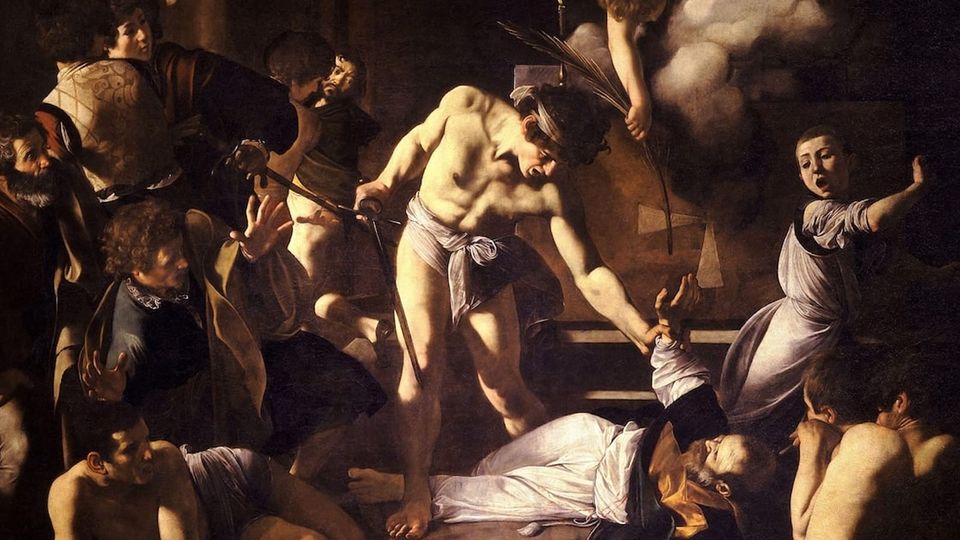
This was way in the back of the Chiesa di San Luigi dei Francesi, standing there before Caravaggio’s The Martyrdom of Saint Matthew. Ten feet tall, 10 feet across, a half-naked swordsman has crashed a baptism; he has come to kill the preacher. It is written that there was once a king in Ethiopia who promised Matthew half of his kingdom, if Matthew could convince a woman to marry him. The woman was a princess who had become a nun. And so Matthew invites the king to a Mass, there is a grand sermon, and then Matthew tells the king that the princess is already taken, she is the bride of Christ. The king storms out. Caravaggio’s painting shows what happens some days later.
It is a blockbuster. It feels like something holy and cataclysmic is happening on that wall but also a little like walking in on a mob hit. There is dread, seething rage, chaos, shock and bodies bent in horror, passion, vulgarity, cowards fleeing, a mess of limbs, violence and desperation, pure panic barfing up out of the face of a young girl, all of it all at once. The crumpled Saint Matthew looks up as an innocent, heavenly cherub reaches the palm of martyrdom down for him.
The truth is I had come looking for this. That my days and maybe yours too all feel terrorized by the synthetic, by impostors, by preening frauds spouting homilies, terrible kings of our crooked age making their own shady deals, by commercials and terrible minimovies and nu-tech demonstrations, factory-farmed gigabytes of television that no one will watch. Cheap art, glitching art, fake art, art that is proud that you know it is fake, can you imagine all the possibilities for commerce? I had come looking to have my ass handed to me, is what I’m saying. I had come looking for dispatches from real places.
When Caravaggio was five years old, the plague came to Milan. There were purple-blue corpses piled up and dripping with blood, dumped in pits or piled in houses boarded up from the outside. Gravediggers who ransacked the houses in town, stripping them for valuables when they came for the dead and raping the living women they found hiding inside. In the streets they organized religious processions to reenact Christ’s march to Calvary, priests who walked for three days barefoot as thousands followed along flogging themselves, until there was just a whole mob of bloodied flesh, all of this to send the plague back to Hell, and it is almost certain that little Caravaggio saw all of it, that at the very least he felt all this doom and revulsion outside his windows, the shrieks and commotions out there in the roads, the candles they lit in the doorways at night as a kind of superstition, whipping in the dark, a city crying out to be rescued.
His father and grandfather died of the plague on the same day, his uncle later that same year. His mother raised him poor, and by the time he was 13 she was dead too. And here usually the biographies note a period of darkness, some years with few details, from which he emerges bruised and tormented, dressed in rags, surly, rotten even, the money from selling his father’s land all gone. He is listless, horny and mean, seeming to get no satisfaction from anything; brawling just because, sleeping with everything he can find, not painting much, sometimes not painting at all. It’s even thought that during the Dark Time wandering from home he may have tried to become a soldier or a swordsman of some kind.
He was often consumed by what seemed like nihilism and apathy, indifferent about his work, and at other times driven by violent passion, getting into duels over women, over a tennis match. He once smashed a plate into a waiter’s face over a dispute about some artichokes. Intermittently he painted, portraits of Men Of Note, regionally known priests and politicians, little busts of wisemen and military heroes and getting paid per head. Pictures of fruit and of flowers, junk for the fascination of dull northerners and rustic bumpkins.
He changed his address 10 times between 1592 and 1595. He lived with a priest who fed him only salad. Another place where he slept on the straw floor of a sort of barn and got kicked by a horse so hard he never went back. He went door to door to art dealers, sold his work to secondhand shops. X-rays done on these early paintings reveal little evidence of any traditional technique, planning, or revision at all, any evidence that the lessons of his apprenticeships ever really took. He was a delinquent student who resorted to his own methods, and in the process invented this spooky theatrical showdown between light and darkness. Scenes that are both ghostly and alive; biblical tragedies set in dusty taverns and back alleys.
Eventually Cardinal Francesco Maria del Monte bought two of Caravaggio’s pieces to hang in his palace in Rome, smaller works but provocative ones—in one, a palm reader slyly removes a ring from the hand of a boy having his fortune told; in the other a blond dandy is taken for a ride at a rigged card game. Devious scenes of lowlifes and crooks.
In 1565, a French cardinal bought a chapel in the Chiesa di San Luigi dei Francesi, intending to be buried there. He commissioned frescoes of Saint Matthew’s calling and his death, but when the cardinal died 20 years later the chapel was still bare. The original artist relinquished the job; more years passed, more artists, more abandoned attempts. “They were thrilled by the importance of the commission, but paralysed by self-doubt,” Andrew Graham-Dixon wrote of those others in his biography of Caravaggio.
But then Cardinal del Monte had a suggestion for the executor of the French cardinal’s will and fortune, the painter from Milan he’d found in the secondhand shop, and so there it all was for me to find hundreds of years later. Here was a Bible scene; here was a version of history; here was decoration in a Frenchman’s vanity project, at long last, in a church in the middle of Rome. But it was something else, too: here was a maniac genius on the big stage for the first time, who had until then never painted anything with more than four figures in it, finally set free from those hours painting trinkets and still lifes for rubes, reaching back in this room and seeing what number he could hit on the radar gun. On that wall are all the things that delivered him here; the things that terrified the boy, that sent the young man adrift and then brought him back to dry land as he reached his 30s. There was a plague and there was its banishment on these faces; there was sickness and there was immortality and there was a father looking up at death. Here was a point in time, a point in a life. A man coming to understand some things about his insane powers.
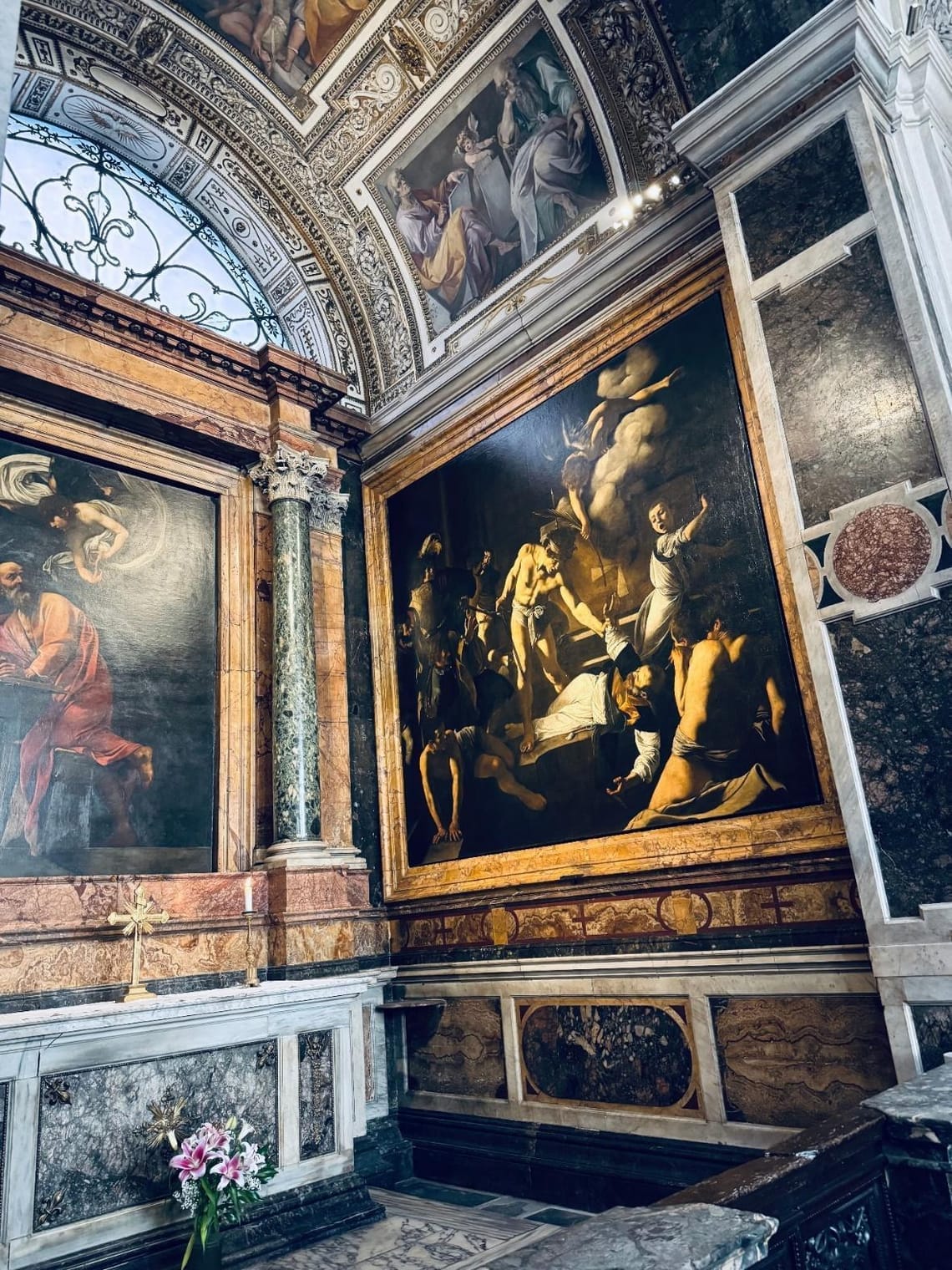
I can say that when I approached that last chapel, on my left, hidden at first by all the marble, and then slowly, slowly, around the bend this assassination ambush scene appeared out of the black, tarry darkness, it felt like taking a submarine to the bottom of the ocean and glimpsing a rare fish in the beam of a flashlight. As all of us packed against the railings, one against the other, tired and shining from the September heat, standing still and hushing sounds of vague awe and gratitude to each other, it felt a little like family seeing a newborn for the first time. I have been thinking about coming around that bend for a month now.
The day we got home from Italy there was a video going around online. Sam Altman, the CEO and co-founder of OpenAI, was announcing a program called Sora 2, OpenAI’s newest “video generation model.” There was a trailer he had come to show us all. Altman is looking into the camera with his sickly, bulging eyes, telling us about his Very Special Project in a voice that sounds a little like an advertisement for plaque psoriasis medicine. “It’s the most powerful imagination engine ever built.” And then there is two minutes of footage, a montage of scenes that Altman and some of his ratlike OpenAI consiglieres appear in too, star in, which we are told were imagined and generated entirely by a computer program after feeding it some commands and prompts. You could say plenty about the scenes themselves—there were faraway planets that felt like a Rainforest Café and scenes of “comedy” that had the nattering imitation cheer of a VISA commercial. There was “Beauty” that felt like stock iPhone wallpapers; “Drama” that played like the opening credits of an NCIS spinoff.
None of it though was more foul than the proposition itself: here was the future, a place where you would not become the artist or even the rich French priest who might hire one, there would only be a humming robot to imagine all those plagues and glories for you instead. But these are not real men from real places, these are not lives we will remember. There are chapels out there where they don’t belong.