
Enter the Minotaur
by Zito Madu
Last week, I flew to Detroit and drove three hours to Buchanan, Michigan for my last reading of the year for my debut book, The Minotaur at Calle Lanza, a memoir published on April 2nd. I’ve spent the past few months answering questions at readings like this one, on personal topics like immigration, father/child relationships, the humiliation of poverty, Venice, Detroit, Nigeria, surrealism, and so on.
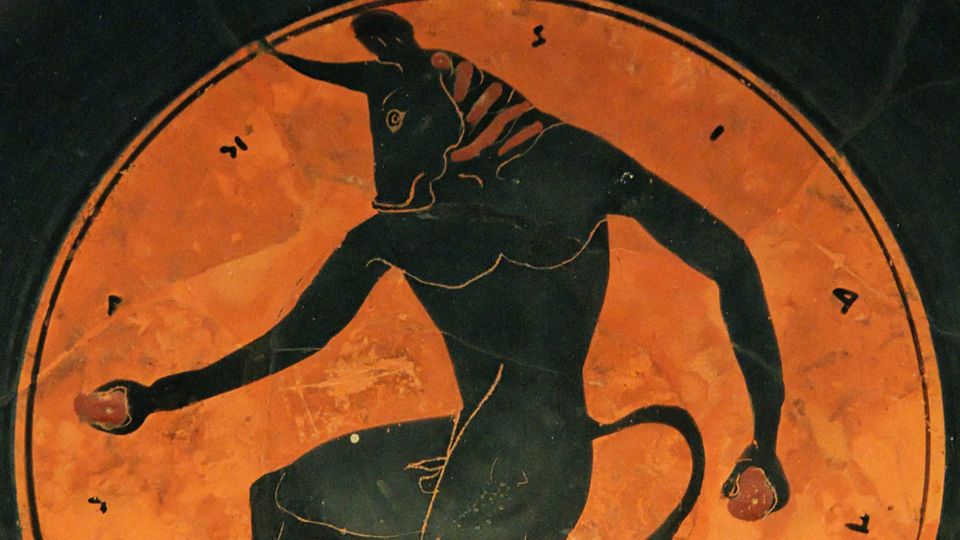
Near the end of the book, I tell the story of coming back to my apartment from dinner one evening when I was living in Venice and crossing the bridge near the Basilica Santa Maria della Salute, where I transformed into the Minotaur, the half-man half-bull creature of Greek myth. The book’s sometime categorization as “speculative nonfiction” is generally attributed to this scene (though not, strangely, to the one in which my grandfather appeared to my mother in her dreams while she was pregnant with me and commanded her to give me my name, nor the ones in which I write about being my grandfather resurrected).
In any case, at readings, I’m often asked the question: Why did you choose the Minotaur?
On the drive back to Detroit from Buchanan, I realized I’ve answered this question differently almost every time. Venice feels like a labyrinth to walk in, and I sometimes talk about that; other times I talk about the island of San Giorgio Maggiore, which houses a boxwood maze inspired by Jorge Luis Borges’s Garden of Forking Paths.
In Watermark, Joseph Brodsky describes Venice in the same way:
Once or twice over these seventeen years, I've managed to insinuate myself into a Venetian inner sanctum, into that beyond-the-amalgam labyrinth Régnier described in Provincial Entertainments [sic].
[...] So you never know as you move through these labyrinths whether you are pursuing a goal or running from yourself whether you are the hunter or his prey. Surely not a saint, but perhaps not yet a full-scale dragon; hardly a Theseus, but not a maiden starved Minotaur either.
I’m always quick to make the point that this Minotaur is my own, and not the original Asterion, the one killed by Theseus. Mine is not in antiquity but in the contemporary world, and it seemed as natural in Venice as the Venetian lion symbol. A lion is real, to be sure, and a Minotaur is not, but in writing the book I was going after the true more than the real.
In other words, I don’t see my experience of the Minotaur in Venice as separate from my everyday life. If I were a South American writer, my work would be called magical realism. I’m not sure whether the term would be applicable to the work of an African writer, or an American who is a first-generation immigrant. But for someone who was born in an Igbo village, though the Minotaur might be new, there are much stranger things in our stories about ordinary lives.
I used to keep track of all of the times friends told me that I’d showed up in their dreams, because these dream-roles were all strangely alike: I’d show up in the background of a dream, like an intruder, a specter, sometimes as a Minotaur and sometimes as a regular person, and in the dream I’d be saying something to myself, something they couldn’t hear or understand. I’d distract them from the rest of the dream, to the point that I became their main focus. One friend woke up the next day and asked me immediately to clarify what I was saying in the dream.
Sometimes I answer the question about the Minotaur by referencing the surrealist magazine of the 1930s called Minotaure, which used the creature as a point of exploration of the human and the beastly, the monstrous as a third way of being, a way to look back at what it means to be a human from outside the normal order of things. To go beyond accepted classifications, in order to form a better way of being.
Keep us breathing fire!





For $3/month you can read this whole post and get our weekdaily newsletter too!