
Etymology Today: LIBERAL
by Maria Bustillos
Here we present various etymologies for the word, LIBERAL.
I. Google AI Overview
First it is worth noting that the results displayed below for the search, “etymology: liberal” on Google AI Overview are very unlikely to reappear for you, should you google the same phrase yourself; in a dozen or so identical tries over the last few days, Google AI Overview has never returned the same results twice, for me. But that is only the start of the trouble.
Here we are, looking to find the sources of meanings for the word “liberal.” Only a single source, Shakespeare, is named directly in the results; if you’re curious about any of these usages, if you want to trace their path back through the history of the language, Google AI Overview is worthless. For example,
Over the centuries, its meaning has shifted from denoting social status to describing a broad political philosophy.
This is a trash Khan Academy-style pseudo-reference, plopping out a conclusion with no hint as to how it was reached. Or by whom (or when, beyond “over the centuries”). How is this etymology? Again: who ever said any of this, and why? Even worse, the tiny round link at the end lands you on a hotly contested, highly politicized Wikipedia entry for an altogether different word, “liberalism.”
What is the word “libertarian”—or the word “libertine”!—doing in the search results for an etymology of “liberal”?
![Google AI search result on “etymology: liberal”. liberal /ˈlɪb(ə)r(ə)l/The word "liberal" traces its roots to the Latin adjective liber, which means "free," "unrestricted," or "independent". [via Online Etymology Dictionary] Over the centuries, its meaning has shifted from denoting social status to describing a broad political philosophy.Historical Evolution14th Century (Status & Generosity): First appearing in Middle English, it initially meant "nobly born" or "befitting a free-born man". By the late 1300s, it evolved to mean "generous" or "magnanimous"—as in someone freely and nobly giving to others.16th & 17th Centuries (Restraint): The word sometimes took on a pejorative connotation, meaning "unrestrained" or "lacking discipline," as used by Shakespeare. 18th Century Onward (Politics): As the Enlightenment took hold, the term shifted to mean free from prejudice or bigotry. By the early 19th century, it became the foundation for liberalism, a political ideology championing individual liberty, constitutional rights, and free markets. Root & Linguistic Relatives. The Latin liber gave rise to several connected terms, all centered on the concept of freedom: Liberty: The state of being free. Libertarian: An advocate of extreme individual freedom. Libertine: Historically, one who acts without moral restraint. Common Phrases Liberal Arts: Derived from the Latin artes liberales, historically signifying the branches of education and intellectual development worthy of a "free man," rather than the vocational skills associated with manual labor. Liberal Professional: Refers to occupations demanding specialized intellectual training and economic autonomy. For a deeper dive into its historical and linguistic development, you can explore the Online Etymology Dictionary entry or read more on the Wikipedia Definition of Liberalism page. AI responses may include mistakes.](https://storage.ghost.io/c/11/a3/11a34ed2-0d03-4467-9051-6142cc358694/content/images/2026/06/googlong.jpg)
When I tried the same query again a while later I got the result below, which mentions neither libertarians nor libertines; this one made the relevant distinction between “a free-born man” and “a slave.”
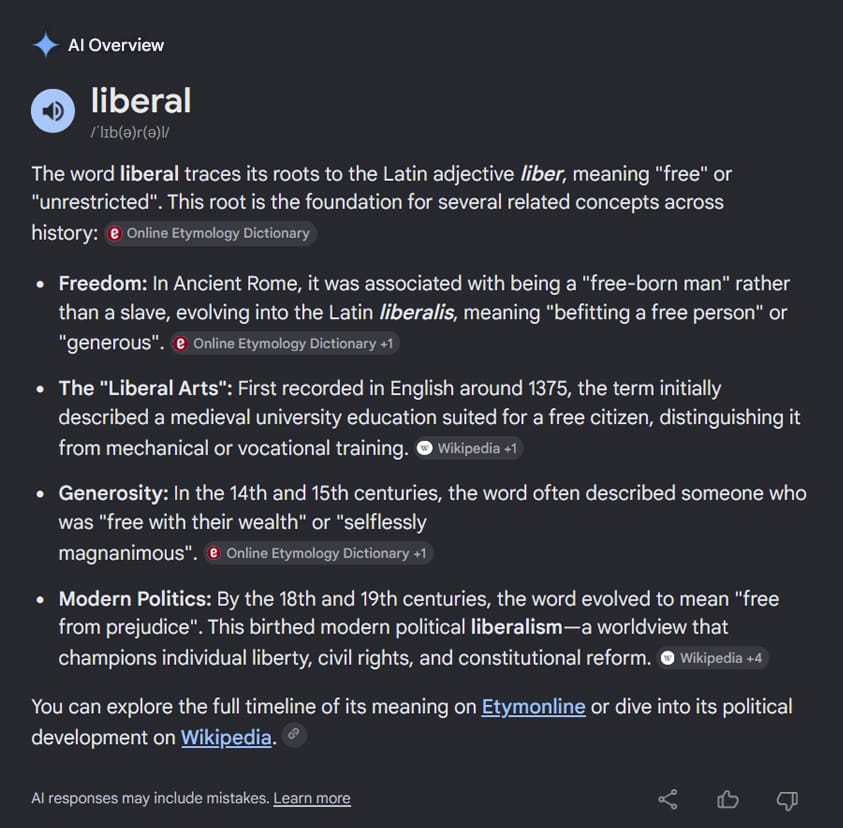
The most disturbing thing about Google AI Overview is Google’s evident contempt for the values of scholarship, such as verifiability, exactness, consistency, and accuracy. Or maybe the worst thing here is what looks to me like artificial pressure to associate the term “liberal”—via references to “libertarian” and “classical liberalism” up top, with free-market notions of right-wing politics—rather than egalitarianism or democracy—associated with the political aspects of the word “liberal.”
Which is inaccurate, from an etymological perspective.
Keep us breathing fire!





For $3/month you can read this whole post and get our weekdaily newsletter too!