
Explorer of English
by Kọ́lá Túbọ̀sún
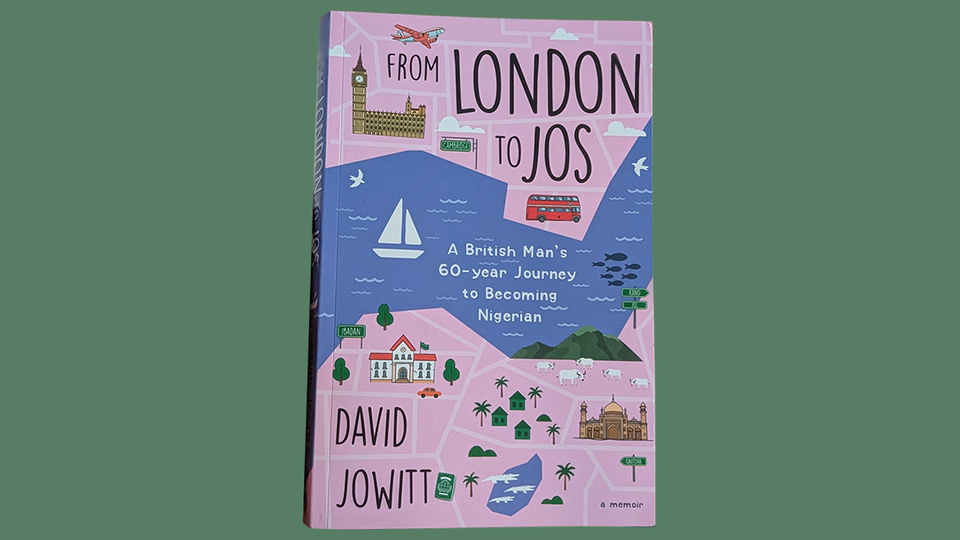
From London to Jos: A British Man’s 60-year Journey to Becoming Nigerian, a memoir written by the late David Jowitt, is one man’s adventure through post-independence Nigeria; Jowitt lived through the civil war, military regimes, democratic fits and stops, and many changes in the civil service. It is a story of faith, friendship, and a story of love (or the many loves of his life, both corporeal and intellectual). Familiar names come in and out: Achebe, Obiechena, Mosuro, Soyinka, and even the Queen of England, whom the author met when she visited Nigeria in 2003.
Jowitt died in 2023. I never got to meet him, though I wish I had.

Born in London to working-class parents though he was, his name floated around my field of view in the Nigerian academic community for so many years. At the time of his passing, he was a professor at the University of Jos, Nigeria, the city where I completed my year of mandatory national service in 2005–06. Jos, a city located about 4,000 feet above sea level, has one of Nigeria’s most temperate, Europe-like climates. Its people are mostly farmers—carrots, cabbage, tubers—and an easy-going lot. Yet over the last couple of years, the sectarian and religious crises in Northern Nigeria have made their way there, and ruined its once bucolic character.
Jowitt’s name and reputation rested on his exploration of the standardization of what is now known as “Nigerian English,” a variety of English spoken in Nigeria that has grown enough in size and usage to be widely considered its own variant, an area of scholarly work to which I too have contributed.
Long before Google began designing the Nigerian versions of its products to speak like the people who use them, that new dialect of English had begun to form in the tongue of Britain’s former colony in West Africa, just as it had in Australia, India, Canada, and other places. In contrast to many of the former colonies, Nigerian school syllabi failed to catch up with the reality of use—or, better said, school administrators refused to adopt the role of following and reflecting real language use. Institutional authorities chose instead to continue to prescribe how to speak the language: exactly as the Brits do. The result was years of horrible results in English in Nigerian high schools.
Nobody has yet seen fit to connect the problem of prescriptivist learning and forced compliance with the “standard” educated dialect in the U.K.—British Received Pronunciation, or RP—to poor comprehension and expression. (This dialect was described by phonetician Daniel Jones in 1918 as “the form which appears to be most generally used by Southern English persons who have been educated at the great English public boarding schools,” a designation that to this day causes strife in the United Kingdom not dissimilar, in many ways, to its effects in Nigeria and elsewhere.)
Keep us breathing fire!








For $3/month you can read this whole post and get our weekdaily newsletter too!