
Ezra Klein Does Politics the Wrong Way
by Tom Scocca and Maria Bustillos

Tom Scocca: Ezra Klein has now recorded two podcast interviews and written a long introduction to a third podcast, all devoted to asserting that it was good and correct to for him to use his New York Times column, hours after Charlie Kirk was killed, to hail Kirk as someone who “was practicing politics in exactly the right way.”
Maria Bustillos: Hi. I am usually annoyed with Ezra Klein, but now I will never pay attention to him again. Why—how can he still think this was a good idea?
TS: The ostensible argument is that Charlie Kirk demonstrated a fundamental belief in engagement and persuasion, so that even if Ezra Klein may have disagreed with his conclusions, Kirk’s methods were at the heart of liberalism.
MB: I would prefer to live in a world where nobody gets shot ever, but I have seen no evidence from Klein or anyone else that Charlie Kirk was going into any of his so-called debates with a view to weighing opposing points of view in good faith.
TS: What is grimly funny about this is that Klein has now demonstrated, across thousands of words and with multiple interlocutors, that he himself is completely immune to persuasion.
People have explained to him over and over again, factually and conceptually, that his version of Charlie Kirk was a complete fiction and that it was genuinely vile and harmful for Klein to insist on cannonballing into the pool with praise for him.
And Klein just brushes them off.
The real and inescapable thing that Klein is saying is that he believes he was in community and fellowship with Charlie Kirk in a more true and important and durable sense than he is in community with the millions of people Kirk sought to marginalize, abuse, and expel from his vision of America.
MB: Yeah because he and Kirk are both “public figures,” people who count.
Perry Bacon had I thought the most cogent analysis of Klein’s catastrophic blunder.
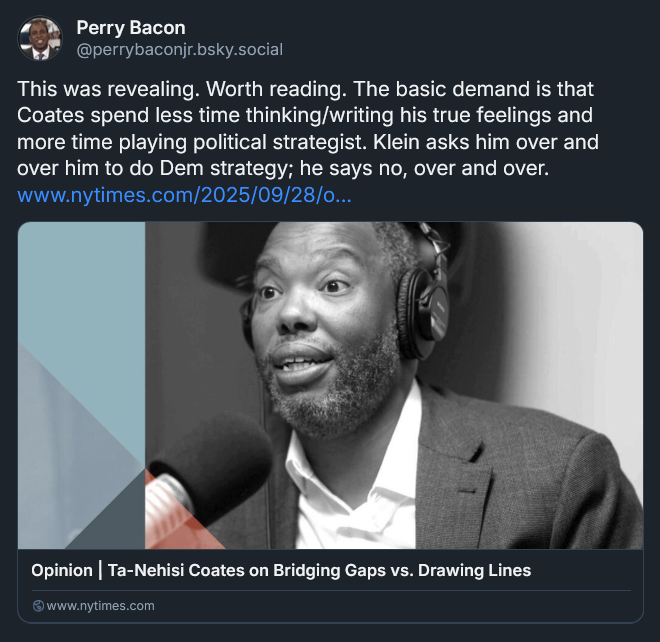
Bacon’s (very charitable) view is that Klein sees himself as influencing politics, rather than trying to tell the truth as he sees it, as a journalist or public intellectual would do. What do you think about that?
TS: Bacon is right that Klein conceives of himself as an oracle of strategy who is called to steer the discourse, but there’s a much deeper problem than that. Klein represents—as does David Remnick, in conversation with Klein—a whole class of people who have spent the last nine years constructing a mythology or ideology and trying to pass it off as a strategic observation.
These people have convinced themselves and one another that a collection of made-up and frequently impossible claims are the objective truth about American politics.
MB: I agree, and I think in this case that it goes back to Obama. Both of these men were so besotted with Obama, like plenty of really smart people were bamboozled by the Obama presidency; they can’t admit that his terrible failures paved the way for this moment, that there is an unbroken thread of betrayal of Constitutional principles stretching from Gerald Ford to here.
Obama failed to prosecute the war criminals and thieves who came before him. Anyone who sees the photos from Abu Ghraib, if there is anyone left to see them, and learns that none of those ultimately responsible for those crimes paid a price, will rightly condemn Barack “We Tortured Some Folks” Obama.
TS: Well, let’s hold the question of what Obama did or didn’t do, himself, for a second. One of their central articles of faith is that Obama offered a broad-minded and welcoming politics—a rhetoric of inclusion that made Americans believe that the color-blind future had arrived—and other Democrats insisted on harping on race or sex or gender, and those other Democrats’ hostility to regular American sensibilities drove millions of people rightward, into the arms of Donald Trump.
There was a genuinely flabbergasting exchange in David Remnick’s exchange with Klein on The New Yorker podcast about Hillary Clinton’s so-called Basket of Deplorables speech:
Klein: He was this generationally capable political balancer, holding both our liberalism and our illiberalism inside himself. After him, I think, this began to break down. Trump rises and you have, say, the Hillary Clinton “deplorables” speech, which is—
Remnick: Which was a deplorable speech.
Klein: The worst word in that speech is “irredeemable.” She says that people voting for Trump are “irredeemable.” When you begin to talk like that, it’s a severing of political community.
MB: That was so crazy. And it really does tie in with the fantasy version of Charlie Kirk. There are people in the U.S. who believe (for example) that trans people should not exist, and Kirk was one of them; there is no way to accept such a person into an egalitarian society.
TS: Now just as a matter of plain history, Barack Obama was dragged from coast to coast for having said that conservative Americans “get bitter, they cling to guns or religion.”
MB: It’s an impasse, and that is how Clinton ought to have characterized it… Deplorable? Sure, but the main point is: undemocratic, un-egalitarian—
TS: There was not an inch of difference between the Basket of Deplorables and the Bitter Clingers as political rhetoric or as events in the discourse. Both times, the speaker was delivering remarks that were constructed around a message of empathy and outreach toward their political opponents, and both times, a single piece of the text got pulled out and treated as an insult. A whole right-wing messaging machine seized them and turned them into weapons.
But Bitter Clingers came from Barack Obama, who was a man admired by political journalists, and Basket of Deplorables came from Hillary Clinton, whom the political journalists regarded as an abrasive bitch.
MB: I don’t know about that. They were coming after Obama all right. He had to be very quick to apologize, and he managed to take the temperature down. Interestingly here is his opponent, Hillary Clinton (from the Guardian piece linked here, April 2008):
Clinton, campaigning in Indiana ahead of its 6 May primary, condemned the comments as elitist. 'I don't think it helps to divide our country into one America that is enlightened and one that is not,' the New York senator said in Indianapolis. 'If you want to be the president of all Americans, you need to respect all Americans,' she added. 'Americans who believe in God believe it's a matter of personal faith. People embrace faith not because they are materially poor but because they are spiritually rich.' The row could threaten Obama's chances in Pennsylvania, which votes on 22 April.
She would be hoisted a few years later by the same petard.
TS: Well, that was in 2008, when Obama was still being shaken down by the press to prove he wasn't too radical or too confrontationally Black. He passed that test, so Bitter Clingers no longer defines him for center-left pundits.

Incredibly, in his podcast with Ta-Nehisi Coates—I was going to say “conversation” but that’s not quite the word for it—Klein circled back to Clinton’s speech:
[Klein] If we want to talk about writing them off, let’s start here. I’ve been obsessing, for a piece I’ve been writing, about the Hillary Clinton “deplorables” comment. I want to play it.
Archived clip of Hillary Clinton: You know, to just be grossly generalistic, you can put half of Trump’s supporters into what I call the basket of deplorables, right? [Audience laughs and applauds.] The racist, sexist, homophobic, xenophobic, Islamophobic — you name it. And unfortunately, there are people like that, and he has lifted them up. He has given voice to — their websites that used to only have 11,000 people, now have 11 million. He tweets and retweets their offensive, hateful, meanspirited rhetoric. Now, some of those folks, they are irredeemable, but thankfully, they are not America —
Then he asked Coates, “What do you think when you hear that?”
Well, what I think when I hear that is that Ezra Klein seems to have cut off that clip in mid-thought. Here’s what came after “they are not America”:
But the other basket, the other basket, and I know because I see friends from all over America here. I see friends from Florida and Georgia and South Carolina and Texas, as well as you know New York and California. But that other basket of people who are people who feel that government has let them down, nobody cares about them, nobody worries about what happens to their lives and their futures, and they are just desperate for change.
It doesn’t really even matter where it comes from. They don’t buy everything he says but he seems to hold out some hope that their lives will be different. They won’t wake up and see their jobs disappear, lose a kid to heroin, feel like they’re in a dead end. Those are people we have to understand and empathize with as well.
MB: Yeah, I remember. You could practically hear the scream of joy from Fox News after the Deplorables thing during the campaign, right in the heat of it.
Look how wide open she left herself, though. Clinton was a really poor campaigner. I guess there is just an inch of space between Bitter Clingers and saying that some Americans are “irredeemable.”
It’s true enough that nobody who is running for president in the U.S. can afford to say that anyone is irredeemable, because there’s a universe in which even Charlie Kirk could change his mind.
TS: For nine years now, self-styled liberal journalists and political strategists have been pointing to the Basket of Deplorables speech and then saying that Hillary Clinton should instead have said... exactly what she did say in the speech. Exactly! “He seems to hold out some hope that their lives will be different.”
MB: No, I don’t really think anyone is completely irredeemable. People who want to be president need to appeal to a better future, be inclusive, hopeful, hold the door open—
TS: Uh. Bullshit.
MB: No, I mean… I think you’re quite right about what she meant to express, but it was a disaster.
TS: OK, then explain how the other guy won. Not Obama, the other other guy.
MB: Sure. In the absence of a positive, inclusive vision, the hateful vision won.
TS: “They’re eating the dogs, they’re eating the cats.”
MB: Yes. Same as now. There is a vacuum where a way forward should be. I really think this! People loved Obama because he’s like, “We can be one people, come this way.” Clinton failed to course correct, and offered no such path.
TS: You’re making the same mistake Klein makes here, which is to profess that American fascism was created by liberals.
MB: No, I’m saying there is a vacuum in leadership. Not at all the same thing.
TS: That our millions of brutal and enthusiastic bigots did not organize and choose this.
MB: Oh they did! Of course. And then there was no meaningful alternative to choose, other than just “not that.”
On a related point, what do you think would have happened if Harris had (e.g.) openly opposed the genocide?
TS: In August through October of 2024? The mainstream media would have annihilated her.
Worth doing anyway? Yes. But the idea that Harris lost because she was caught between the institutional commitment to Israel and a public horrified by the slaughter in Gaza does not convince me.
MB: I’ll always wonder.
TS: There were huge downsides to the morally correct course of action.
MB: Yeah but with the morally correct course of action comes this turbocharged energy from the public. That’s what happened with Obama.
TS: Well Obama was right about Iraq but also there had been plenty of time for that rightness to sink in.
I could not give less of a shit about the 2008 or 2016 primaries. We don’t live in the same country.
MB: Can’t argue with that.
I only bring it up to illustrate how power can gather in the hands of politicians bold enough to bet on the people being just basically decent. I still think that’s true.
TS: This is also what’s so poisonous about the Ezra Klein worldview: it’s organized around somehow traveling back in time to 2016 and being nicer to conservative white men, who didn’t want anyone to be nice to them anyway. None of the stories these people tell each other manage to account for the fact that the Democrats won in 2020.
It’s genuinely remarkable: the story they’ve settled on is that Democrats lost in 2024 because of the things the party (or “the groups,” or “the left”) said and did from 2018 to 2020, in the runup to an election they won.
None of the chronology in this myth makes any sense. See also the claim that the Democrats somehow abandoned Obama’s unifying power and antagonized Republicans in the runup to 2016, when Obama was still the president.
MB: Yeah. Another thing I wanted to ask you about was the misogyny of this, the racism, the transphobia, the homophobia...
These guys like Klein are so keen on their politeness, and all my life what constitutes politeness has been respect to anyone else in the room, any other human being. So elementary!! The “It’s a Small World” mindset that any kid grows up learning. All people are worthy of respect, privacy, inclusion, rights?
TS: Yes, maybe the most heinous moment in the whole podcast with Coates revolved around this.
MB: Say on.
TS: First, Klein warmed up his own leftover spiel:
I said in a podcast with my colleague Ross Douthat—he was pushing me on left radicalism—I was saying I don’t care about left-wing radicalism. I don’t think it’s a great threat. I don’t think it’s a huge political problem. I worry about left-wing pessimism, fatalism, that we are losing and don’t want to change anything.
And I said that the question for me is: How do we win Senate seats in places like Kansas and Missouri and Ohio? I said I would like to see us doing things in red states like running pro-life candidates.
MB: He keeps saying this!? wtaf, they all lost!! All the pro-life Democrats were replaced!! By Republicans!!
TS: And then came this:
[Coates] I don’t have the numbers in front of me, but the immediate thing that springs to mind, for me, in that question is not who you’re abandoning, but: How do you square the fact that reproductive rights have proven to be pretty popular in red states? I’m thinking about referendums that have been passed such that they’ve had to change the rules. How do you separate that? Like, there are people who didn’t vote for Kamala but who say: Give me my reproductive rights. [Klein] I was using pro-life as an illustrative example.
MB: “Pretty popular” as in romped to victory with huge majorities?!
TS: And then Coates offered him “gentle pushback,” as Coates put it.
Coates: What immediately strikes me is if you take the reproductive rights example — which I know it’s not necessarily the example that you would hold out. But I think the problem with musing about that is: Abandoning it is a very real possibility for people who don’t have the option to fly to another state or do X, Y and Z.
So I suspect when they hear somebody of your status, even if it’s not the example you mean, putting it out in the air, they feel — and it’s not just that you’re putting it out in the air. You’re putting it out in the air and then saying: I don’t necessarily even mean that one.
But if you’re going to say that, I think you really have to put the data behind it. I think that’s really important.
MB: Can we PLEASE stop being gentle with the pushback against THIS ENTIRE BULLSHIT.
“X, Y and Z,” which go tastefully unspecified. Everything about Coates’s response is understandable, and inadequate, and demonstrates exactly how our cozy We Intellectuals, Man discourse is so fucking broken—
“Putting it out in the air.” I ask you. “Somebody of your status.” When Klein is explicitly saying that women should be thrown under the bus for political expediency.
TS: Klein was not just proposing throwing women and reproductive rights under the bus—he was saying that he doesn’t even care about women one way or the other. It’s just a thought experiment, an example of the sort of people one might throw under the bus for political advantage.
Oh, I don’t mind anything about the way Coates said it.
MB: OMG I think it is gigantically important. Right at that moment an unencumbered interlocutor would have just laughed and said, “So, you think women should die! I guess.”
TS: The deck is totally stacked against any sort of frank discussion of these things, within these institutions.
MB: That’s just exactly what I’m saying.
TS: I appreciate Coates having done it with delicacy because in the end it nails down that there are no terms on which Ezra Klein will listen to the idea that women’s rights are not dispensable.
You can appeal directly to his obligation as a leading pundit not to be reckless with people’s lives, and he doesn’t care. Because what the idea of "running pro-life candidates" represents to Klein is the idea of putting conservative white men in their rightful place on top of things. And any objection to that is an objection to restoring the status that white men demand, without which they’ll vote for Trump.
MB: I am a big fan of TNC and I also unequivocally disagree. At some point this has to be addressed. Look at all this mealy-mouthed language! These are the most exalted, highest-paid people in what is left of our profession. The ones who should be saying the true things loudest and best.
That’s not delicacy. That’s drawing back.
TS: I didn’t read Coates’s side that way. All of this happened in the context of Coates having already written in Vanity Fair that Klein was the equivalent of a Confederate sympathizer.
MB: Well… that is true, about the Vanity Fair piece. And I know it’s not Coates’s sole responsibility to drag Ezra Klein into some state resembling sanity. Even so I am longing for the Joe Welch moment, every day.
TS: And honestly early on the piece, when Klein told Coates he’d written his praise of Kirk because he wanted to “sit with” Kirk’s family and admirers “in their grief,” and because after seeing this political figure killed, “I thought about me, I thought about you,” and Coates said “But was silence not an option?”—I had to physically get up and take a little walk around, like after you see someone knocked out in a fight.
MB: Silence was an option. And silence remained an option, but instead he’s spent days doubling down (again, with the aid of no less a figure than David Remnick):
[David Remnick] Ta-Nehisi Coates, for example, wrote a piece in Vanity Fair, setting out a collection of statements from Charlie Kirk, that was quite representative. Did you think that was unfair?
[Ezra Klein] No. I agree with Ta-Nehisi on virtually every view he has on things that Charlie Kirk had said. As I wrote in my second piece, I have poured virtually every ounce of myself into preventing everything that Kirk poured himself into creating. For more people than I had understood, the sense that we are in any way in community together—the sense that we are still in a place where we are all practicing and doing politics—has already eroded. Something that’s very alive for me is a feeling that we are not that far from national rupture. So many things that we like to say “can’t happen here” have already been happening here.
I don’t understand how he thinks he’s squaring “I agree with Ta-Nehisi” with “I do believe myself to be in a political community with people who cared about and loved Charlie Kirk,” as he said earlier.
This is not a tenable position logically, politically, not with respect to taste, not as an egalitarian or even a Democrat.
TS: This is exactly it! What Klein is saying is that he doesn’t care that deeply about the substance of Charlie Kirk’s work or its effects, he principally just sees Kirk as a colleague in the opinions business.
No one on this planet needed Ezra Klein of the New York Times to offer a bold, sweeping endorsement of Charlie Kirk mere hours after the killing. He was driven by ego and by identification with the political showman and podcaster.
When Charlie Kirk repeatedly said that Black people were cognitively defective and inclined to crime, that didn’t register with Ezra Klein as a violation of his political boundaries—because Black people, special celebrity podcast guests aside, are not who Ezra Klein perceives as his community.
If they were, he could never have written that column.
He is also terrified of right-wing violence reaching him. The people it’s already reaching, they aren’t his problem.
MB: So this, too, was an unavoidable reckoning: having to face that the Ezras Klein of this world, the Axelrods and Carvilles and other assorted neoliberal deadenders, are just plain racists?? Misogynists, transphobes, people willing to sacrifice others and still pretend they are egalitarians!?
TS: By their own words, they are.
Fundamentally these savvy, triangulating, putatively big-tent liberals accept the premise that Trump voters are the real American people, and their will cannot be contested. Look at Klein’s incredible assertion that “in 2020, we almost lost to the Republicans, and began seeing that we were losing a bunch of voters we thought we were fighting for — losing more working class voters, losing on white voters” and “in 2024, we really got our [expletive] handed to us.”
The Democrats won bigger in 2020 than the Republicans won in 2024!
But to Klein, the winning 2020 Democratic coalition was a mirage and the winning 2024 Republican coalition was the truth—even though he knows perfectly well that incumbent parties were slaughtered worldwide in 2024, and the Democrats outperformed that baseline, and even though (as Coates repeatedly pointed out to him) he himself has been very big on the highly specific and contingent problem that the Democrats had shackled themselves to a decrepit mummy who couldn’t campaign on his own behalf or theirs.
MB: I’ll always believe that if Axelrod and co. had not prevented Tim Walz from saying, “These weird fuckers have got to go,” they would have gotten Biden’s numbers and more.
The whole other conversation, though, is that the gloves came all the way off the Republicans once Amy Coney Barrett got in.
TS: And yes, the post-Barrett change is pretty important here, because again, if you look at this mythology, this sense of propriety and political balance that Klein wants to bring back: the Democrats were running anti-abortion candidates in the heartland AT A TIME WHEN ABORTION WAS A CONSTITUTIONALLY PROTECTED RIGHT.
You can’t bring back Bart Stupak in a post-Dobbs world, when if the Democrats ever take power again, they need to restore basic reproductive health care! It’s a fantasy!
MB: That was one of the weirdest things about Klein’s position here. He’d been one of the loudest voices yelling about Biden’s decline!
TS: Right! He knows that if Biden had bowed out and allowed a real primary to unfold, the 2024 race would have gone completely differently.
MB: Have you got any closing thoughts? Mine are all unprintable.
TS: I just think that we’re cursed with this caste of white men who basically want to settle scores from 2020, when people were mean to them online and their junior employees got sassy, and they’ve invented a whole synthetic politics to flatter their egos and indulge their grudges.
MB: Ta-Nehisi Coates (again) makes the best of a vile situation. I wonder what his mentor, David Carr, would have thought of all this.
TS: Here’s one more too-revealing passage from Klein:
[Ezra Klein]: I think of the huge backlash to Bernie Sanders for going on Joe Rogan’s show because Rogan was transphobic. Such a big backlash that when I defended him — I became a Twitter trending topic. And to Elizabeth Warren for going on Bill Maher’s show — Bill Maher is Islamophobic. There were protests at Netflix when they brought on Dave Chappelle. I think there was a politics of content moderation that took hold that was more about enforcing boundaries of what were and were not ideas we should be engaged with — rather than about engaging them, even if opportunistically.
TS: This is what really gnaws at him, not somebody calling Ketanji Brown Jackson mentally inadequate.
MB: “I, Ezra Klein: Trending Topic.” What a sorry chapter in The American Experiment.
TS: These guys profess to be demanding inclusion but they’re really demanding that the coalition be disciplined and certain elements excluded. They want to pitch a big tent over Missouri even if that means yanking the trailing edge of the tent away so the Northeast is out there uncovered. And the Black South.
MB: Meanwhile nobody in Missouri goes in the tent, either.
TS: They want to set the tent on fire.
Ezra Klein got his feelings hurt, and he thinks Missouri has the balm to soothe them.
Feelings are the gateway to fascism.