
Football in Palestine
by Zito Madu
About two weeks ago, there was a video on my timeline of an Israeli attack on Palestinians in Gaza. In that sense, it was a day like any other. As with all the other, similar videos, I felt the familiar tension between wanting to witness, to see for oneself with one’s own eyes, the horrors being committed against human beings in Gaza and the West Bank, and knowing that simply witnessing these things is not enough on its own; knowing how the endless stream of videos will wear on you, to the point that it reduces your capacity to think, or to work, or to critically engage with what you’re seeing. At least that is so for me.
I hesitated to watch the video because of that tension, but also because this one included children playing football. I had seen videos of Palestinian kids in Gaza playing football before, videos that had been used to show how, even in a man-made hell, children were still finding joy with the game, and this video was the inverse. A return to the current norm—the joy wiped out, and dominance reinstated through the interruption of the game and the dead bodies afterward. But I watched the video.
A crowd of people were watching a children’s football game at the al-Awda School in Abasan al-Kabira. As one of the little goalkeepers collected the ball and readied himself to send it upfield, there was the sound of a blast and then everyone, including the person recording, began shouting and fleeing. As the videographer fled, the dead could be seen scattered around.
The video reminded me of an older story from about ten years ago, when four Palestinian children were killed while playing soccer on the beach in Gaza. The oldest was 11 years old. In his report, The Guardian’s Peter Beaumont wrote:
The first projectile hit the sea wall of Gaza City's little harbour just after four o'clock. As the smoke from the explosion thinned, four figures could be seen running, ragged silhouettes, legs pumping furiously along the wall…
It was there that the second shell hit the beach, those firing apparently adjusting their fire to target the fleeing survivors. As it exploded, journalists standing by the terrace wall shouted: “They are only children.”
Later, the Israeli military investigated itself and labeled the killing of those four boys as a “tragic accident.”
I’ve been working on a few football projects lately, both personal and collaborative, which have required me to articulate my personal philosophy of the game and to write about why I find it so interesting. On an elevated, more abstract level, I think of football as an art, a platform for expression and for people to engage with wonder, one which connects billions of people in a way that no other thing really does. In that sense, it is invaluable because it is near-universal and acts as a shared language that allows so many different kinds of people to experience each other, and to share experiences in common.
On a personal level, I find the game deeply joyful—from playing it to watching superhuman athletes do unbelievable things at high speeds, feats accomplished so well and so often that it becomes normal. My writing on football has always sought to present the game and its large and small beauties in a way that encourages people to look at it again as if for the first time. To see the game with fresh, child-like eyes, rather than always trying to solve it, or to reduce the importance of it to tribalism or which team won or who is overrated or underrated; to be open to the wonder of it and let each game and moment move you as you would when experiencing a beautiful painting or piece of music.
Seeing football as an art and as a source of magic and joy has, for so long in my life, represented a way to be alive. This is a bit hard to explain, but essentially, since I was young, I’ve felt in some sense that I was not in the real world. I’ve often described it to friends and to my mother by saying that I feel like I have never actually felt the light of the sun. It’s this deep suspicion that I haven't ever been truly present in life; that I’ve stood watching myself as a performer going through an act that he doesn’t fully believe in, through an existence mediated by fictional external conditions, which can be stifling and all-encompassing to a level that they create a situation that looks like life, that can feel like life, but is actually only an imitation of it. What I have always dreamed of is freedom, and I believe and hope that once that freedom is gained, I can live life in a real way and in the real world, and escape from its imitation.
It’s a bit like what Emil Cioran described in The Trouble With Being Born (as translated by Richard Howard):
The same feeling of not belonging, of futility, wherever I go: I pretend interest in what matters nothing to me, I bestir myself mechanically or out of charity, without ever being caught up, without ever being somewhere. What attracts me is elsewhere, and I don’t know what that elsewhere is.
Playing football, especially when I was young, was when I would often feel alive. Alive, in the sense of being so present that everything feels real and as it should—my mind’s connection with my body, the tightness of my boots, the pain of defenders stepping on my ankles, the sweat running down my body, the pain in my chest, the sounds of the audience and my teammates, the breeze, the cold, the heat, the sun—everything. It is not the ultimate path to freedom, but it is a space where that freedom and aliveness can be felt.
This personal and philosophical stance on football has meant that I, against what should be my better judgment, believe in the game’s power. I believe that even though it can’t overcome differences or magically erase the conflicts that separate people, it is a great arena to explore a better way of living because it does act as a shared space and experience for so many. Because football’s inherent principle, one of the key reasons that it’s seen as “the beautiful game,” the world’s game, is its inclusivity. We all seem to acknowledge that the game is great because it belongs to everyone, because it has spread far through the globe; and from that point of view, what gives the sport its social and moral depth, what often saves it from itself and from the corruption of the powers that be who run the business of it, is that the joy of it is to be shared. The more people who come into football and can express themselves and play and laugh with a ball at their feet, the greater the game becomes.
For me, the sport is a space where the sun can be felt. It is a space where anyone should have the opportunity to experience that freedom to be and to express themselves through running around with friends chasing after a ball. The chance it offers to experience joy can exist inside even the strictest blockades and occupations.
To see children in the worst imaginable situation on earth find that time and opportunity to tap into the joy of football, to run around on the beach or at a school while death is all around them, to laugh with each other, to do stepovers and score goals, tackle and foul each other, to have them truly embody the power of football as a source of wonder and as a semblance of actually living, and fully real, is a reminder of why the game is worthwhile to begin with. Then to see that laughter stilled, the joy destroyed, and the light of the sun turned to darkness and death, is to know in the worst possible way the limits of sport. To watch children killed like that is to come in contact with an evil that’s an enemy to life and everything that makes life possibly beautiful.
Back when I lived in Michigan, we would hold this mock World Cup tournament in one of the big indoor fields outside of Detroit. I believe it was the Total Soccer in Wixom. It happened over one weekend or over the week, but each registered country would play multiple games a day. I remember how utterly exhausting it used to be.
Most of the years that I played in that World Cup, I naturally played for Nigeria. And since I spent my youth playing football and growing up around Dearborn, I would always have friends in the Arab and Muslim teams that were heavily represented. Each year we would lose to a team with my friends on it, and I would have to endure the trash talk alongside the infighting as Nigeria were knocked out.
One year the infighting and the politics within the tournament—arguments among people who weren’t good demanding to play ahead of those who were better, arguments over people not passing, on who wanted to play which positions, and everything else under the sun—got so bad that I decided to leave the Nigeria team. They wanted me to play defensive midfielder so that someone who wasn’t nearly as good as me could play winger. After that I freelanced for a bit, playing for everyone from Iraq to Morocco. The idea of nationality was as loose in our World Cup as it often is in the real one.
The team that I played for in my last mock World Cup was Palestine. I remember that they had just enough players to compete but not enough to feel like a full team. And that they always lost early. I decided to play for them first because they asked me, and that was flattering, because I had run circles around their defenders in a previous year. Second, because being on a team of players who weren’t that good meant that they would just pass me the ball and let me dribble and try to score without having to play much defense. And third, because being asked by them was an honor.
I had known about the Palestinian struggle beforehand, through people I had met in Dearborn growing up and through some of the poets and writers I had read up to that point—Mahmoud Darwish, John Berger, Edward Said, etc. But being asked to play for their football team was something that felt much closer, more intimate.
The games went as I predicted. My teammates would pass me the ball, and then I would dribble through as many defenders as I could and try to interplay with the forward when I started running out of breath. Somehow this tactic worked. The first game we won, they celebrated as if it was a championship since they had never actually won a game in the tournament before. But then we kept winning, all the way until the semifinals.
The team we faced in the semifinals was Lebanon. Lebanon weren’t particularly a great team, but they had technical midfielders, plus one particular problem: Hamoody, the older brother to former Sporting Kansas City forward Soony Saad, was on the team. Hamoody, Sonny, and I had actually played for some time for the same coach on the same youth team in Dearborn when we were young, and everyone then and through their respective careers knew that even though Soony had gone much farther in the sport, his older brother was the better player. Before the game started, I joked to Hamoody that he should take it easy on us.
He didn’t. His first goal came from a 30 yard strike when our defense had dropped off on him because they were scared of the passes he had been making. He scored the goal like it was the easiest thing in the world. His second goal came towards the end of the game as we were pushing for an equalizer. The defensive line had come up and he slipped behind them to receive a long ball right in front of our keeper. The keeper was so afraid that he came out but then froze in front of Hamoody, who then lobbed him with the same effortlessness with which he’d scored the first goal. Hamoody was out of shape then, but I can’t recall if he ever did a real sprint or sweated in that whole game. Everything came so easy to him.
Though the loss was disappointing, when we sat together to watch the rest of the tournament unfold, we were all pretty happy. It was the farthest the Palestinian team had ever gotten. What stuck with me through that tournament and the aftermath was how light and joyful it all felt with them, how much we laughed and celebrated, and the feeling and experience of being exhausted on the benches, all in the sun together. It was more fun than I had had playing in all those years before.
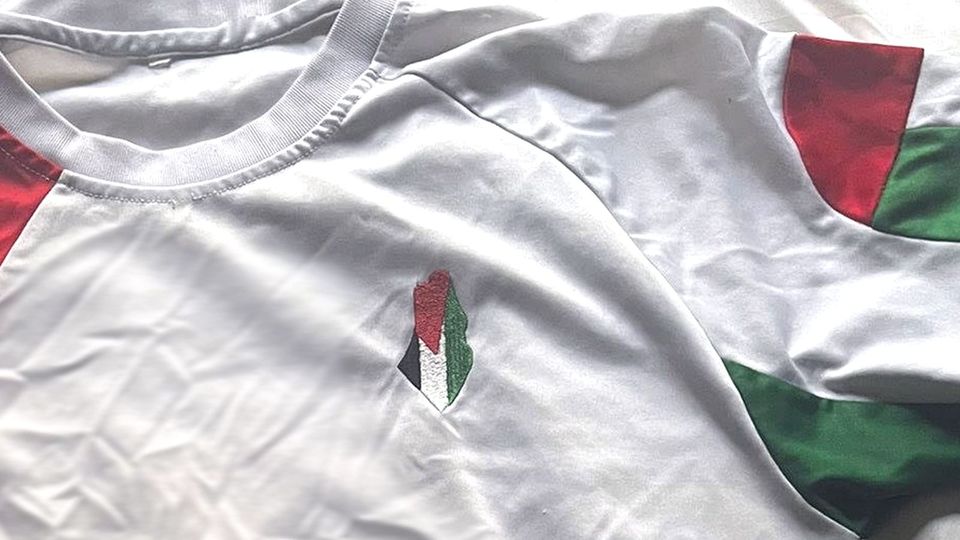
Before I went home, I asked them if I could keep my jersey, which was designed to look like the Palestinian flag. They said yes, and asked me if I would play with them the next year. I said yes, but regrettably I never played in that tournament again.
For a long time, that shirt hung in the closet of my childhood home. I was so proud to have it there. I was so proud of those memories of playing with the Palestinian team, to have formed that intimacy with them, even for one small tournament. To have been alive together.
A few years later, I started coming to New York City frequently and making a lot of friends here. One of them was a Palestinian woman. One particular thing I had noticed about her early on in our friendship was the way she would talk vaguely about her background, or avoid the subject entirely if anyone asked more questions about it. At first I thought she was just being private, but as we got closer, she expressed that it was because she could never be sure whether people would understand the plight of her people and the place that she was from. She often had to start from the beginning and explain the history to her friends, all while making sure she said it in a way that didn’t seem provocative.
She was surprised when I told her that not only was I aware, but I had actually played for the Palestine team in our mock World Cup tournament. She didn’t believe it until I showed her the picture on my phone of me with my teammates smiling on the bench. We then talked about how the struggle of the national Palestinian team mirrored the struggle of the one I had played on, and she casually commented that she had always wanted one of their shirts.
Part of me wanted to keep my shirt—after all, it meant so much to me. But again, for me, part of the joy of the game is in it being shared. The next time I went back to New York City, I brought the shirt with me and gave it to her. She was happier than I had ever seen her, to that point. In a material way, it was a loss for me. But I felt the connection made from the gift, the joy that she had from having it, her feeling that she and her people were being recognized by someone else, and I found that from then on, she could speak to me about her experiences as a Palestinian honestly, and this added depth, not only to our friendship, but to the culture of the game as well. The sharing felt more responsible to the power of the game that I believed in, than having it as a trophy.
If you enjoyed this free post, subscribe or donate to Flaming Hydra and receive incandescent essays, comics, criticism and more from us each weekday.