
Having It All
by David Roth
Our reindeer is bald. I didn’t realize this until recently, and a lot of that is down to familiarity, just in the sense that I’d been looking at him every day for a couple weeks, and have done so every year around this time for probably 15 years. I see what was there the day or even the year before to the extent that I see it at all, and that image accumulated over time, and over whatever changes had gone before; it built itself outwards like a coastal shelf, remaining and replacing itself at the same time. I am this way with my own reflection, too. There are photos of someone who looked more or less like me that I both recognize as myself and only barely recognize.
The reindeer sits more or less where it always has. This year there is a nearly empty cognac bottle next to it, and the little plastic column that amplifies our wireless internet signal is behind it; three of its four feet touch the veneer top of the liquor cabinet. It has a shiny red nose made out of a Christmas bauble. Every year when I take it off the high shelf in the closet where it spends the warmer months, something has fallen off of it—the antlers, which were once Christmas tree trimmings with Christmas tree needles on them and now are long knobby twigs, or more worryingly the mismatched and precarious legs.
The reindeer is maybe six inches tall, and made of oblong trimmings that a sidewalk Christmas tree vendor long ago put together into something roughly the shape of a longish, porky, eyeless animal, in this case one wearing a jaunty red bowtie made of ribbon and with its right front leg cocked sassily up due to the irregular chunk of fir standing in as its torso. There were never eyes, and I don’t imagine the reindeer would be in our home, now or really ever, if there had been. Part of the appeal of the thing from the start was that it was imperfect to the point of jankiness. That the antlers were once less like weird nude antennae barely registers now. How it might age was not a consideration at the time; it was not purchased at a time when I really brought much consideration to bear on decisions like that, or anything else. I hoped that my wife would like it, and she does; it smelled like the sidewalk-straddling Christmas tree market from which it was purchased and where it was fashioned by a French-Canadian vendor for reasons that I remember amounting to “it gets boring out here.”
We kept him, and over time he acquired some significance simply as a result of that. Whatever he used to look like, whatever it was beyond the fact that he fit into the hallway closet that led us to keep this eminently disposable thing in our home, I just see the reindeer, now.
We spend Christmas each year in Maine at the house where my wife grew up, surrounded by the things that her father, a widower, has brought and continues to bring into that house. He bought and found and sold antiques during his years working first as a fireman and then in fire safety, and that pursuit has expanded to fill his retirement. His work is his passion is his social life is his addiction, an equilibrium that finds its expression mostly through the accumulation of enormous hardback books and loose lamp parts. The internal dynamic is complicated both on the merits and in the ways in which every weird thing about it reinforces every other one. His situation creates complications in terms of doing basic living-in-a-house stuff like finding a clear flat surface to put a plate on. But it’s pretty simple in terms of how it works from one day to the next. He goes to yard sales and thrift stores and area dumps in search of more things; often the people he knows there have set things aside for him, and they work out a price, and he brings the things home.
My father-in-law knows what a great many things are, and delights in spotting ancient doodads and kitchenware at sales and dumps and cluttered stores in the way a birder might thrill at seeing an obscure plover. He also knows what they are worth, or at least what people are trying to sell them for elsewhere or online, and he will stick with his price because he believes it’s right. The disparity in volume between what comes in and what goes out comes down to his constitutional inability not to pay $2 for something he knows is worth $5, even if that value can’t practicably be realized. This is a relationship business, although the relationship aspect seems to outweigh the business one. He spends some money and makes some money, but mostly he is looking at stuff and talking with people, and he enjoys it. Knowing what something might be sold for is not the same as selling it for that price; the work of getting and the comfort of having seem to have outpaced the profit motive some time ago, here, and that gap only widens. But it is, in every sense, his business.
The metaphorical dimension can be a bit much—the circuitous paths through each room carved in deference to and around all those dunes of stuff, the ways in which the various drifts and moraines and stacked bankers boxes filled full of things claim space that people never quite manage to claw back. The psychoanalytic aspect is so obvious as to be insulting; yes, it’s a man who is living alone making his home feel more full, very astute. It has slipped out of balance, but there was something in this space that was always wanting or threatening to become like this, and there are times when I wonder what else things are for if not for this.
I am looking, as I write this, at some boards of lumber, and a few stacks of trading cards, and hundreds of books in bags and boxes and piles, and a brass floor lamp without a shade, and four duck decoys spread over three different surfaces. All of that has some sort of value or intended use; much of it has even been priced for sale at the antique mall where he keeps some stalls. None of that stuff is going anywhere, though, and has not gone anywhere for some time; it is just part of the room in the same way as this couch or those chairs or the other, nicer old stuff whose place in the home is more considered and practical and permanent. As long as there is still a place to sit it’s hard or anyway futile to argue with it. When I turn my head to the right, I see my father-in-law in a big chair, watching a YouTube video on his phone at maximum volume; a Scottish man is excitedly describing the thing that he and his squalling metal detector have turned up. The words “buried treasure” sound pretty good in that accent, even if he is mostly turning up junk.
In our own apartment, we are not running out of space so much as we are always at risk of falling behind in churning the necessary percentage of stuff out of it. The space is not that large, and we are neither extravagant nor in a position to be more extravagant than we are, but stuff shows up and will stay if we let it. This puts us in the position of thinking about things, just in terms of trying to stay on top of what comes and goes and maintaining some balance between the two. Something doesn’t have to have a use to stay, but it should have a purpose; the reindeer has no practical utility, but it means something to us and I can’t imagine any circumstances in which we’d get rid of it or feel compelled to upgrade to a newer model. A thing that stays doesn’t have to do anything, but it should do something for us.
The movement of things through the culture, along the various channels through which things move, is part of what gives modern life a detectable pulse; the stores open and close like gills and something breathes through that process. That breathing is not the purpose of anything; it has no purpose, and often feels something like the enemy of purpose. But it is stubborn and people respect it, as itself and at an unspoken level as The Reason For The Season.
Every year, surrounded by all my father-in-law’s dead stock, I feel both oppressed and kind of idly awed by its permanence and sprawl. There is always so much new stuff, and always also all the old stuff. We played their family’s preferred version of rummy with some playing cards he got from the dump, which had energy-saving tips (“use a lid!”) on each card. The Jacks and Queens were drawn to look faintly concerned as they advocated for taking shorter showers or making sure the dishwasher was full before you run it. I can see a line between abundance and clutter, between enough and too much, that my father-in-law cannot or does not, but I don’t think our understanding of things is really all that different. We just feel differently about them.
Or maybe we just engage with them differently. In addition to the usual gifts this year, he gave me a box of 1990s baseball cards he’d purchased at the Goodwill, probably for very little. These are from a giddy and unsustainable boom period in the industry’s history, when demand for trading cards was extremely high and the companies riding that wave responded by producing an outlandish glut of the most slipshod product imaginable. None of these cards are worth anything—too many of them were printed, and too many people kept them; in a business driven by scarcity, they are all too common to have any value.
Still, I appreciated the gift a lot; it was, unmistakably, Just Stuff, but it was my kind of stuff, which he knew. On Christmas morning, I went through a stack of Donruss Studio cards from the early 1990s, which offered a solemn portrait of a ballplayer on the front and a little list of lite personal information in lieu of statistics—what they wanted to be if not a ballplayer, or who they admired or what they do in their spare time. I found myself making a list of the players’ pet peeves:
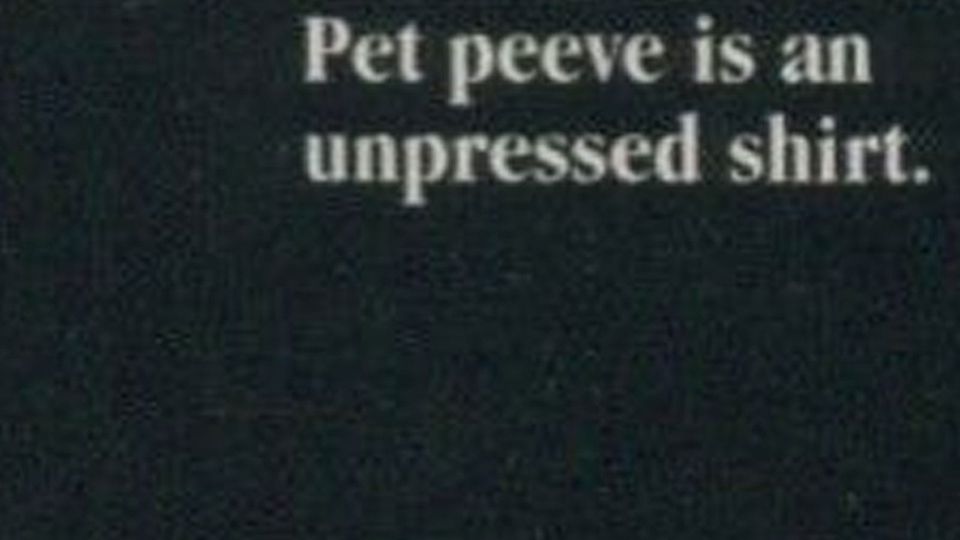
- Mike Piazza: "an unpressed shirt"
- John Smoltz: "taxes"
- Tim Wakefield: "high taxes"
- Kevin McReynolds: “the media”
- Craig Biggio: "Casey Candaele," who was Biggio’s teammate on the Astros
- Jeff Bagwell: "Casey Candaele"
- Randy Milligan: "having to play ball on Easter Sunday"
- Brady Anderson: "reading other people's pet peeves"
- Reggie Jefferson: "racism"
- Ron Gant: "traffic and racism"
There is nothing really to do with any of this; I made the list not because this information is or could ever be useful to me but because it struck me in some way that made me want to hang onto it for a while. It’s just some stuff to have, and now I have it.
I don’t need it; no one could ever really need it; that’s not the point. I moved the box out of my preferred path to and from the couch and left it, so that it can better vanish into the life’s work he is building around it, and so that I will know where to find it when we come back. That’s what it’s for.