
Health Care You Can Trust
by Nathan Munn
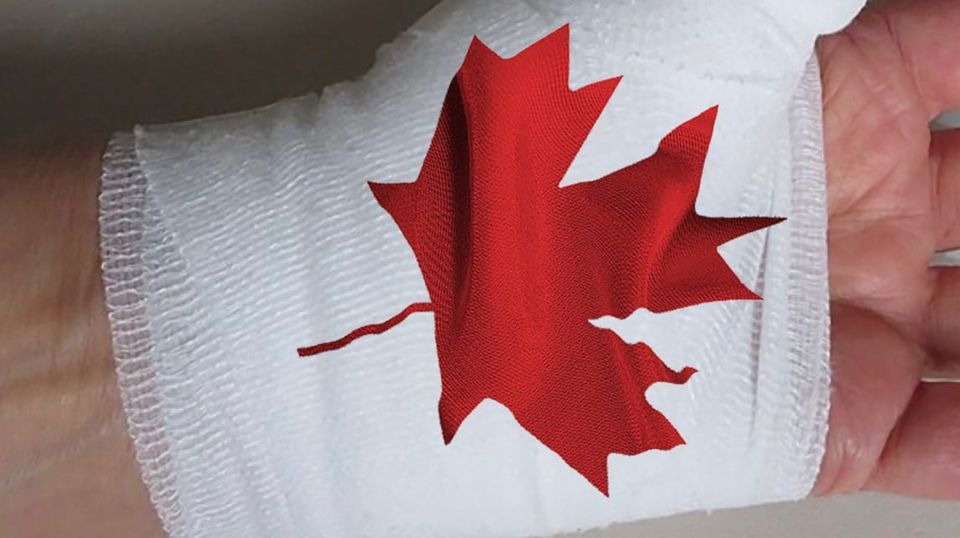

If you, a Canadian, should catastrophically break your femur and dislocate your hip doing something stupid, as I did 20 years ago, you’ll quickly find your screaming, shivering form scooped up by friendly paramedics, delivered to hospital, triaged, X-rayed, repaired by world-class surgeons (alongside radiologists, nurses, anaesthesiologists, etc.), delivered to a semi-private room with attentive aftercare and decent food for a week’s rest and recuperation, and sent home with a pat on the back and a Dilaudid prescription—without ever seeing a bill.
In practice, in other words, the Canadian public health care system operates effectively as universal urgent care. I’ve been lucky with my urgent care experiences, I know, because we often read about people suffering nightmarish outcomes here. But beyond the baseline reassurance of our generally excellent, always-open emergency rooms, the reality of the Canadian health care system is that if you want to access a long-term family doctor, or to receive a non-essential surgery within three years, in most cases you're shit out of luck.
Health care is administered at the provincial level in Canada, and each province has its own quirks, strengths, and weaknesses. At a high level, beyond overcrowding in the ERs (which has always been a problem, but is now worsening) the biggest gripe across the country these days is how incredibly hard it can be to access the system at all.
Like millions of Canadians, I don’t have a family doctor. In Quebec, where I live, there are many semi-private walk-in clinics that accept the provincial health card as payment, which they use to bill the government for your visit, much like Medicare in the U.S. But “walk-in” is a misnomer, since you often have to use a cumbersome online portal to book 24 hours in advance, and getting an appointment can be a cutthroat business. Your doctor, if you get to see one before giving up and heading to your closest ER, will be a total stranger who may be suspicious you are there simply to acquire drugs. Also, even if you return to see the same walk-in doctor multiple times, the administrative staff will get very pissed off if you refer to yourself as “a patient”; these doctors don’t have patients, just appointments.
Despite the annoyances, these clinics are an expression of public-private partnership that seems to work decently well, filling an important gap and keeping people out of ERs. Also, when it comes to comprehensive, timely health care, Quebec prioritizes children’s needs: both my kids have a fantastic family doctor at a government clinic, where they can generally see their doctor within 24 hours.
But now, privatization is beginning to rear its head, with newer, cash-only clinics that don’t accept the public card popping up, allowing those with the bucks to see a doctor whenever they like. Payment receipts from the new private clinics are rejected by my insurance company, since they know I can damn well go to the hospital or a “walk-in” if I really need to see a doctor, so why would they pay for it?
Last year, after visiting a fully private clinic for a chronic issue (costing me $300 out of pocket), my condition worsened later in the day and I wound up going to the emergency room. When I showed the public triage nurse my documents from the private clinic, he looked repulsed. “Why didn’t you just come here?” he asked, bewildered, as if the government wasn’t actively begging people to avoid ERs due to overcrowding.
I’d gone to the private clinic to relieve pressure on the public system in the first place, but I didn’t push back; he was right. We pay for the system, why wouldn’t we use it? That nurse’s fierce pride in the public system is common among the health care workers I’ve met: they’re there to save your life, no matter who you are, and they’re not fucking around. I love that.
Canadians waiting for care really have literally died in the waiting room. And anyone who has spent 12 hours rotting away in an understaffed Canadian emergency room only to finally meet with an exhausted ER doctor who glares at you as you sputter, trying to justify your reason for being there, as you’re suffering through whatever misery brought you there... that can be a shitty moment. But staying alive long enough to find yourself within the life-affirming whirlwind of care that exists beyond the waiting room is exhilarating.
There are mistakes sometimes, as there are in every country. After a bunch of lymph nodes swelled up in my neck in my mid-20s, doctors suspected lymphoma, and I had day surgery to remove one of the nodes for a biopsy. Afterward I met with a leading oncologist in his impressive office filled with awards, where he gave me The Talk. “You can survive this,” he told me, looking me straight in the eyes. “Saku Koivu beat it, and so can you.” I was scared shitless, but a while later the biopsy came back negative for cancer. Cart before the horse, Doc.
Before the 50501 protests really took off my wife and I were talking about how much citizens of the U.S. are risking to participate in protests, in comparison with people in most developed countries: a thinner social safety net and the absence of universal health care make it dangerous for the average person to take a day off work to attend a disruptive protest that might end with their being injured, or even admitted to a hospital.
The political implications of public health insurance are profound. Citizens in a democracy who have an absolute right to health care are far more free to participate in protests—especially the kind that disrupt the status quo.
As staffing shortages, budget cuts, and an endless flow of patients stretch the Canadian public system to the brink, governments are finally getting more creative. After I was laid out for days last month with a 41 degree fever and a throat that felt full of shattered glass, my wife learned that strep tests could now be done at our local pharmacy for a fee of $35, which I know won’t be covered by either the government or my insurance. I paid for the test, it came back positive, and the nurse prescribed antibiotics on the spot; I got the care I needed without burdening the public system, and at a fair, low price.
Politicians and businesses continue to pursue the worthy goal of making the health care system more efficient and effective. But bad decisions risk undermining the existing system’s best qualities.
My favorite thing about Canadian health care is its fundamental decency, which is expressed through policies that nourish the dignity of patients, their families, and the professionals who care for them.
During a recent visit to the local hospital, I swung by the cafeteria and picked up a yogurt-and-granola cup, a piece of berry pie, a chocolate soy drink, and a brownie, for a grand total of nine dollars. (Just the pie would have run me six bucks before tip at a cafe.) I was served by a kind and energetic young guy who wished me a great day. I parked my car in the hospital lot overnight for just $7.75. Later I happily discovered the first two hours of parking at the hospital were free, specifically to make quick pop-ins to visit a sick relative easier.
These seem like small things, but they show that no one is trying to gouge people in their most vulnerable moments. That builds trust, and solidarity. The system isn’t perfect, but Canadians don’t want to give up on universal care. We just want to improve it, while staying faithful to the fundamental philosophy of Canada’s single-payer system: we’re all in this together.