Hegseth: Full Metal Manhood
by Zach Rabiroff

1.
Late in the presidential campaign of 2024, at the Schroedingeresque moment when Donald Trump’s second election was both a foregone conclusion and a historical impossibility, the presidential candidate held a rally in Scranton, Pennsylvania, in which he debuted his plans for the U.S. armed forces. The theme of the speech was abolishing the “woke” military; to illustrate what he meant by this, Trump’s staff had prepared a video presentation titled, “AMERICA’S MILITARY PRESIDENT, DONALD J. TRUMP, VS. COMRADE KAMALA HARRIS.” On a large screen behind the candidate, rallygoers were treated to a montage of clips of R. Lee Ermey’s performance as the wild-eyed, shrieking Marine drill instructor and sadist, Gunnery Sergeant Hartman, in Stanley’s Kubrick’s 1987 film, Full Metal Jacket.
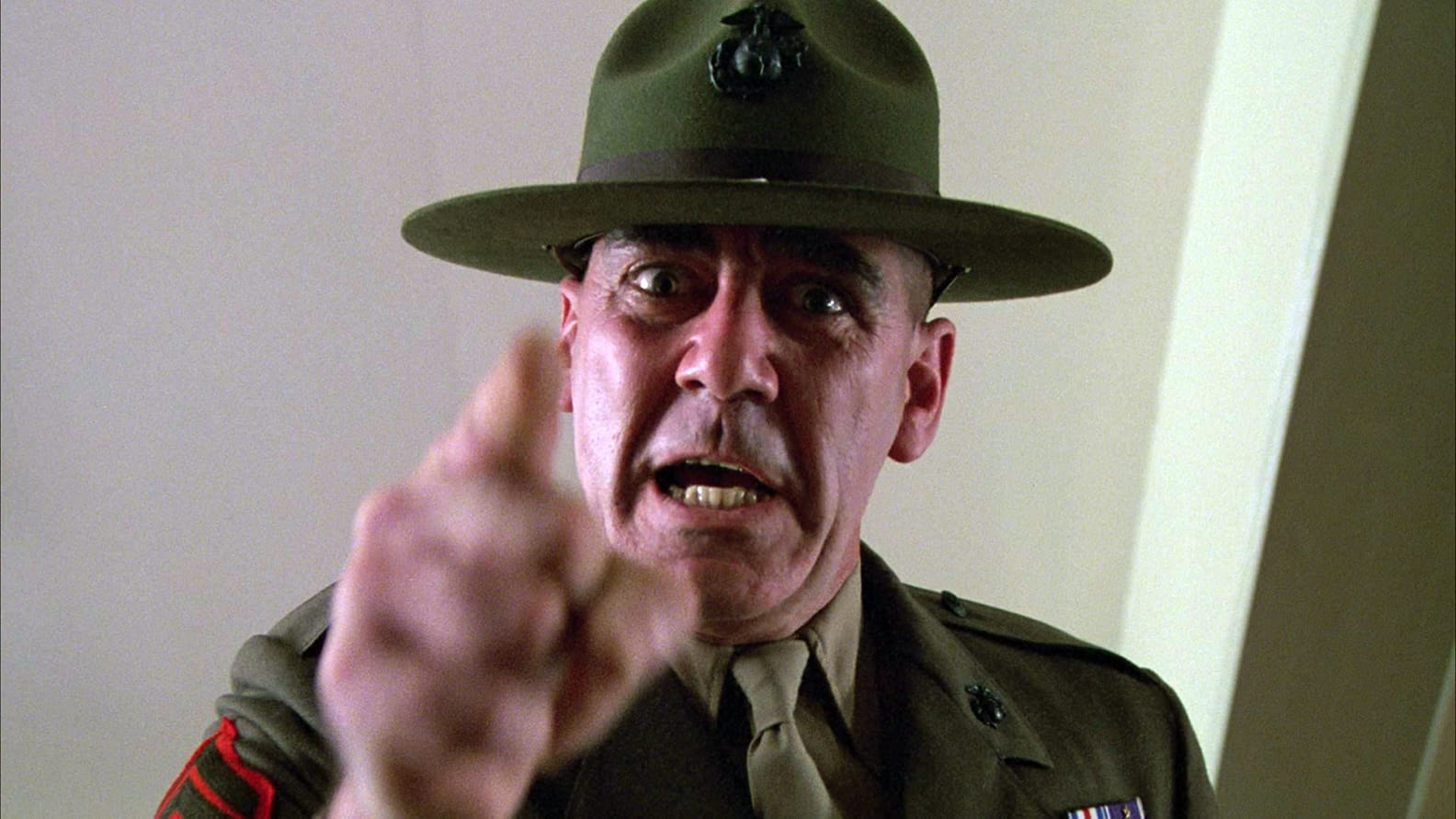
“YOU WILL NOT LAUGH! YOU WILL NOT CRY! YOU WILL LEARN BY THE NUMBERS!.”
“LET ME SEE YOUR WARFACE!”
“YOU WILL BE A WEAPON. YOU WILL BE A MINISTER OF DEATH PRAYING FOR WAR. BUT UNTIL THAT DAY YOU ARE PUKES. YOU ARE THE LOWEST FORM OF LIFE ON EARTH.”
Intercut with these clips were TikTok videos and news clips of trans people and/or drag performers, both military and civilian, scored to bouncy dance music. At the end of the montage, the text read, “LET’S MAKE OUR MILITARY GREAT AGAIN.”
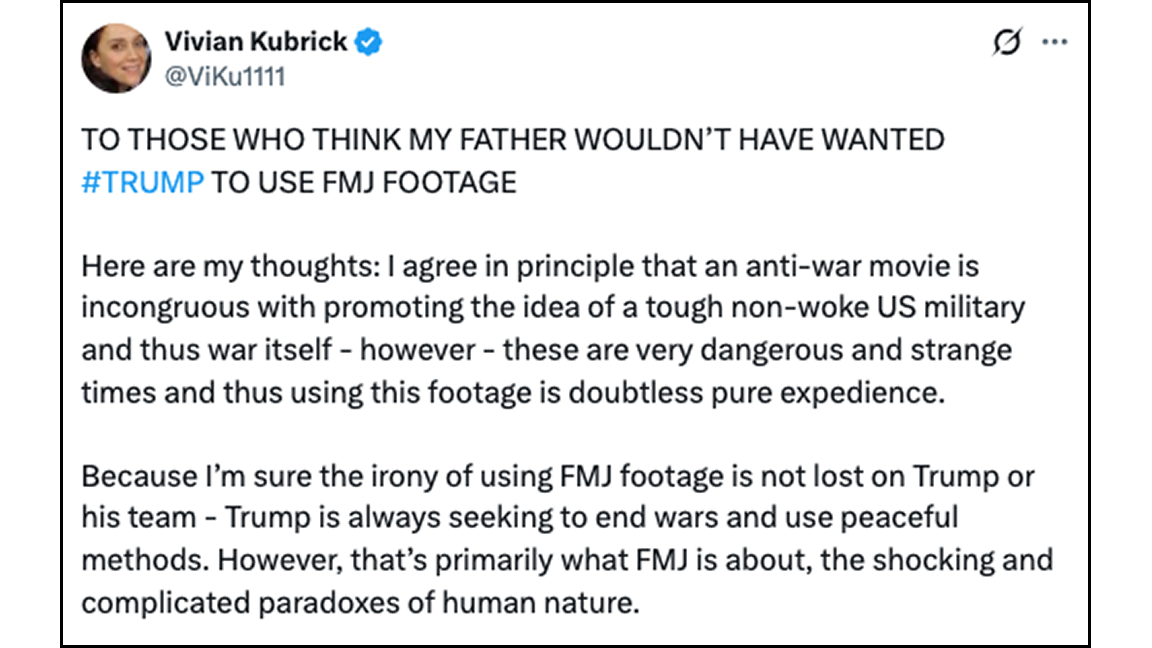
For a very brief moment, Trump’s use of Full Metal Jacket ignited something of a scandal among film nerds, who spotted a rare and important moment to have something relevant to say. The movie’s lead actor Matthew Modine opined that Trump had turned an anti-war film into “a perverse, homophobic, and manipulative tool of propaganda.” This, in turn, garnered a response from the late Stanley Kubrick’s daughter Vivian, who—in a lengthy post on X, asserting that her father had voted for Reagan—conceded that the film was indeed critical of the military, and then explained that Trump was just using it in the service of propaganda, which her father would have loved:
Oddly enough, this was something of a rerun of the debate that had accompanied Full Metal Jacket when it was first released in 1987. Critics had liked the movie, more or less, but they were as baffled by its moral position as they’d been by all of Kubrick’s films; that this one, being about Vietnam, had to have a moral position was assumed as a given.
Pauline Kael, always on the lookout for signs of incipient fascism in her entertainment, had this to say:
It must be ideas that Kubrick is trying to get at… [Modine’s character, Private] Joker just seems a detached sort of wise guy, with a superior manner; perhaps his mocking attitude is supposed to help the hip young audience identify with him. He doesn’t really connect with anything. And the Peace symbol he wears isn’t a sign of the protest he can’t quite acknowledge; it’s explained as a symbol of the Jungian duality of man. What is emotional in the book [The Short-Timers, on which the movie was based] is made abstract. The movie has no center, because Kubrick has turned this hero into a replica of himself: his Joker is always at a distance—he doesn’t express his feelings. So the movie comes across as not meaning anything. But it has a tone that’s peculiar to Kubrick. His cold-sober approach—the absence of anything intuitive or instinctive or caught on the wing—can make you think there’s deep, heavy anti-war stuff here. The gist of the movie, though, seems to be not that war makes men into killers but that the Marine Corps does.
Kael’s opinion was a common one, and it helps explain why, somewhat predictably, the movie in general and Sergeant Hartman in particular became touchstones for a certain kind of military recruit or would-be recruit almost as soon as the movie first reached the screen. But it’s always baffled me, because Full Metal Jacket is, to my mind, the most morally didactic movie Kubrick ever made, and we’re talking about the guy who directed Spartacus.
To recap for those who haven’t seen the film: Modine’s fresh recruit, Joker, enters basic training for the Marine Corps on Paris Island. We follow him and his fellow recruits as they are subjected to a constant stream of degradation from Sergeant Hartman. Among the other recruits is one Leonard Lawrence (nicknamed “Gomer Pyle” after the eponymous TV character), played by Vincent D'Onofrio, who packed on 60 pounds to get the role. Pyle, a hapless, overweight, inveterate screw-up, becomes the special target of Hartman’s abuse. Joker at first attempts to help and educate Pyle, but when this fails, and Hartman instructs the other recruits to join in the abuse, Joker reluctantly does so, savagely beating Pyle alongside his peers. Subsequently, a psychologically broken Pyle uses a rifle loaded with live ammunition (the titular full metal jacket) to kill both the drill instructor and himself.
The film’s second half—which Kael did not like—is set in Vietnam, where now-Private Joker is a reporter for Stars and Stripes who sports a peace symbol on his jacket and the words “Born to Kill” on his helmet, the meaning of which he helpfully glosses for the viewer: “I think I was trying to suggest something about the duality of man, sir… the Jungian thing, sir.” Dispatched to cover a unit that is caught in heavy fighting during the Tet Offensive, Joker at first resists taking part in the action, but in the film’s final scenes kills a Viet Cong sniper, a pregnant young woman, in cold blood. He is standing in a burning building, and Kubrick’s screenplay describes the backdrop as “a scene in hell.”
This is not a difficult character arc to grasp: Joker has been presented with two alternatives, the human and the killer, and courtesy of the United States Marine Corps, he has chosen the second option and consigned his soul to Hell. One person who agreed with this reading was the author of the novel on which the film was based, Gustav Hasford, a former Marine, journalist, novelist, and poet, who co-wrote the screenplay with Kubrick and Michael Herr. In a profile in the Los Angeles Times just before the movie’s release, Hasford denounced Kubrick—who, he claimed, had manipulated both the film’s story and Hasford himself. (Still fuming the following year, Hasford ultimately skipped the Oscars. “Nah. I’d have to wear a tuxedo,” he told a reporter.)
But I think there’s more going on in the Trump movement’s strange embrace of this movie than just the usual fascist indifference to the intentions of art. And to understand what that is, I think we need to talk about Pete Hegseth’s makeup room.
2.
Two months into Pete Hegseth’s tenure as Defense Secretary, CBS News published a story reporting that the former Fox News host had spent between $10 and $15 million to upgrade the makeup facilities in the Pentagon’s green room, the better to prep for his many expected TV hits. If there was a gendered implication, rather than a merely corrupt and narcissistic one, in the tone of CBS’s reporting, the Defense Secretary himself responded in a way that left no room for subtlety, tweeting on X: “We should have installed tampon machines in every men’s bathroom at DoD instead—the leftist ‘news’ media would have loved that.”
Hegseth at the time was 44 years old, which would have made him 12 years old in 1992. That was the year of the Soviet Union’s collapse; in The End of History and the Last Man, Francis Fukuyama worried that the end of ideological conflict with Communism meant an end to the ideological purpose that had shaped democracies for the past century. In the same year, a scholar named Michael S. Kimmel published “Issues for Men in the 1990s,” a paper in the University of Miami Law Review that included a section on “masculinity and risk-taking.”
“Masculinity means always ‘going for it,’ taking no prisoners, living on the edge,” Kimmel wrote.
Operation Desert Storm reinforced the view that we have always linked the capacity for violence with manhood. During peacetime, a new generation needs to demonstrate its manhood in the way its predecessors did on the battlefield. Each generation, therefore, constructs its own fantasy battlefields to prove its manhood under fire.
The logic here was simple. War is the activity that gives men their spunk; the Cold War had been a 50-year production line for American spunk and virility; therefore, the end of the Cold War meant an end to manly American men. At the end of the decade, the military journalist Stephanie Gutmann encapsulated the same feeling in the title of her book, The Kinder, Gentler Military: Can America’s Gender-Neutral Fighting Force Still Win Wars?
By the time Pete Hegseth entered Princeton in 1999, this obsession with virility was already on his mind. As editor of the conservative Princeton Tory, he published an op-ed by another student asserting that sex with an unconscious partner did not constitute rape.
In 2004, Hegseth decided to prove his manhood under fire, so to speak: he joined the Army National Guard, and then the 101st Airborne Division in Iraq. When that tour came to an end, he got into politics, attempting a campaign for Senate in Minnesota. He failed. He took a job at Concerned Veterans for America. He failed at that, too, and was dismissed amid charges of financial chicanery. He took up drinking. There were allegations of sexual assault. Pete Hegseth was demonstrating manhood in his own way.
Both Gustav Hasford’s The Short-Timers and its adaptation Full Metal Jacket are very aware of soldiers who demonstrate manhood in their own way. At first glance, the film appears (like just about every other Stanley Kubrick picture) more notable for the thoroughgoing absence of women than for its depiction of them. But as Roger Ebert observed in his original 1987 review, the entire first half of Kubrick’s film is constructed as an elaborate sexual metaphor; or, put more simply, one big dick joke. The Marine recruits are instructed to sleep with their hands around their rifles and recite poems of love to them. They refer to women in outlandishly vulgar terms and exchange dialogue in flat tones about assaulting each other’s sisters. In one of the most famous scenes, as written by Hasford in the book:
During our sixth week, Sergeant Gerheim orders us to double-time around the squad bay with our penises in our left hands and our weapons in our right hands, singing: This is my rifle, this is my gun; one is for fighting and one is for fun. And: I don't want no teenaged queen; all I want is my M-14.
Sergeant Gerheim orders us to name our rifles. “This is the only pussy you people are going to get. Your days of finger-banging ol Mary Jane Rottencrotch through her pretty pink panties are over. You're married to this piece, this weapon of iron and wood, and you will be faithful.”
In that 1987 Los Angeles Times profile, the writer, Grover Lewis, describes Hasford as “beefy to paunchy, an innately macho man to his code, but not physically intimidating to other men. He has a resonant yet curiously high-pitched voice with a soft trace of Alabama accent.”
Later in the article, Hasford tells the interviewer about his years after leaving the military and landing at a publishing house for fetish magazines: “We had one called Playpen. Which featured guys dressed up like babies. Truck-driver types dressed up like babies and being attended to, not in any sexual way, by matronly looking middle-aged women.” This was the context in which Hasford began writing The Short-Timers. And in a more subtle but even more pervasive way, it is the context in which Donald Trump took office in 2025, and Pete Hegseth installed his makeup room in the Pentagon.
Pete Hegseth appears to believe that the act of killing, much more than the act of sex, is what makes you a man. I think Joker would have agreed. And if all this seems a little too reductive, a little too gendered for its own good—well, what else can we say about an armchair bureaucrat who expels transgendered soldiers from the armed forces; who assembles his flag officers to demand “male standards in all combat roles”; who is reported to have intervened directly to prevent the promotion of qualified female officers; who makes AI social media posts of Franklin the Turtle reenacting the notorious “Get some, Marines” sequence from Full Metal Jacket while shooting Venezuelans from a helicopter? Who, incredibly, has called for guns to be allowed on military bases, as though he’d never watched Kubrick’s movie all the way to the end.
Maybe it’s just another example of the duality of man. The Jungian thing, sir.
If you love this free post subscribe, starting at just $3/month, to