
House of Cardinals
by Osita Nwanevu
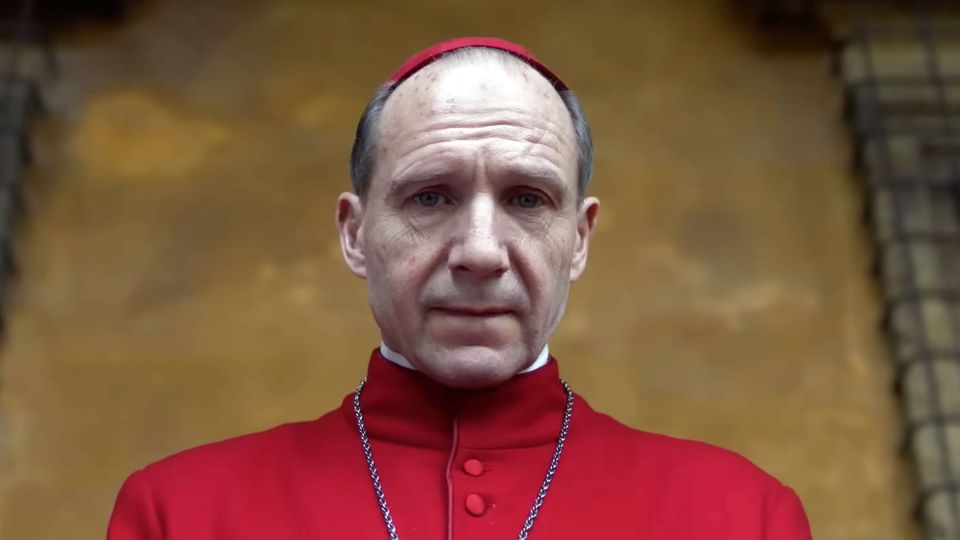
There are few institutions as ready made for cinema as the Catholic Church. High aesthetics and high drama, much of it swirling around one of the most recognizable and influential men in the world—this is a well that will never run dry. And because films and shows about the Church are easy, most of them are bad, though a few seem to break through with critics every so often. The big one five years ago was The Two Popes, a what-if story about Benedict and Francis affably hashing out their differences that I was as ambivalent about seeing as Anthony Hopkins and Jonathan Pryce were about their accent work in the film. I never got around to it. As penance a few nights ago, I saw Conclave, Edward Berger’s papal thriller based on the novel by Robert Harris.
Conclave is about a conclave. A pope we are told almost nothing about dies. The Cardinal Thomas Lawrence—Ralph Fiennes, who excels here, as ever, at looking gloomily concerned—must organize and run the election to succeed him. But, if you can believe it, there are shenanigans afoot. It turns out that the top candidates—these pious, principled men —have secrets.
Cardinal Tremblay—John Lithgow, who excels here, as ever, at being John Lithgow—may have been fired by the pope before his death. There’s something going on between Cardinal Adeyemi (Lucian Msamati) of Nigeria and a nun being tended to by the chary housekeeper Sister Agnes (Isabella Rossellini). The new Cardinal of Kabul (Carlos Diehz), a man no one’s heard of, mysteriously appears. And somewhere outside the Vatican, where all assembled for the conclave have been sequestered, cut off from all outside information that might influence their deliberations, bombs are going off.
The spaces they’re confined to are as beautiful and believable as we’ve come to expect from Vatican sets at this point. The narrative is less so, beginning with the fact that all the major players in the conclave—for the leadership of an institution that appointed its last pope from an English-speaking country in 1154—happen to be either American, Canadian, British, or otherwise fluent enough in English that viewers can follow along easily. Most of the specific narrative beats of the film are plausible in isolation; taken together, one begins wondering rather quickly how poor Cardinal Lawrence stumbled into running the most improbably cursed conclave in generations. But the final preposterous twist aside, all of them—the sex scandal, the simony—are plotted out in the service of a message.
The Catholic Church, you see, is an institution like any other, full of ambitious men behaving badly. Their foibles and petty jealousies litter their holy work like the cigarette butts they drop in the Vatican’s plazas, which Berger’s camera lingers over meaningfully. In other close ups, his camera lingers too on the tools and implements of their trade—seals, ballots, furnaces, and canisters of smoke—and on the tightly clasped hands and furrowed brows, dimly lit, that tell us how earthbound and grim their task really is. If Berger’s direction hasn’t hammered the idea home to viewers, the script is there to help. “We’re mortal men,” someone says. “We serve an ideal. We cannot always be ideal.”
Conclave isn’t the first film to unwonder the Church in this way and it won’t be the last. It’s more philosophical than most of its peers, however. We find out early that Lawrence and Cardinal Bellini (Stanley Tucci) are liberals, invested in disruptive and controversial ideas like elevating the role of women in the Church. (“Let’s not mention women,” one of Bellini’s backers advises.) Neither of them want the papacy, or so they say. But both of them are drawing—and splitting—the liberal vote anyway. Meanwhile, the leading candidates are conservatives: Adeyemi, who hates gays, and the cartoonishly racist Cardinal Tedesco, who hates Adeyemi. Whatever to do?
Why, make a speech, of course. “If there is one sin that I have come to fear above all others,” Lawrence says before the assembled cardinals, “it is certainty. Without doubt, there is no mystery, and no need for faith.” What the church needs, he insists, is “a pope who doubts”: one who rejects suffocating dogmas, embraces diversity, and promotes the free exchange of ideas.
This line sounds familiar because it is supposed to. As cynically as the film regards the Church’s internal politics, Conclave is ultimately an earnest allegory about our political moment—another lament about our inability to reason our way through our divisions and find common ground. Lawrence, the hero at its center, is something like Henry Fonda in 12 Angry Men wearing vestments and a persistently constipated expression.
This film is more transparently ideological, though. Here, Catholicism is nothing more than the gilding on a narrative about liberalism, specifically liberalism of The Atlantic’s variety—a liberalism that expresses the need for doubt but demonstrates little, least of all about the need for doubt. Tolerance and curiosity are wonderful virtues to uphold, generally speaking. But how much intolerance should liberals tolerate? Should reason delimit the boundaries of liberal curiosity or do we owe the unreasonable and the irrational a hearing? These are fundamental questions. Conclave is less interested in addressing them than it is in appropriating the Church—an intrinsically illiberal institution—as a vehicle for telling liberals what they already believe about what the world needs now. It’s a homily on the value of doubt woven incongruously through the drama of choosing the next man—and it is always a man—to inherit spiritual authority over 1.4 billion souls. It’s a paean to curiosity that shows almost none about faith and its demands, a defense of tolerance that shirks the tests it sets for itself by rendering its bigots safely irrelevant.
It is also, more simply and unforgivably, a high-minded and superficially frank film about the Catholic Church that says as little as it can get away with about its sexual abuse scandals. And this too serves a purpose. Even horrifically flawed institutions, it implies, might be salvaged by diligent people of apparent conscience like Lawrence, whose actions during the abuse crisis we can only guess at. The man we’re shown has managed to scale the heights of the church with a naivete about its inner workings that seems incredible—“I thought we were here to serve God,” he says aloud at one point—and any real doubt on his part about its capacity for redemption would make Conclave’s project untenable.
The best depictions of the Church manage to say more than Conclave does about its contradictions and misdeeds without tilting into didacticism. In the hands of better filmmakers, and in the eyes of many believers besides, the Church is both suspect and sublime, both fully of the world as one of its largest and farthest-reaching institutions and also forever at a distance from it. Federico Fellini, deeply haunted and amused by the Church throughout his life and career, captured all this in the space of about two and a half minutes in 8 ½. Guido, the troubled director at the center of the film, visits a spa where he’s granted an audience with a cardinal. He’s deluged with entreaties and advice about dealing with the Church before descending into the depths of a sauna and into Hades, where—with steam and towels taking the place of incense and robes—he’s chided with annihilating platitudes and assertions of the Church’s blank and total authority. “There is no salvation outside the Church,” the Cardinal intones. “Outside the church there is no salvation. Everything outside the City of God belongs to the City of the Devil.”
And in The Young Pope and The New Pope (2016, 2020), Paolo Sorrentino, one of Fellini’s disciples, pulled off one of the most challenging, funny, visually splendid, and thoroughly unconventional explorations of the City of God ever put to screen. Together they’re some of the decade’s best television. Naturally, there are scenes from a conclave. I doubt they’ll ever be topped.

If you liked this free article from Flaming Hydra, why not subscribe? Enjoy quality media. Support the journalist-owned press.