
How to Solve a Murder: Part Two
by Arwa Mahdawi
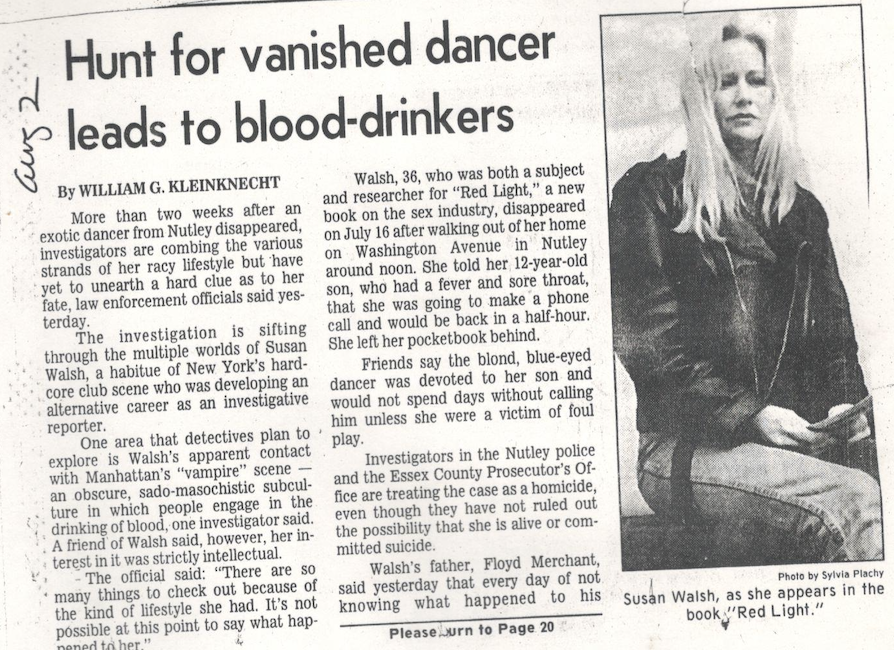
In July 1996, 36-year-old Susan Walsh supposedly left her house in New Jersey and never came back. She is presumed dead but a body has never been found. This is part two of a series on my five-year investigation into her unsolved disappearance. You can find part one here. The next few installments will appear weekly.
People vanish more often than you might think. According to the National Missing and Unidentified Persons System (Namus), more than 600,000 people go missing every year in the U.S., and only a handful of them ever make the news. While a large percentage of those people are quickly found, a couple of thousand cases every year are never resolved.
In the event you go missing one day, there are some things you should do to make sure the press treat you with sympathy, and the police put serious resources towards finding you. First, make sure to be a white woman: preferably attractive, affluent, and under the age of 40. (Missing white woman syndrome is very much a real phenomenon.) Secondly, ensure that your past is pure as the driven snow, that you have lived a blameless life without the faintest whiff of scandal. Anything particularly salacious in your past will be used against you.
Susan Walsh ticked most of the boxes when it came to part one of the Sympathetic Victim Formula. She was conventionally attractive, with long blond hair and blue eyes. She wasn’t rich, but she lived in a middle-class suburb and was a college graduate, doing a postgraduate course in English at NYU alongside her work for the Village Voice. There was even a celebrity connection: her brother-in-law was Joe Walsh from the band the Eagles. Finally, she was the doting mother of an 11-year-old son, David Walsh.
But when it came to scandals—or at least, the sort of things the tabloids consider scandalous—there were many. Walsh had worked for Screw, a porn magazine founded by Al Goldstein, who had well-established links to organized crime. Goldstein is credited with pushing hardcore pornography into the mainstream. According to her brother and a couple of friends, Susan had been helping Goldstein out with a hush-hush project just before her disappearance.
Susan also had addiction issues, which she funded through dancing and sex work. She had long periods of sobriety but her drug use had ramped up again in the period immediately before she went missing.
Keep us breathing fire!







For $3/month you can read this whole post and get our weekdaily newsletter too!