
Life in retreat
Today: Zach Rabiroff, a writer on books, comics, and culture living in Brooklyn, New York.
Issue No. 295
At the Museum Near the Hospital
Zach Rabiroff
At the Museum Near the Hospital
by Zach Rabiroff
The artist’s work is deceptively simple: acrylic and oil portraits of everyday people, facing squarely toward the viewer with piercing stares. They resemble the subjects in an Errol Morris documentary, except that these figures are fixed and silent, quizzical, skeptical, judging, all striking the same characteristic note in the force of their gaze.
The artist—call him H.—grew up in Turkey, back in those strange, unpredictable days before Recep Erdogan and his AKP Party came to power, at a time when the military played the odd role of adjudicator between the country’s rival factions and counterfactions in what approximated something like an absentee junta. Not a constitutional order by any stretch, but not, perhaps, the worst thing that could be imagined.
H. wasn’t an artist yet: he had more prosaic goals in mind. “I used to be an advertising professional, studied business and marketing,” he tells me. “And I used to dream of being a full time writer.” For a time he published in literary magazines, writing what now would be called “LitRPG”—a metafictional genre of fantasy novel in which characters are overtly subject to rules of tabletop gaming—Marquez by way of Gary Gygax. This was around the time when Erdogan was first emerging on the scene, still a figure representing populist, constitutional democracy. The younger generation, by and large, was galvanized by his movement. Not H., though. At least that’s not the way he remembers it now.
“I was in my early 20s at that time and my age group wasn’t interested in politics,” he says. “But I was feeling in my bones that Erdogan was planning to go towards an authoritarian government, and I was writing stories of characters finding the courage to stand against an impossible evil. Fantasy literature was pretty new in that era. I don’t think my writing was super good but it was fresh so I had some minor success. So you can tell that [my stories] were implicitly political but I myself lacked a deep understanding of politics.”
It was easy enough to maintain that distance in the early days. Erdogan, after all, had the aura of reform around him. And if his overt Islamic faith raised concerned eyebrows among the Paul Wolfowitz set in the West…well, that didn’t exactly work against him, either. In any event, it all seemed miles away.
But there were signs, if you knew where to look for them. The artist did, observing that people show their true selves when they are around their friends. “Erdogan, when he was around his friends, was saying that ‘Democracy is a tool to use,’ and that he would drop it when the tool didn’t fit the job anymore.”
“Authoritarians always find an enemy and put themselves [forward] as the only person who would get rid of the enemy, and they always say that they need support and extra power to deal with that ‘mighty’ enemy,” he added. “Another thing I didn’t like was that he only kept the people who showered him with flattery around him.”
What’s more, it all seemed like good fun at first: a natural politician sometimes taking things a little too far, but just putting on a good show. “People in general thought that Erdogan wouldn’t dare to do the things he was talking about,” H. says. “When there was a public outcry about something he was doing, he stepped back and reversed it. But he would bring back the subject the public didn’t like multiple times, morphing it a bit every time. Because the news cycle was so full, people would forget.”
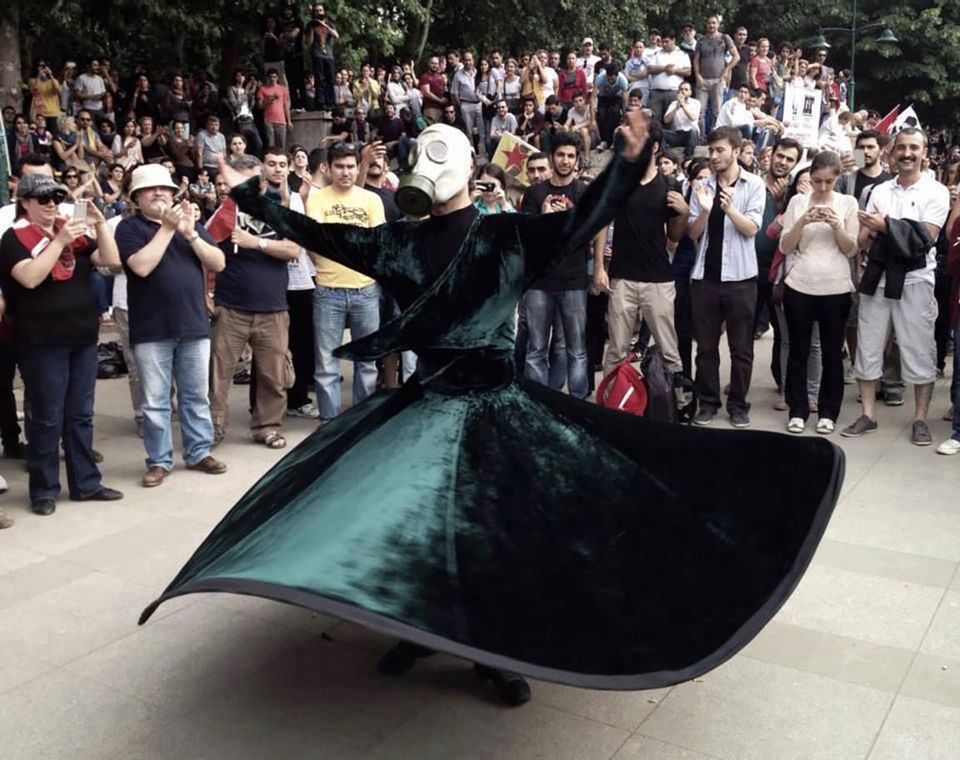
“But Gezi,” H. says, “changed things drastically.”
Keep us breathing fire!

For $3/month you can read this whole post and get our weekdaily newsletter too!