
Hear the music / Feel the burn
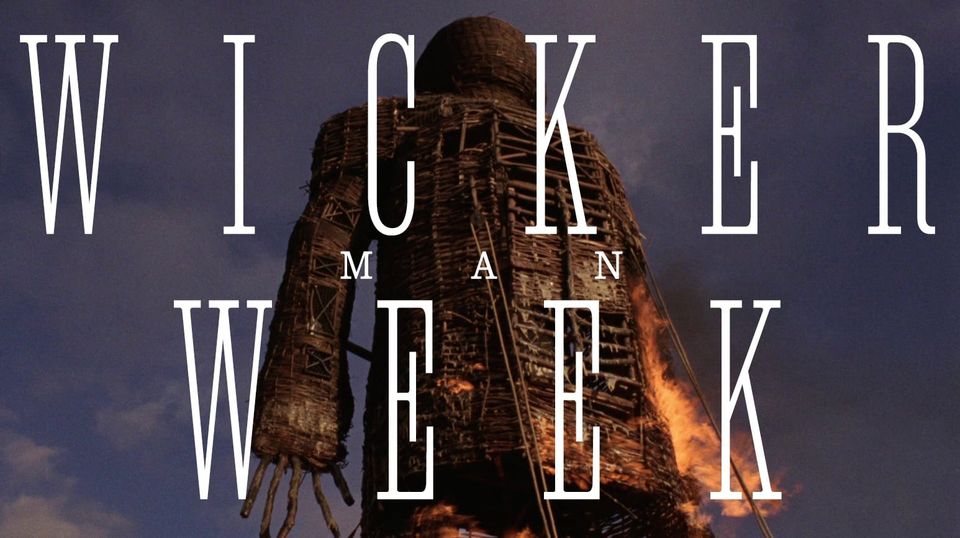
Today: Welcome one and all to Wicker Man Week, in which a number of Hydras will consider and discuss the 1973 film starring Edward Woodward, Britt Ekland, and Christopher Lee. Opening the proceedings: Tal Lavin, author of Wild Faith; and Annalee Newitz,columnist, podcast host, and author of Stories Are Weapons, The Terraformers, and the recently published Automatic Noodle.
Issue No. 426
The Wicker Man: The Musical
Tal Lavin
An Oppositional Reading of The Wicker Man
Annalee Newitz
An Extra Day to Vote! in HYDRANYM No. 21
The Editors
Yakkin’ About The Wicker Man
Tal Lavin and Annalee Newitz
‘The Wicker Man’: The Musical
by Tal Lavin
The Wicker Man (1973) is my favorite movie. Among its many contradictions and beauties, it proves that a musical—and the movie really is a musical at heart—can be completely terrifying.
The centrality of music in The Wicker Man is evident from the first scene: a seaplane swoops over the rugged landscape of the Hebrides, as a poignant arrangement of Robert Burns’s “Highland Widow’s Lament” pours out over the sunlit crags and the serge-grey water:
Oh, I am come to the low Countrie,
Ochon, Ochon, Ochrie!
Without a penny in my purse,
To buy a meal to me.
The song, sung by Lesley Mackie, who plays Daisy in the film, instantly transfixes you with its lovely, strange steeliness. The unearthly music composed by Paul Giovanni and the group Magnet—a band put together from scratch and passion, like much else about the movie—weaves throughout its tight 90 minutes, building up the sense of a fleshed-out alternative reality, carved out from time, cut off by the sea. The soundtrack mixes snatches of nursery rhymes, British folk ballads, and original compositions with a calculated eeriness that makes the strange vision of Summerisle feel ancient. “Baa baa black sheep,” as a melody line out of context, or a brass-heavy rendition of “Willie O’Winsbury,” or the climactic, sabbat-like performance of “Sumer is icumen in” are the music of an old land and its lost denizens, haunted by their shades.
The Wicker Man is not an especially violent film. It’s a masterpiece of psychological dread, and that dread is anchored by superbly conceived aesthetics, creating a lasting sense of uncanniness and displacement. A cake shaped like a human body, cut into with an implacable knife; a wizened bit of navel-skin hung from a tree; nude women whirling nimbly around a fire; a wheel of bread in the shape of the sun; a man dressed as a salmon and a man dressed as a gape-mouthed fool; a pentacle of swords: rich, dreamlike images, given the timbre of nightmare by our hapless hero, a man too tightly shackled in his convictions to see the beauty in that strangeness. In the new extended cut, Christopher Lee—a man of quite startling beauty himself, with the baritone of an enraged god—pauses to comment on the sexual congress of snails, and the camera watches them with a kind of sinuous voyeurism, inviting us to be complicit in the film’s seduction, and its horror, and its fiery culmination.
Keep us breathing fire!








For $3/month you can read this whole post and get our weekdaily newsletter too!