
Zen con / Mind the dip

Today: Activist, musician, and writer jj skolnik; and Laurie Woolever, author of Appetites, World Travel, Bourdain: the Definitive Oral Biography, and Care and Feeding.
Issue No. 582
Meditating on the Wellness Grift
jj skolnik
Chips and Goop and Nietzsche
Laurie Woolever
Meditating on the Wellness Grift
by jj skolnik
I have meditated every single day for 400 days today, according to my tracker app. I took up the practice after a traumatic incident threw me out of balance; I needed very badly to self-regulate, and focusing on my breath, letting my thoughts come and go without judgment, felt like it could help. And it did. Sitting for five minutes—then 10, 15, 30—helped me step back from intrusive thoughts and feelings. It’s become a crucial tool for me.
I want to point out here that I was also in PTSD-focused therapy at the time I began my meditation practice. I have been in some kind of therapy for most of my life. I was marked with a significant amount of difference from the outset and experienced violence during childhood; I’ve been running uphill against the wind basically the whole time and have needed some extra help. I haven’t always been able to afford it, but I’ve had consistent access for a good long while now, and I’m so grateful for it.
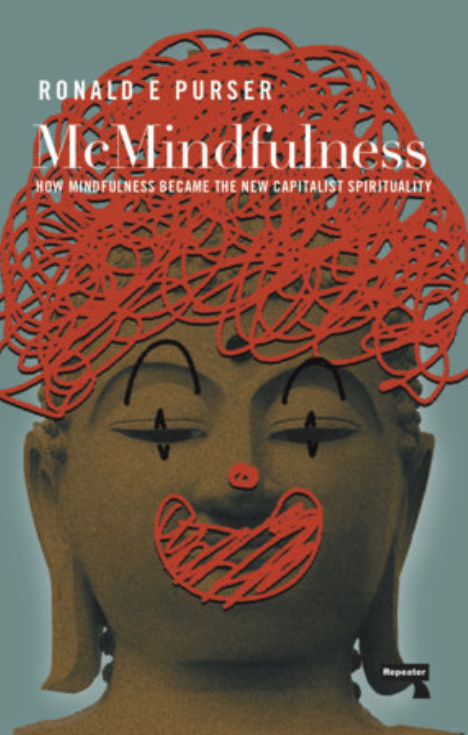
Wellness grifters often treat meditation as a magical cure (though not quite a panacea, since they don’t just have retreats to sell you; they’ve got supplements, cleanses, and an assortment of accessories too). Quacks and mountebanks have been a consistent feature of life in the U.S. for roughly as long as it’s existed, and they are currently experiencing one of their cyclical renaissances. I recommend Ronald Purser’s McMindfulness: How Mindfulness Became the New Capitalist Spirituality for an excellent analysis of how easily meditation was commandeered into the service of the consumerism, egotism, and capitalist needs you might have thought it was intended to oppose. It is much cheaper, after all, to offer workers “mindfulness breaks” than it is to give them better health benefits, and sitting too long with the wrong intentions can be used to isolate and control someone very quickly. Instead of breaking feedback loops, the way I’ve been able to do, it can also be used to trap you in them.
The term “nonspecific amplifier” has been used in the psychiatric and sociological study of psychedelic drugs to describe the way psychedelics actually function—instead of creating the same kinds of experiences for everyone, psychedelics can only work on what’s already there. I think that meditation is similar. I must note here that I have also done psychedelic therapy, and have had some very useful breakthroughs—but as someone with a history of drug addiction, I’ve been incredibly careful about how I’ve personally approached it, and do not feel comfortable engaging with it without a doctor’s supervision. This is not to say that all doctors are trustworthy, but I’ve been lucky to have ones who have been.
Because I have come to both meditation and psychedelic therapy with very specific, bounded needs, having already done a lot of work, and have checks and balances in my life, I’ve gotten a lot of use out of both of these tools. The amplification has worked in my favor. But it’s not lost on me that some of the worst tech and manosphere dipshits our society has to offer have used the same tools, loudly and in public, to enhance their bad behavior. Nonspecific amplifiers in action.
There is no sensible reason why the wealthiest country in the world has the deteriorating health outcomes we do, but the U.S. has almost completely privatized its health insurance system, private equity has destroyed scores of hospitals that were once the primary providers of care for huge swathes of the country (see Megan Greenwell’s Bad Company: Private Equity and the Death of the American Dream for a powerful case study thereof), and there is still significant gendered, classist, and racialized bias in healthcare. The precariousness of life in the U.S. created the conditions in which wellness grifters could flourish.
Everything is expensive. Since we’ve tied health insurance to a full-time job, and full-time positions are declining, fewer people have access to care. Into the breach comes RFK Jr. and an army of influencers, podcasters, and supplement companies who can’t wait to sell you the totally unregulated cure for what ails you. Things are wrong; we lack; we suffer. People desperately want a way out. It is this fear, created and stoked by a politics that enriches a few at the cost of benefits for all, that these assholes prey upon.
When I tell people how good meditation or psychedelics have been for my health, I always worry a little. For me, I hasten to add, for my specific needs, in my specific condition, at this specific time in my life. I tried to meditate in my 20s and it didn’t take, and I tried psychedelics when I was deeply unwell and it was not good for me. There is no one tool that works for everyone. I know we’d be better off if we lived in a society in which we took care of one another, but that would be the beginning, not the end. The only solid wellness advice I can give that would apply to all comers is this: If anyone claims to have the one thing that fixes everything that ails you, run.
CLOUD CUCKOO LAND (ON FIRE)
![DUDE'S LIKE "59, 58, 57..." [QUOTE POST] Karl Bode @karlbode.com · 2h CEO said a thing! Paramount C.E.O. Promises Editorial Independence for ‘60 Minutes,’ Lesley Stahl Says](https://storage.ghost.io/c/11/a3/11a34ed2-0d03-4467-9051-6142cc358694/content/images/2026/06/image-21.png)
![Bluesky post from Leila Brillson: Happy Horse Would Like To Try Cake Publish Day to all who celebrate [SCREENSHOT OF THE ONION ARTICLE] Commentary: I Work Very Hard, And I Would Like To Try Cake, By A Horse Published June 19, 2026 | Hello. I am a horse. I work very hard at my job of being a horse. When humans say move the heavy thing, I move the heavy thing. When humans sit on top of me and pull on my head, I carry them where they want to go. The main food the humans give me is hay and oats. But I am thinking it would be nice to have a different food. I am thinking I would like to try cake. Yes, yes. Cake. I know all about it. When humans eat cake, it is in glad times. It is the food for a celebration, such as when a woman becomes 47. I have seen cake on the Fourth of July. When humans have a cake, they stand around it and clap hands and smile and say happy birthday at each other. Sometimes there are beautiful markings on a cake, such as balloons or a pink shape.](https://storage.ghost.io/c/11/a3/11a34ed2-0d03-4467-9051-6142cc358694/content/images/2026/06/image-22.png)
![Bluesky post by Sam Thielman: what if pump and dump but the entire global economy [QUOTE POST] FinTwitter @fintwitter.bsky.social · 5h INVESTOR DEMAND FOR SPACEX IPO APPROACHES FOUR TIMES OVERSUBSCRIBED - SOURCES](https://storage.ghost.io/c/11/a3/11a34ed2-0d03-4467-9051-6142cc358694/content/images/2026/06/image-25.png)
Chips and Goop and Nietzsche
by Laurie Woolever
About once a month when I was a kid, we’d all get in the car on a Sunday morning, having attended Mass the evening before, and drive an hour to visit my grandparents in Herkimer, New York. My grandmother would cook lunch for at least twelve people (though we were only ever six), typically a ham or a whole turkey, with a loaf of bread, mashed potatoes, gravy and a vegetable, two pies and homemade whipped cream; the beverage for everyone was always a glass of whole milk. After lunch, the adults would talk in the kitchen, and my sister and I would play outside or read my grandmother’s magazines. It was during one of these visits, when I was an anxious ten-year-old, that I read a short essay in which the writer, a woman, explained that the phrase It doesn’t matter was the key to living a happy life. I don’t recall whether she credited Nietzsche or Kierkegaard with the sentiment; this was the mid-1980s and my grandmother only subscribed to Good Housekeeping and Reader’s Digest, so the philosophical North Star of the piece is far more likely to have been Erma Bombeck, or maybe Peg Bracken.
One need not despair if the outcome of a situation didn’t align with one’s rigid expectations, the author hastened to explain; she didn’t mean to suggest that a person shouldn’t care about anything. It was more akin to “don’t sweat the small stuff,” which is something my mother liked to say, despite having expended gallons of her own perspiration over the most minute stuff.
Keep us breathing fire!







For $3/month you can read this whole post and get our weekdaily newsletter too!