Instrument found

S.I. Rosenbaum’s TEETH BEACH continues

Today: Writer and artist S.I. Rosenbaum.


Issue No. 585

TEETH BEACH: The Singing Saw
S.I. Rosenbaum


TEETH BEACH: The Singing Saw

by S.I. Rosenbaum
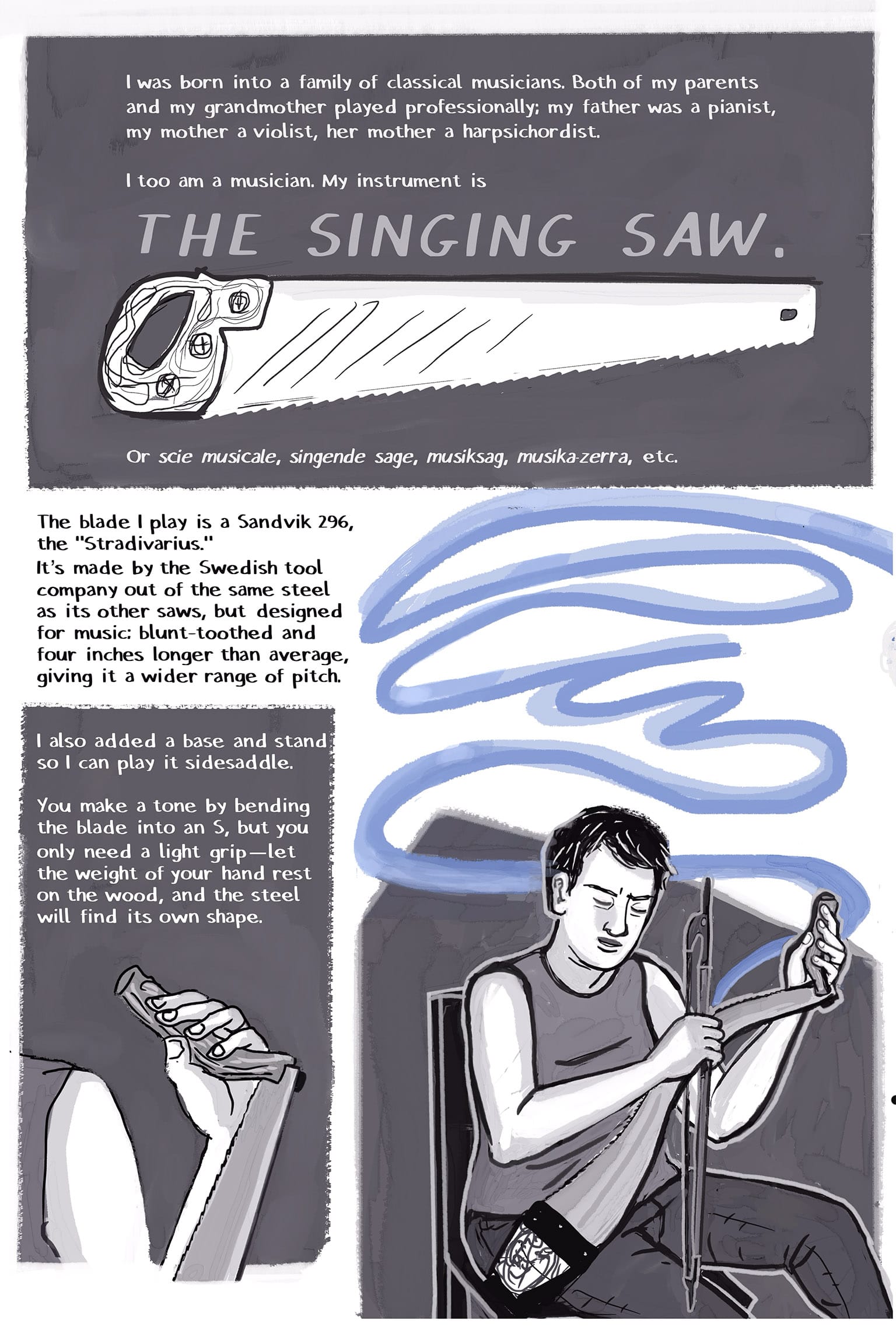
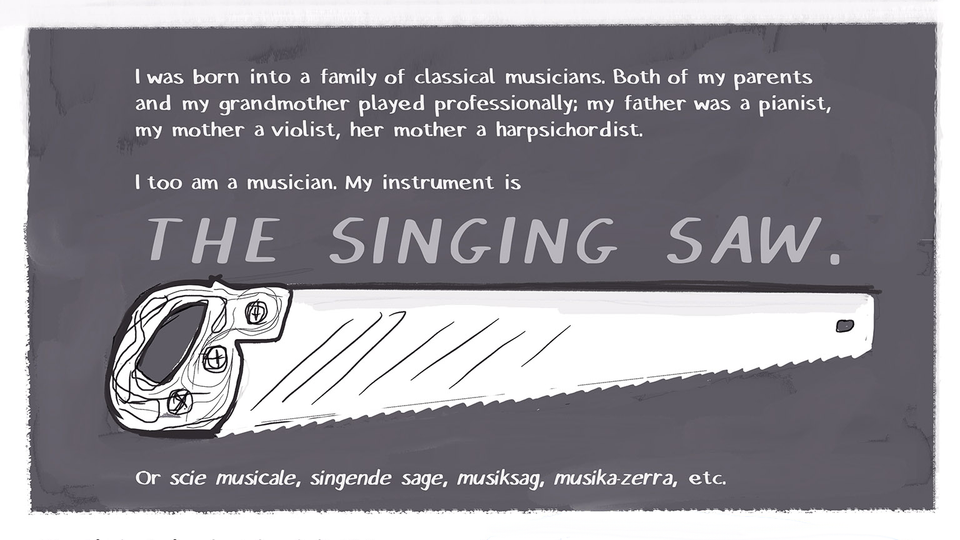
1: All-text panel. Narration against a grey background:  I was born into a family of classical musicians. Both of my parents and my grandmother played professionally; my father was a pianist, my mother a violist, her mother a harpsichordist. I too am a musician. My instrument is THE SINGING SAW. Or scie musicale, Singende Sӓge, musiksåg, musika zerra, etc. 2: The narrator's left hand, drawn in tones of grey, holding the handle or "cheat" that screws into the hole at the top of the saw. Narration:  The blade I play is a Sandvik 296, the "Stradivarius." It's made by the Swedish tool company out of the same steel as its other saws, but designed for music: blunt-toothed and four inches longer than average, giving it a wider range of pitch.  I also added a base and stand so l can play it sidesaddle. You make a tone by bending the blade into an S, but you only need a light grip - let the weight of your hand rest on the wood, and the steel will find its own shape. 3: The narrator, SI, plays the saw. She's white with close-cropped salt-and-pepper hair, wearing a sleeveless top and jeans. The saw rests on its stand wedged against her outer right leg as she sits in a chair; her left hand bends the saw while she bows the flat edge with her right, holding a German bass-fiddle bow. Her eyes are closed, her lips slightly open. The art is all in grey, but electric-blue lines of sound unfurl like a ribbon over her head.
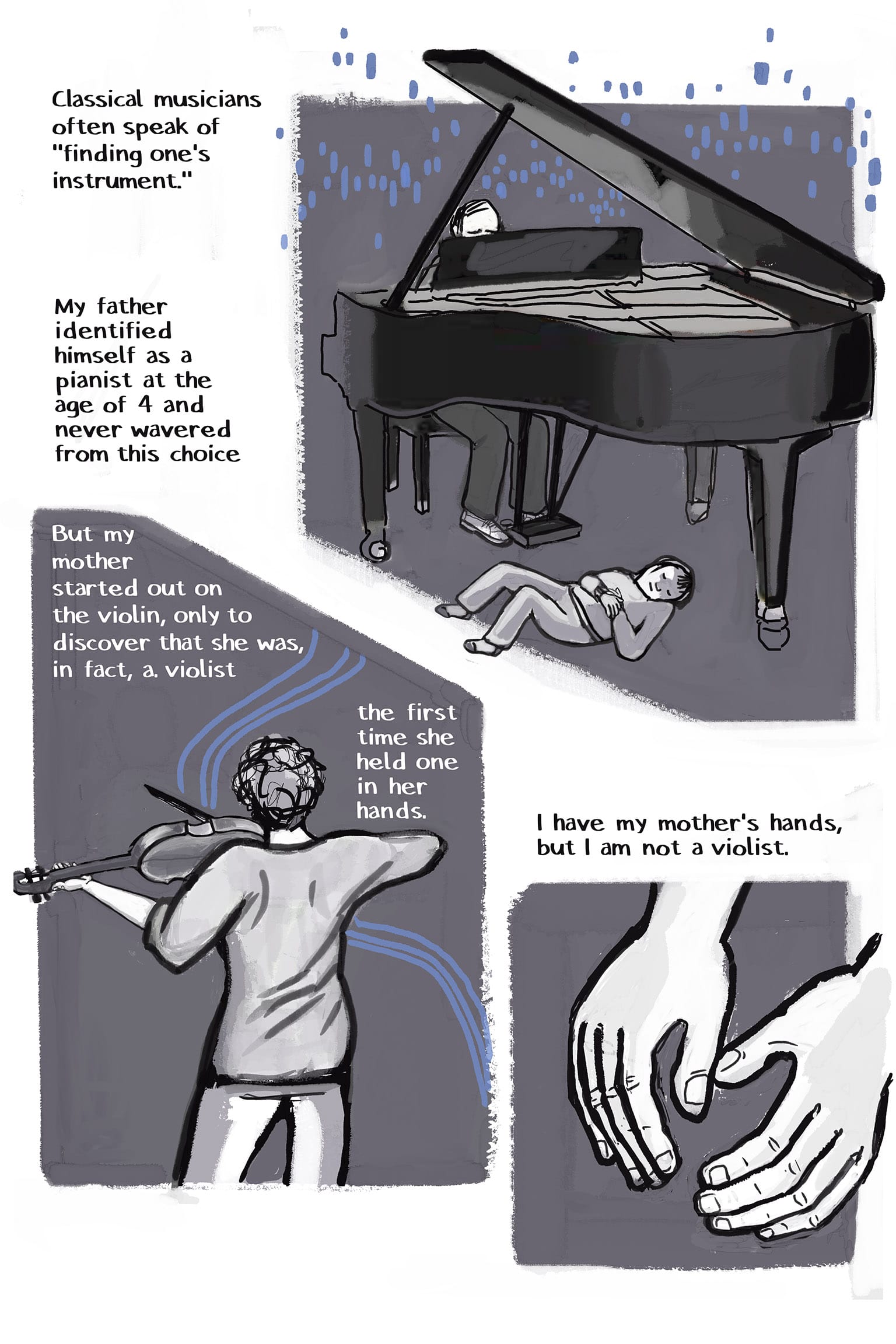
1: A grand piano, seen from the back. Above the open top, a man's bald head is visible as he sits at the keyboard. Squares of electric-blue sounds rise over the instrument. Underneath, a small child is happily asleep on her back. Narration:  Classical musicians often speak of "finding one's instrument." My father identified himself as a pianist at the age of 4 and never wavered from this choice 2: A woman, seen from the back, gracefully playing a stringed instrument under her chin; sound emanates in sets of parallel blue lines. Narration: But my mother started out on the violin, only to discover that she was, in fact, a violist the first time she held one in her hands. 3: The narrator's hands, loose and empty. Narration: I have my mother's hands, but I am not a violist.
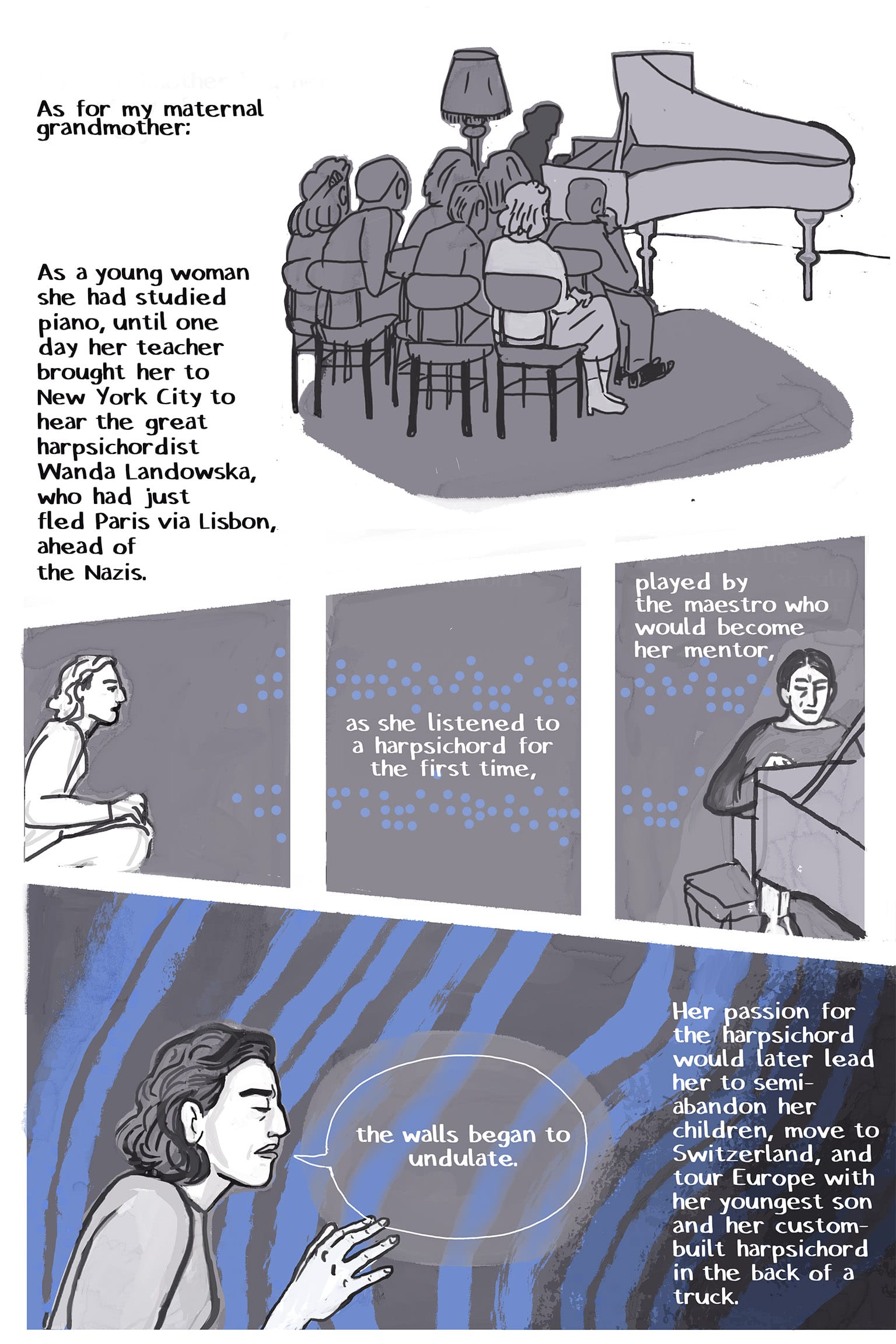
1: a small group of people gathered in chairs in front of a harpsichord, their backs to the viewer. The player is in silhouette. Narration: As for my maternal grandmother: As a young woman she had studied piano, until one day her teacher brought her to New York City to hear the great harpsichordist Wanda Landowska, who had just fled Paris via Lisbon, ahead of the Nazis.  2-3: A young woman dressed in a 1940s style leans forward in her chair with great concentration. Blue dots of sound, like braille, start in two rows and continue into the next panel.  Narration:  As she listened to a harpsichord for the first time, 4: The dots continue, coming out of the harpsichord, played by Landowska, a thin, long-faced older woman with her hair in a bun. Narration: played by the maestro who would become her mentor,  5: Close up on the face of the young woman, her eyes closed, a hand raised in time with the music, as if to feel it in the air, bands of deep blue wavering behind her - She says:  "the walls began to undulate."  Narration: Her passion for the harpsichord would later lead her to semi-abandon her children, move to Switzerland, and tour Europe with her youngest son and her custom-built harpsichord in the back of a truck.

Keep us breathing fire!

just a few of our contributors

For $3/month you can read this whole post and get our weekdaily newsletter too!