Killers

by S.I. Rosenbaum

In 1752, a man christened Duarte Lopez fled the Inquisition in Lisbon, Portugal to Newport, Rhode Island. There he underwent circumcision -a heresy and a crime, in the nation of his birth-and changed his name to Aaron. For the first time in generations, he and his family could live openly as Jews.  Aaron Lopez went into business with another Portuguese Jewish refugee, Jacob Rodriguez Rivera, a candlemaker. Rivera either invented or pioneered making candles from spermaceti, a waxy substance found in the heads of sperm whales; these candles burned cleaner and brighter than those made from tallow.  Later Lopez would invest in other things, including slave ships. He would help build the first synagogue in New England, using the labor of enslaved people.  He would personally hold five people in bondage, forcing them to render the raw spermaceti into wax to make candles, some of which no doubt burned clean and bright in the newly built synagogue.  But the candles were his first venture, and in order to more easily obtain spermaceti, Lopez built up one of the earliest whaling fleets in southern New England.  I grew up outside of Boston, Massachusetts. My family arrived in New England around 1900, Ashkenazi Jews from the Pale of Settlement who fled pogroms and the Russian Czar. My spouse's family arrived around the same time, from roughly the same place.  Both of our families' memories stop at the edge of the water.
I can name all my ancestors who lived in Malden and Everett and Newton and Providence, but before that, there's nothing. No one told stories about where we'd come from-that place was gone, anyway. Erased from the earth. We didn't talk about it; but we didn't not talk about it, either. This past was a blank, a wound that had sealed itself over. Because I wanted to write about whaling, I called Linda Coombs, a writer, museum programmer and historian who grew up on Martha's Vineyard. As a kid, Coombs told me, she knew there was a piece of whale baleen-the thick sieve of hairlike material that filter-feeding whales use to catch krill-stored in her grandmother's upstairs closet. That was unremarkable: Coombs is a member of the Wampanoag Tribe of Aquinnah and, like most Native people living on the Southern New England coast, her ancestors had been whalers. The Wampanoag were not whalers by nature; before contact with Europeans they would harvest beached whales, but rarely hunted them. In the industry's early days, though, many Wampanoag were indentured or forced onto whaling ships. Later, whaling became one of the few livings available to them, and they developed a reputation as sought-after expert sailors. Native history after European contact had been a procession of plagues: yellow fever, smallpox, conversion, forced debt, the indenturing of children, the outright enslavement of adults; whaling wasn't the hardest thing they'd done to survive.  By Coombs's generation, she said, whaling wasn't talked about; but it wasn't not talked about. It was just there, like the piece of baleen in the closet.
One of the earliest recorded stories about Maushop, the giant being who is an ancestor to Coombs's people, and who shaped most of the Southern New England Coast, was published in 1792. The story, told by an Aquinnah man and written down by a white amateur folklorist, goes like this: Maushop sends his children to play on the beach, and then he draws a trench with his toe so that the water rushes in, and they are afraid they will drown. The sons hold their beloved sister up out of the water. But Maushup changes his sons: He told them to act as if they were going to kill whales; and they were all turned into killers (a fish so called). It's a strange narrative. It's hard to say if the children live or die, in this story, or if they become whales-maybe orca, black and white like the stripes of the dress the storyteller mentions the sister wearing. To me, it sounds like a story that might have been reshaped in response to what was by then almost 200 years of colonial violence; Native families were often made to relinquish their children to indentureships in payment for forced debts, sometimes as servants, sometimes as sailors. I suggest this; Coombs tells me that this early published story is probably a distortion, a garbled version of a lost original, because the Aquinnah people have always cherished their children. It's hard, she says, to know what is the true history, to reconstruct the stories as they must have been before colonization. There are only pieces, and the pieces have all been altered. This is a Maushop story Coombs tells me:  One day Maushop had a vision that there was going to be a pale skinned people coming at some point in the future, and they would bring many changes. He's saying to people, you can stay in human form and deal with these changes, or I can change you into whales, which are the orcas, and you can swim in the ocean until that gets polluted and you choke on plastic bags or whatnot; I added that part, because that's what's happening now. The whales were safe for a little bit of time, until the whaling industry.
In 2024 one of Coombs's nonfiction books on Wampanoag history for young people, Colonization and the Wampanoag Story, published by Penguin Random House, was "challenged" for unknown reasons by an unknown person at a Texas public library. The county had recently relieved librarians of the duty of handling such challenges to children's books, and established a "Citizens Review Committee" instead. The committee meetings are not made public, nor are the challenges they review, but they voted to recategorize Coombs's book as fiction, not history. This news brought protests from various Indigenous, writers' and librarians' organizations, and the county eventually reversed its decision. The whaling and fishing industries of Southern New England drew sailors and fishermen from everywhere. In New Bedford, the industry's central port, the population was a mix of "kanaka" sailors from the Pacific Islands and Hawaii; South Eastern New England Native people, especially the Wampanoag but also Native nations to their south; Africans; free Black Americans, and Caribbean Islanders; Sephardic Jews, who mostly outfitted or owned the ships; and Atlantic Islanders, especially white Portuguese from the Azores and Creole-speaking descendants of Africans the Portuguese had enslaved on Cabo Verde. There was a racial hierarchy on the ships. Aquinnah people became known early on as boat-steerers-"harpooners" as Melville called them-because it was the highest rank non-whites could attain.  Later, as the Civil War heated up and anti-Black racism intensified, Wampanoag sailors rose in the hierarchy. At least three became captains of their own ships.
When he wrote Moby-Dick, Melville had already shipped out on a whaler, but he apparently didn't do much to interview his shipmates. He includes a garbled version of a Maushop legend in which Maushop searches for a lost child, but in Melville's telling, a party of Native people searches for the child, omitting Maushop entirely. And the Aquinnah Wampanoag "harpooner" he includes is a thinly-drawn "savage," with the made-up mononym "Tashtego." In reality, the Wampanoag sailors among whom Melville would have shipped were literate and numerate Christians with names like Amos Haskins, Joseph Belain, or Solomon Attaquin. They were men who for generations had made their way as steady, responsible and educated mariners. Some of them became artists, too, hand-carving stamps in the shapes of whales which they used in the ship's logs to indicate how many whales had been killed on a given day, which boat had struck the final blow, and how many barrels of oil each whale had rendered. In 1902, fifty years after the publication of Moby-Dick, an Aquinnah Wampanoag man named Amos Smalley was a boat-steerer on the Platina, out of New Bedford. This was in the last days of whaling, and Smalley would be one of the last Aquinnah whalemen. He'd grown up, he would recall later, playing with sticks as if they were harpoons. He'd first shipped out at 15, in 1891, and attained the rank of steward. When he shipped out again seven years later, he told the captain he wanted to become a boat-steerer, and the captain obliged. Smalley harpooned his first whale off the coast of South America in 1898. In the Ad Vivum photography studio on Hastings Street in New Bedford, Smalley had his portrait taken. He was in his 20s then, with clear skin and hair he wore cut short with a side parting.  The Platina was his third voyage. They were near the Azores islands in the mid-Atlantic when a sperm whale was sighted off the port bow and the Platina gave chase. In the boat, Smalley waited to be lowered into the water- You never lower while the whale is up spouting; the least slap on the water will reach him like a telephone call, he would recall later.
Then the mate in the boat with him saw the whale more clearly. That fish is white! He's white all over! He's a son-of-a-bitch! In 1904, the same year the Platina returned to New Bedford, Mary A. Cleggett Vanderhoop-who was white, and married to an Aquinnah Wampanoag man-took it upon herself to write up some of her husband's people's stories in the New Bedford paper: her purpose was to establish that the Wampanoag still existed as a people, as prevailing political opinion was that interracial marriages such as her own had rendered the Wampanoag "bloodline" too "diluted" to legally constitute a Native tribe. Her version of Maushop is "a great Indian god," a "chief," and the tales she retells are covered in a distinct sheen of Victorian smarm -until the very end, when her tone changes, becomes inexplicably darker. The stranger comes, she has Maushop announce to the Aquinnah Wampanoag, an unbidden guest, to take that which was ours. And then and there the great Moshup, as if by magic, transformed his children into killers. Today, in Old Ocean, roam these children of the chief at will. Warm blooded are they, and they nurse their young. In appearance they resemble the whale, being fully as large. They are spotted black and white, though occasionally an all white one is seen. The sign by which we know they are the true sons and daughters of the great Moshup is this: They eat whales, In doing this they invariably eat the tongue first. How do you hold something like this in your cultural memory? How can you remember that your ancestors became whales and remember slaughtering whales? Who can carry that contradiction? | asked Linda Coombs, and she replied, We're talking about humans, so i'm sure there were people who absolutely felt that way; maybe they went out on one trip and then said, "I can't do this." And then you have the guy who loves seeing the blood.  She said, We had the whale as our relative, then we're hunting whales and taking their lives. What was going on in the mind of any Wampanoag person, God only knows.
Amos Smalley later swore he'd never heard of Moby-Dick when he shipped out on the Platina. But he'd always been told to watch out for any whale that looked like an orca, with patches of white, or worse, an all-white whale. An all-white whale was cursed. His captain -who had read Melville -would later insist in a 1907 newspaper story that the huge sperm whale they hunted that day was pure white from head to tail, so luminous that I could see him under water when he was a half mile from the ship. Smalley's boat was lowered into the water. It was my job to harpoon that whale, white or black, and I braced myself to do it, he'd recall later in a piece written up by his friend, the ex-radical Reader's Digest editor Max Eastman, who summered on Martha's Vineyard. Smalley held a harpoon of a new make, one with a bomb attached; he threw it, and then waited until he heard the muffled pung of the explosion deep inside the whale. The mate told him, You put your iron right over his heart. You killed him. In the ship's log, the kill was recorded. The whale stamp notes that it was Smalley's boat that made the kill and that the whale was so big it rendered into 80 barrels of oil, the only 80-barrel whale killed that voyage. Many years later, when whaling was gone and he was a scallop fisherman living on Martha's Vineyard, Smalley would sit at the ferry dock and tell anyone who cared to listen the story of how he killed Moby Dick off the Azores, so long ago. The Azores are an archipelago of Atlantic islands discovered and colonized by Portugal early in the 15th century. The islands had been uninhabited when the Portuguese found them-perhaps the last time colonizers would see empty land, though they would never stop looking for it. The volcanic soil made rich farmland; the sea around the islands teemed with fish.  Prevailing winds across the Atlantic made the Azores the first port of call on most New England whaling voyages. So by the 1860s whaling crews were often more than half Azorean Portuguese.
Later, when the industry faded, people who had come to New Bedford for whaling mostly left the city and went home. The Pacific community vanished from the city entirely. The Portuguese, however, settled in New Bedford and brought their families across. The population of New Bedford remained in a large part Portuguese. This is why there is a Portuguese consulate in New Bedford to this day. After the election of 2024 did not come out the way we hoped, my spouse and I found ourselves in a place as transgender people that felt familiar to us both from Jewish history-our own as Ashkenazim, but also through the Sephardic memories of the Inquisition. Once again, we fled a state that told us that our bodies were not our own to alter, as Marrano Jews had been forbidden circumcision. There were people who would inspect us, investigating whether or not we were really who we claimed to be, as New Christians had been scrutinized. Once Portugal had forcibly converted its Jewish population in 1497, the king announced that there were no longer any Jews in Portugal. On his first day in office, the president now announced that there was no such thing as trans people in America. We thought of our ancestors who had fled Europe. Our time on this new continent seemed to be at an end. We would have to turn ourselves into something else and depart again across the sea. Israel was, obviously, not an option. But today's Portugal, no longer ruled by the Catholic Church, had good legal protections for queer people, and a straightforward residency visa process. In 1761, Aaron Lopez applied for citizenship in Rhode Island, but despite its reputation for religious tolerance the colony would not accept a Jew. He repaired to Massachusetts, became its first Jewish citizen, and built a house on a hill in Leicester where he sheltered his family during the Revolutionary War. In 1782, on a trip back to Rhode Island, he stopped to water his horse in a pond in Smithfield, and drowned to death there in full view of his family.
Later, when the industry faded, people who had come to New Bedford for whaling mostly left the city and went home. The Pacific community vanished from the city entirely. The Portuguese, however, settled in New Bedford and brought their families across. The population of New Bedford remained in a large part Portuguese. This is why there is a Portuguese consulate in New Bedford to this day. After the election of 2024 did not come out the way we hoped, my spouse and I found ourselves in a place as transgender people that felt familiar to us both from Jewish history-our own as Ashkenazim, but also through the Sephardic memories of the Inquisition. Once again, we fled a state that told us that our bodies were not our own to alter, as Marrano Jews had been forbidden circumcision. There were people who would inspect us, investigating whether or not we were really who we claimed to be, as New Christians had been scrutinized. Once Portugal had forcibly converted its Jewish population in 1497, the king announced that there were no longer any Jews in Portugal. On his first day in office, the president now announced that there was no such thing as trans people in America. We thought of our ancestors who had fled Europe. Our time on this new continent seemed to be at an end. We would have to turn ourselves into something else and depart again across the sea. Israel was, obviously, not an option. But today's Portugal, no longer ruled by the Catholic Church, had good legal protections for queer people, and a straightforward residency visa process. In 1761, Aaron Lopez applied for citizenship in Rhode Island, but despite its reputation for religious tolerance the colony would not accept a Jew. He repaired to Massachusetts, became its first Jewish citizen, and built a house on a hill in Leicester where he sheltered his family during the Revolutionary War. In 1782, on a trip back to Rhode Island, he stopped to water his horse in a pond in Smithfield, and drowned to death there in full view of his family.  Because we lived in Providence, we were allowed to apply for our visa at the consulate in New Bedford, which serves only a small area of Southern New England. Our appointment came the day before Thanksgiving. Wampanoag activists have been on the forefront of a movement to rename this holiday the National Day of Mourning. It commemorates a moment when their direct ancestors saved the lives of colonists who would spend the next 400 years attempting, never successfully, to extinguish them completely. It was a grey day. We drove past the Whaling Museum. We parked on a street near the water. In the consulate our interviewer found out we were writers and brought out his own self-published book of poetry, written in Portuguese and in Cabo Verdean creole. On the way home we passed signs protesting the genocide in Gaza. Once there were whales who swam off the coast of the Azores. When my spouse went there this fall, shortly after we obtained our Portuguese residency cards, a boat took her out to look for them. She didn't find whales but she did find dolphins, a pack of juveniles swimming excitedly alongside the boat. The captain told her that for a long time whales had avoided ships around the islands, because they remembered the whalers. It was only recently that the young ones have started to come close. They have finally begun, he told her, to forget.  End

Notes and Bibliography

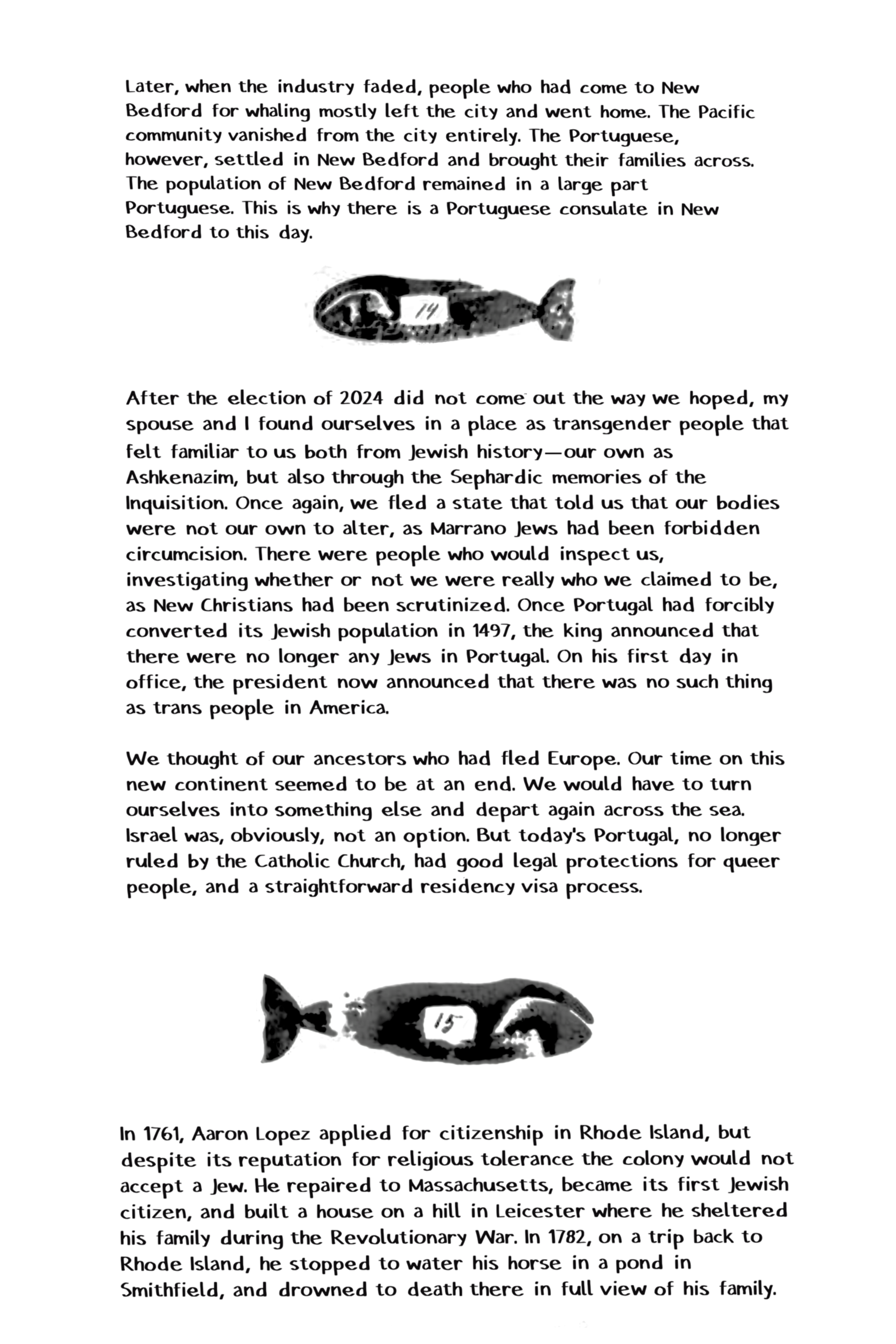
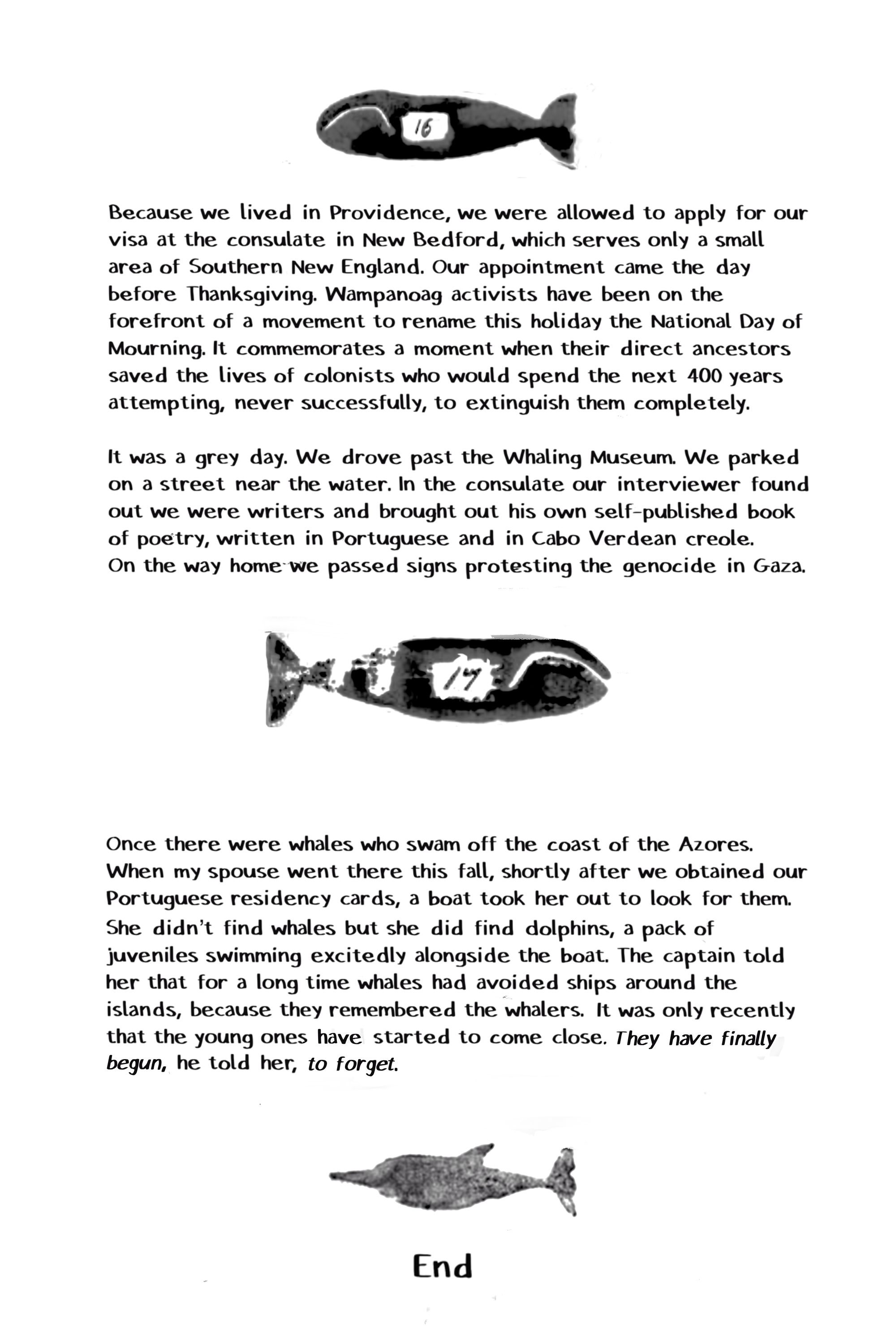
The images of whales used throughout this piece are taken from actual whale stamps used in the logs of whaling vessels, including some said to be probably carved by the Wampanoag whaler Joel G. Jared. 

On the demographics of New Bedford and the whaling industry: 

NEW BEDFORD COMMUNITIES OF WHALING: People of Wampanoag, African, and Portuguese Island Descent, 1825–1925

A Generous Sea: Native Hawaiians, Pacific Islanders, and the Jewish Community in New Bedford Whaling & Whaling Heritage

For an extensively-researched report on Amos Smalley: The Legend of Amos P. Smalley, by Adam Mellion at All Visible Objects

On Melville's use of a Maushop story: Chasing Flukes: “The wondrous traditional story of how this island was settled by the Redman”

For the history of Native involvement in whaling: 

Nancy Shoemaker's books, Native American Whalemen and the World: Indigenous Encounters and Contingencies of Race, and Living with Whales: Documents and Oral Histories of Native New England Whaling History are authoritative. 

Many thanks to Linda Coombs and the Wampanoag communities of Mashpee and Aquinnah. 


Record history in the comments

You found the secret way to generate a gift link