
Music in the Blood
by Maria Bustillos
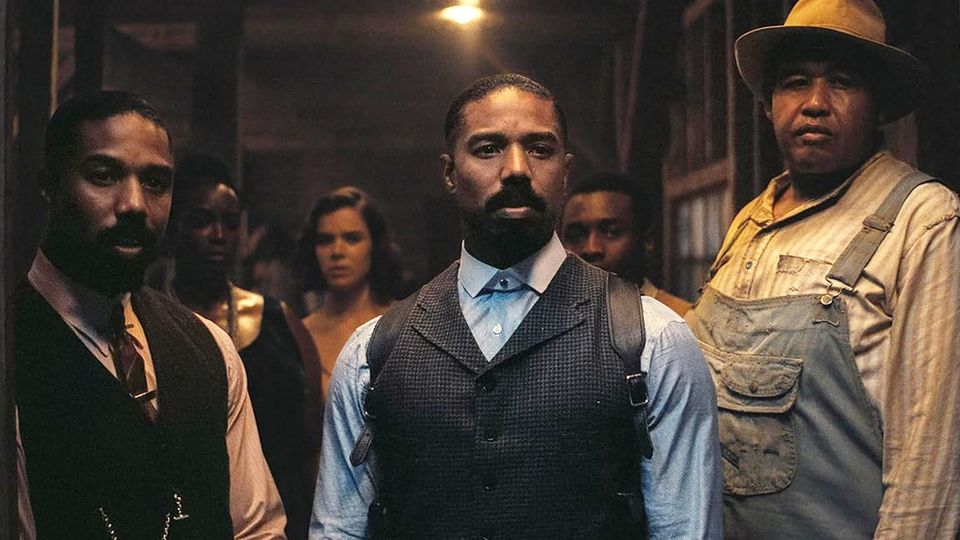
Sinners, the new vampire horror movie directed by Ryan Coogler and starring Michael B. Jordan, opened this weekend to boffo reviews and impressive global box office receipts of $61 million. Coogler’s films have made more than $2.4 billion at the box office, according to Variety, giving him clout enough to get this wild, weird project made from his own original script in the space of little more than a year. Which makes Sinners, among other things, a welcome gift to movie audiences exhausted from the neverending stream of branded trash sequels belching forth out of Hollywood.
Whole lot of SPOILERS below, so look out.
The vampires of Sinners don’t even enter the picture until halfway through, long after the key characters have been introduced and their doom foreshadowed. This is by design, because vampirism here is an allegory of the real world and its corruptions, which few among us become aware of until it is already too late and our own souls have begun to succumb. Maybe nobody can escape some taint of this. Part of you really does die in the getting of status, safety, money, because all money is blood money and our whole world runs on the backs of the poor, of exploited and enslaved people. To some degree any “successful” person is undead for real, has passed beyond the compass of human values.
What you have to do to survive, it’s true, is make some kind of pact with the devil. You may think you’re safe inside the house, you’ve done what you need to outside but inside you’re fine, you’re fine in here, you’re safe, but no. Even if the devil isn’t already inside (he probably is) he is surrounding the whole place outside, quite possibly all of it.
Sinners is about the danger of drinking from America’s poisoned chalice. Who could have foreseen, when production began just one year ago, how that message would explode into this pivotal and terrifying moment in the history of the United States? Like Kendrick Lamar’s electrifying Super Bowl performance in January, Coogler’s new film is a subversive masterpiece of insight, wit, and moral purpose that could only have come into being through the very bloodstream of the system it defies.
The twin brothers at the heart of the story, both played by Michael B. Jordan, have just made a pile in Chicago doing nefarious deeds murkily connected with Al Capone, and returned to their home town of Clarksdale, Mississippi. Both are passionate, ruthless, undeceived men who have learned to make their way in a hard world; each has a poetic side too, sees in himself a protector of his people, of women in particular. And they love their culture, their home, their music; they love the blues. The twins are differentiated according to the chief motivations of each, like yin and yang: Stack, elegant and daring, represents passion, the desire for worldly pleasure, and Smoke—relatively restrained, serious—seeks power, the exercise of will.
They’ve come home to make a deal with a good ol’ boy, a member of the KKK. He sells the brothers a warehouse; they know the danger he represents and conduct their business accordingly. The brothers intend to create something beautiful in this warehouse, something of their own, opening this very night: A juke joint that will make pleasure and money both, a self-created center of their own world, to keep the devil outside and at bay. They are staking their future in part on their young cousin Sammie, a musician of miraculous gifts, played by extraordinary newcomer Miles Caton, who embodies art and its power to conjure love, money, pleasure, power, respect, even immortality.
Now the horror plot is set in motion. Remmick, the Irish vampire leader (a sly, sinister, irresistible Jack O’Connell) arrives, spattered with blood, skin smoking and sorely wounded, on the doorstep of a KKK couple’s shack at sundown; they invite him in (like big idiots who have never seen a vampire movie, because he is obviously angling in an extremely vampire-like manner for such an invitation). Remmick is in flight from a posse of Native American vampire hunters, whose gravity and stoical questioning of the racist lady at the door mark them as uncorrupted, knowledgeable and virtuous inhabitants of this land. But the sun is setting now, they gotta go, sorry, and everyone’s fate is sealed.
Soon Remmick and his vampire gang will set their sights on the souls in the juke joint, drawn by Sammie’s music, which is so supernaturally powerful that the vampires are able to see everyone through the burning walls of the juke joint at the climax of his big number. The vampires of Sinners are musicians as well as monsters, tragic figures full of hunger and cunning. They use different kinds of music to lure their prospective victims, but you can also sense the joy of demonhood in it, a pure, rich ardor for existence itself, the lust of the damned. They are somewhere between Nosferatu and the Lost Boys, vampirewise, aside from the uncanny musical ability, which is derived from their leader, who believes he can use Sammie for his own purposes: “You’re the one that I came for,” Remmick tells Sammie across the threshold.
The music is wildly good in this movie and it too comes with layer upon layer of meaning; here music stands in for all the arts, for the whole history of human passion and suffering transmitted through art. Everyone will tell you about the big montage of Black music in the middle of it and that is amazing, thrilling, already immortal, but my favorite is the vampire Irish dance to “Rocky Road to Dublin,” a fierce, hypnotic song in 9/8 time about a starving, poor and desperate character who is pushed beyond his limits until, at last, his shillellagh he lets fly upon the oppressor.
Remmick is specifically Irish, of a people who long ago assimilated into U.S. life, but still marked by colonial oppression in a way Coogler seems to associate with Black Americans. Smoke, Stack and their people watch in a daze as Remmick shows us how fun it is to enjoy the world’s banquet, corrupt as it is, cannibalistic as it is. What Remmick wants most of all, though, is Sammie. The world’s vampires need art to sweeten their lot, to redeem their lost souls, to show that their sacrifice was worth making. Sammie is a Qianlong vase, a Mizner house, a vintage E-type, a Balthus painting.
Maybe love, passion and craft really can overcome corruption, to some extent.
What are the vampires offering Sammie and the others? They are offering life itself. The things people are hungriest for, passion, lust, sensation, touch, survival, companionship, music, despite the mess of it, despite the cost. Respect and personal liberty, fine threads, fine food and drink, the freedom to travel, to experience. The price is your humanity, the cost is the knowledge that you are accepting, moment by moment, the harm your kind is causing other people.
Is Sinners a dramatization of the struggles of Ryan Coogler, who has risen to the highest rank in his own poisoned profession? He is powerful, feted, and admired, and his film appears to ask whether an an artist must, or even can, hold himself at a moral and aesthetic remove from his milieu, from matters of business, from audiences and media, even from history. Whether the gift can be mastered, rather than overwhelming your life.
Viewed through this prism, the story falls into place. The temptations, the vulgarity and futility of wealth, the vanity and foolishness and deliciousness of “success.” The paradox of Sinners is that it presents an immaculate portrait of the sick condition of artists trying to bring beauty and meaning into a wounded, depraved world—and yet, without question, artists are bringing beauty and meaning into a wounded, depraved world.
If you enjoyed this free post, subscribe or donate to Flaming Hydra and receive incandescent essays, comics, criticism and more from us each weekday.