
Of Men and Palm Oil
by Yemisi Aribisala
In February 2021, Evan Kleiman, a North American chef and radio personality broadcasting from Santa Monica, California, asked me about palm oil. She said “It’s such an intrinsic part of your cuisine, not at all what we think about when we think of palm oil. Explain the difference.” I knew that this question was for the education of an audience who already had their machetes out for the Nigerian who is destroying the environment by eating palm oil.
She understood that there was a global misunderstanding and the corresponding need to clear it up, before people would “really” listen to anything else I was saying. I had been thinking about my answer for a long time before the interview, yet I couldn’t answer the question as eloquently as I had scheduled in my head when it came time to speak.
I wanted to say persuasively: the problem, the real problem is with the unsophisticated global generalisations that the media has led readers to expect. Social media in particular has given readers an insatiable appetite for simplistic memes and slogans. They are the sofa of the mind when there is so much trauma to process.
The media proposal that all palm oil is bad for the earth’s climate is an easy conclusion for the hyperactive mind junk-feeding on headlines to make. But if you don’t know the “small” story of palm oil, the backyard story, if you don’t follow it back home to Nigeria, Ghana, Malaysia, or Indonesia, then you cannot understand palm oil. The real answers are too subtle, or too complicated, or too simple for social media or for the global feed.
The bleached, deodorised thing hidden in the cookies in a British supermarket is not our beloved Nigerian food ingredient. That adulterated, dangerous, reviled thing is in fact the West’s own mysterious derivative product. It is the production of this foreign bleached odourless fat in everything from candles to Oreos that is destroying the most biodiverse forests in South America. Palm trees are being planted in place of rainforests to satiate the cavernous appetite for Northern Hemispherical processed foods.
The palm oil that we eat in Nigeria is not imported from Malaysia or Indonesia (where more than 85 percent of palm oil in the West comes from) or even Ghana next door to us. I’ve read rumours that our trees are beyond hoary, and Malaysia gave us seedlings for replanting…something like that. Nigerians are particularly snobbish about those kinds of importations, or anything that might even to the smallest degree suggest that we cannot grow our own food, our own palm oil of all things.
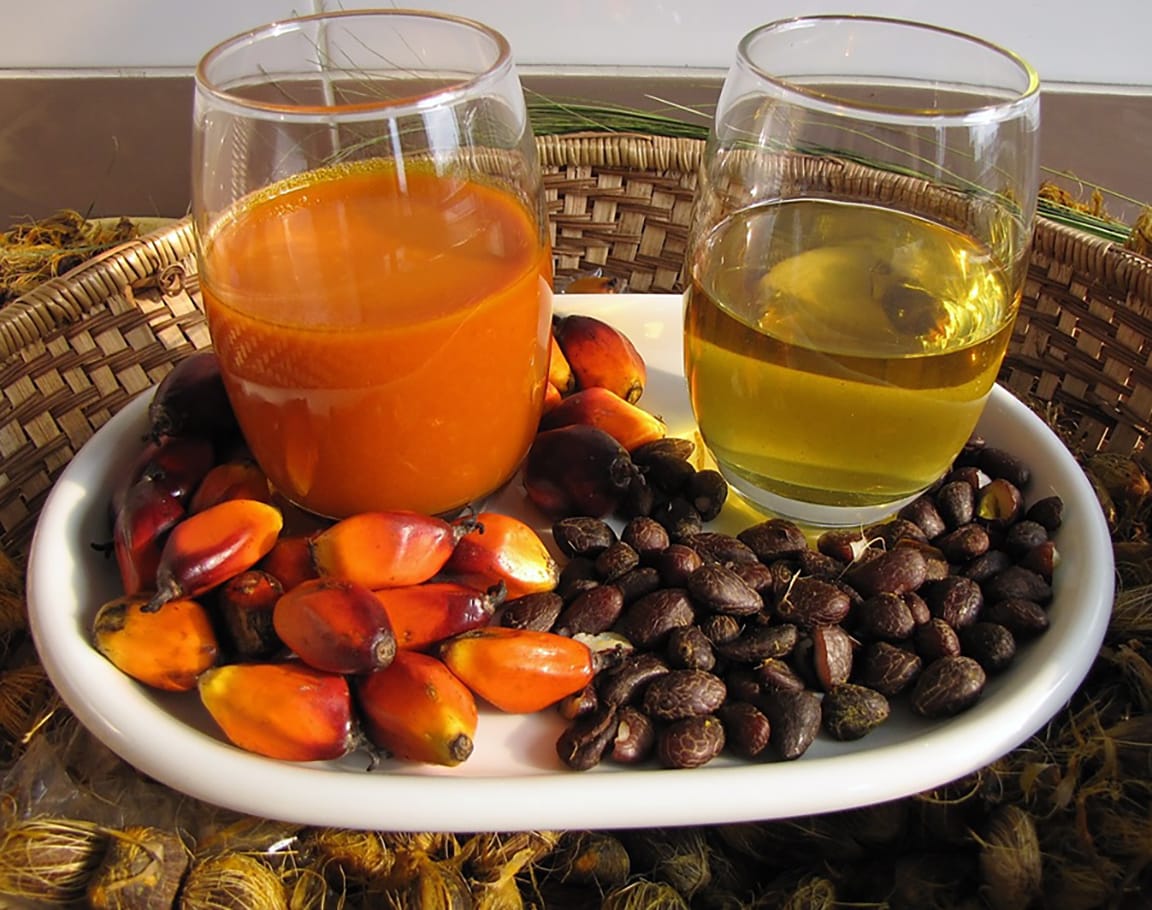
Our Nigerian palm oil is not a gentleman. The end product we want is not perfection or mildness. This idea of odourless, colourless oil is not something that excites the palate of West Coastal Africa. This is a legitimate generalisation. You cannot hide unprocessed palm oil in anything, specifically not in any cookie, cake, or gluten-free bread. It stains dramatically, bellows nuttiness, fattens the soup, and stands its ground, flooding, sinking, rising, insisting on being both at the bottom of the pot and at the face of the soup. This is how we want it. You can’t skimp on it, any more than you would skimp on blood in making a human being.
Europeans tend to despise its weight and insistence in food. They complain about the heaviness of this cloying red powerful fat that won’t know its place. For acceptance in food of the Northern Hemisphere palm oil has to more or less disappear, stripped through processing of its nutritional characteristics. There is no global appetite for the palm oil that Nigerians cook with; it isn’t the stuff that is spurring one of the worst environmental disasters of our time.

That answer, fueled by my own anxieties and irritation, would have been overkill for a simple Los Angeles radio interview. I ended up giving a much-tempered answer to the question of Nigerian palm oil usage because I had to file the Nigerian-ness out of my voice for the sake of not being misunderstood. I had no quarrel with the congenial chef from Santa Monica, nor with her audience. I have a problem with the global misunderstanding leaning in the direction of “Africans” eating palm oil—this was surely the direction in which to shoot, seeing that a food show on KCRW was not the place to bring out my guns and fire them angrily in the air.
.jpg)
I said as placidly as I could that we had to be careful not to confuse personalities, that there is palm oil and there is palm oil. I knew the listener wouldn’t care. The stain of palm oil on the conscience of the world will probably never wash clean.
The tension in my answer came, too, from all kinds of ambivalence to being visible in media, social and otherwise, in the first instance. The longer I remain on Twitter, Facebook and Instagram, the deeper I sink under layers of clichéd one-liners, under sparks of rage and power shows as infuriating as traffic jams.
What on earth would I do without the instant-coffee consciousness of pure evil happening in the world that social media provides—the minute-by-minute opportunity to cry out in pain, to yell out “STOP” at an armed robber running away with a country under his arm—the powerful microphone that can carry my voice instantly across the globe that these platforms provide?
Yet isn’t the unnatural omniscience it brings the cause of chronic head pain? How much trauma is too much for one day? What is the daily word count, the proper dosage of the drug of talking too much, of 24-hour volubility, before the side effects of insanity set in?
An old friend fell asleep in church. I dare not breathe his name. He slept deeply and suddenly woke up in a condition of horror and powerful trepidation. What was the problem? He only admitted it once and when asked subsequently, denied what he had first answered. For one moment, he said, he had been sure he was in hell. He had sprung awake to a level of noise and concluded that he had died without warning and ended up there. The strength of the impression was purely from the volume of sound. The flames sound, the torment sound, the tormentors, those from whose face holes the sounds emanated. The story comforted me in a way that I could not explain.
One’s intentions in joining in social media discussion might be innocent enough. Has anyone ever joined Facebook because they wanted to become an intractable obnoxious thug and arsonist? Yet inevitably the madness creeps up on you and soon enough you catch yourself saying, Africa is this…Men are that…Cancel this…Cancel that…burn her…palm oil is the blood that flows through the canals of hell. The need to fit in wearing the clothing of fashionable generalisations is primal and devious.
The logic or otherwise of a viral hashtag such as #Menaretrash (a recurring hashtag for nearly a decade), the sort of thing that rips around social media for days, is irrelevant. The hashtag is a symbol of protest against the dominance of stupid men over women, an acknowledgement of the global gender imbalances that have crushed women for as long as the world has been in existence. It is a scream of pain and we all will compromise on the fact that screaming in pain is not about lucidity but expression: crucial expression that projects the pain into the air, to be heard, for documentation and expulsion. One does not try to decrypt the screams of mourners. One just acknowledges them as accessories inseparable from the corpse in the room.
Like the public discussion of palm oil, #menaretrash tangles a real concern up into a snarl of falsehoods, truths, and screeching.
My maternal grandmother was such an accurate predictive dreamer from when she was a small child that she had to be locked up and kept away from visitors who came to the house. She would say things to them like, “I saw you in a coffin.” Even when they did end up in a coffin, her people wanted to make sure fingers didn’t point back to what she’d said or seen.
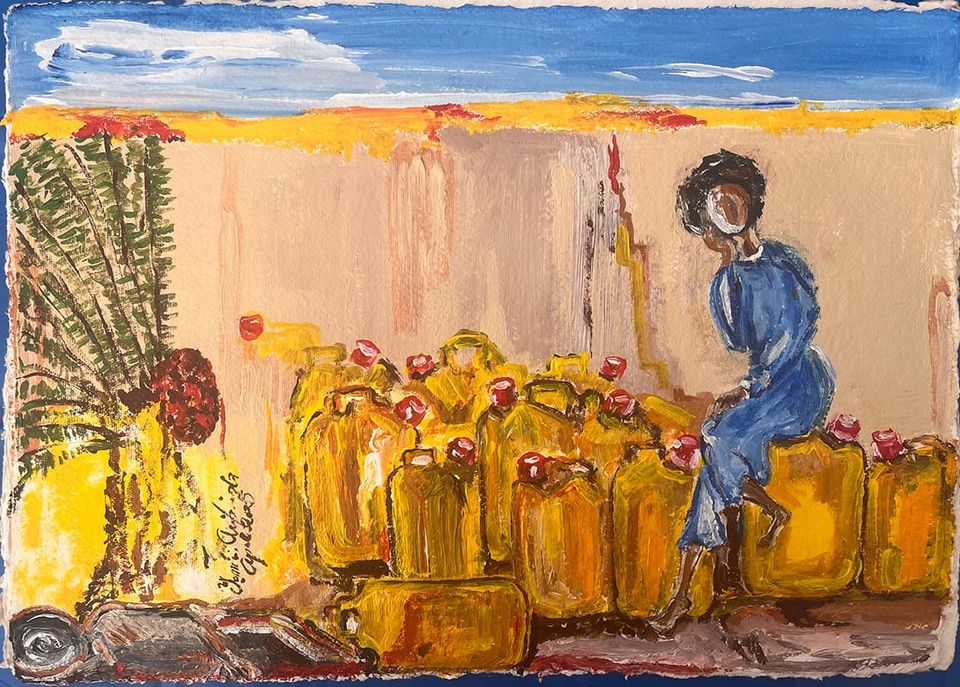
My mother told me that when she was dying, my grandmother had an urgent word for me on her lips. She said, Yemisi’s life is going to be difficult. She said she “saw” me in a run-down house, wretched enough to cause alarm, but there was something else; there were containers of palm oil all over the place, all over the house. Enough, enough to provide solutions to many lifetimes of trauma. I tell this story to complicate the narrative both about palm oil and about the men in my life who are emphatically not trash: men who have been “Ero” (balm) and “Oro” (wealth) to me, like extravagant jerry cans of oil.
In Yoruba, palm oil is mysterious. You wonder which is steeped in which, the language in the oil or the oil in the language. Palm oil is given as an antidote to poison, with the corollary that palm oil cannot be used as poison because it exposes the assassin and refuses to do his will. I have seen enough adulterated Nigerian palm oil to know that this definition must be treated with great reserve, but a mystery remains a mystery. And mysteries allow dark unseen, unexplainable spaces to exist.
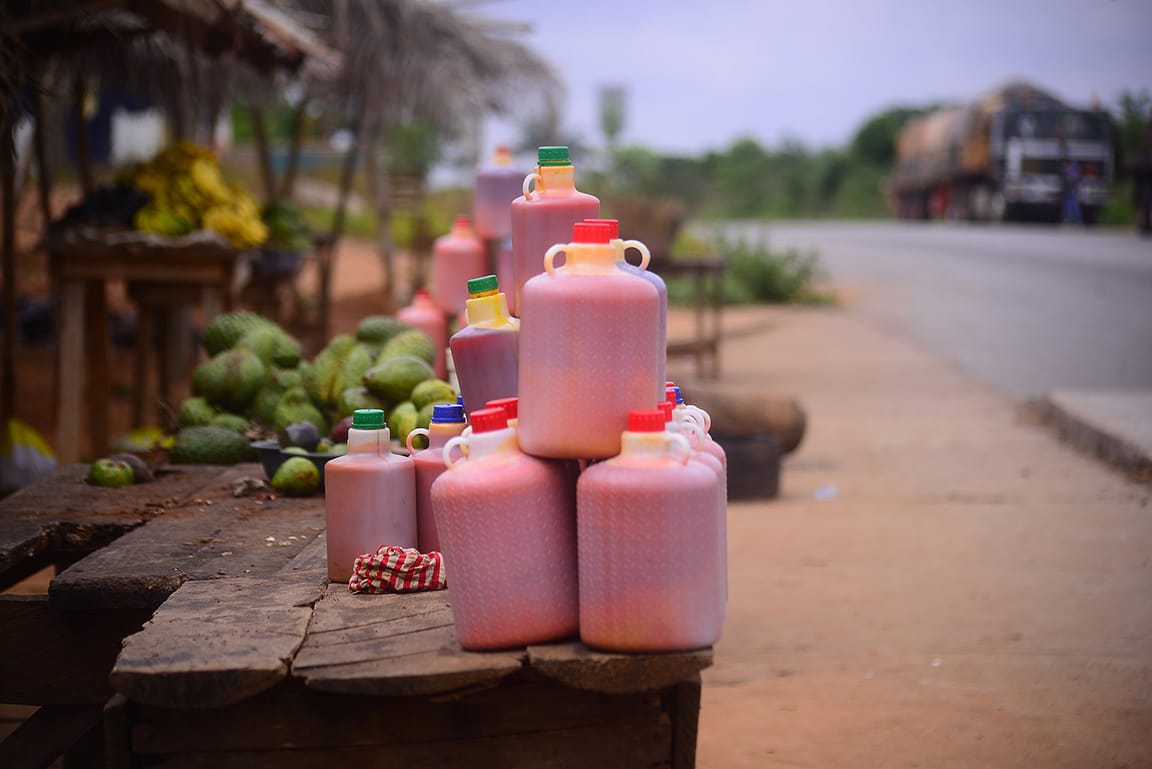
What I know for sure is that Nigerian palm oil often arrives half asleep in the bottle—orange sediment at the bottom, wine on top. You have to shake it, or stand it on its head to get it out. To have all the parts together. When you stand the bottle on its head so that its truth is integrated, manifest, an allegory emerges: the man whose favoritism saved my life is not trash. I have stood on the shoulders of tall men in order to write, and I have also had them stand in front of me, to protect me.
When I was about 8 years old, my grandfather on a visit to the house in Lagos said to me “Whatever you ask me to do for you, I will do it. Whatever it is.” This was no trifling offer. My grandfather was a prizewinning agriculturist with an OBE who gave extravagant gifts. I had no cause to disbelieve the grandness or integrity of the gesture. I left the cheque blank because it was more precious to me than anything I could have filled it in with.
The first ever sexual impropriety in my direction by an adult was from a big-boned beautiful Ghanaian woman with dark hair like a helmet. She asked me for a massage and I said No. Or it was that I was so naive and uncooperative, so slow and haphephobic, she gave up. I have been stomped on by women and pushed to the back of the line by them. I have worked for the worst specimen among them. Submitted my writing to unconscionable women. I have been brought up by some terrifying devious fiction writing ones. I have also been befriended and embraced by many good women. Many whose hearts reach over their heads.
I think this is what the West cannot understand about our palm oil. Condemnation must be unambiguous to be effective. You are never going to throw out the mystery with the colour and aromatics. You can’t clean up the orange clouds and water down the weight and call it palm oil. We say that isn’t palm oil, and our opinion counts. You can’t construct some self-righteous story and point back to us in Nigeria and say that we are destroying the environment. We won’t swallow the accusation nor join the muddying of the waters. And if we are telling harsh truths, the generalisation that all men are trash automatically tarnishes a response of any kind.
What can you answer to small-minded, simplistic falsehoods such as these without falling in the gutter yourself?
Nevertheless I must backtrack slightly in my opinion and say that the hashtag achieves something, something unexplored, something extra: it points back, exposing the personality and the intellect of those who believe such things and propagate them unquestioningly.