
One Small Step
fiction by Sam Thielman
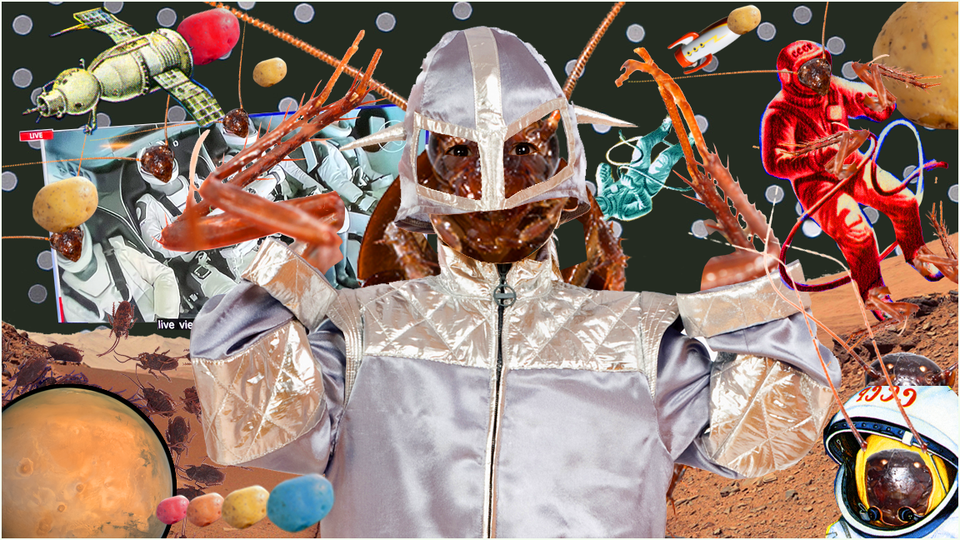
In the surprising study chosen by our editors for the cover of this issue, researchers examined CENTIPAWN, a civilization of superintelligent cockroaches based in disused New York subway tunnels. We believe that these cockroaches discovered interplanetary space flight last year.
We realize this sounds improbable.
During the peer-review process, the panel asked the study’s authors whether they would describe this society as a colony organism or siphonophore like the Portuguese man o’ war jellyfish, and learned that, while this description is not precisely accurate, the new group is able to think as a colony, and after a certain point—that is to say, after enough of them were able to survive unmolested in a single place—the sample colony chose a sophisticated form of governance, resembling human political collectivism, as part of what our authors describe as a larger project across multiple colonies. We are still learning how memory works for this community. But it appears that any new information that furthers the species is reduced to its least complex expression and passed along genetically, so that it becomes a fixed action pattern, like instinct, in the next generation.
In this unusual and rapidly propagating subspecies, neurotransmitter structure might be considered as a sort of Library of Roach Congress. These creatures have a long alphabet, but within it they pride themselves on pith; their word for steak tartare is two letters long, but it contains a fulsome description of the dish including how sweet it should ideally be when it comes fresh out of the kitchen, how long it takes to pass through the digestive system, and what that passage feels like. So far as the arts are concerned, this community is especially devoted to comedy—indeed, researchers often described their translation work as “hilarious,” though few of their jokes survive explanation. You will find a few attempts on page 112.
Collectivism works very well for CENTIPAWN. This may be obvious. The colony under consideration here is not a LENIN (LR) code colony, though we understand that another team of researchers is pursuing the LR hypothesis with a second promising group that has a discernible lineage of individual leaders. In the case of our subjects, it emerged that the number of roaches living in a building in the Sunset Park neighborhood of Brooklyn was large enough to achieve a more complex consciousness, to enjoy it, and to allow it to flourish, albeit with some KROPOTKIN (KR) conditions. We understand that this is a large number of small arthropods to consider and have elected to add a content warning here. It gets much worse. Or better, depending on the strength of your spirit of inquiry.
We have recently relocated our office to a system of caves under a large North American mountain range, which should give you some idea of the gravity of the following. As of press time our organization has begun to assess whether even this precaution will ultimately cut the astrophysical mustard, as it were.
After boiling down a lot of politically complex chitinous chittering and six-legged gamesmanship, the simplest way to describe the current mindset of our subject roaches is to say that they are trying out abstract complexity—morality, ethics, art, literature—to see if they like it. Again, as individuals, they do not think particularly well, so they have to agree generally to partake of higher reasoning since each roach has to carry the additional burden of group cognition atop its various reflexes and appetites and communal responsibilities. These are small German roaches (Blattella germanica), as distinct from the larger, broadly unpopular “waterbug” American cockroach (Periplaneta americana), or the intensely upsetting Madagascar hissing cockroach (Gromphadorhina portentosa), which you’ve likely seen in the movies.
As a species, homo sapiens sapiens aren’t the best standard-bearers for high individual intelligence, given our propensity for rendering our habitats unsurvivable, but we have some cool stuff, or so went the roachly consensus according to the full text of the report (p. 56-108). Roaches lack the will to flourish individually beyond their immediate needs but they evince a frankly laudable dedication to the collective good, hence what we call a Hive-Nest Culture (HNC). Like many urban fauna unfairly maligned as pests, their hardiness cannot be overstated. They can live off almost anything—if you only have books in your apartment, they will happily eat the glue binding the books together. But their HNC resists interpersonal moral rules beyond the primacy and integrity of consensus, and that, we believe, enabled them to examine Soviet social structures, once they’d taught themselves the dominant language of Sunset Park, which is—sometimes—English.
Isaac Householder was a physicist and Marxist activist who refused to leave his apartment building beginning around his fiftieth birthday. Householder, who taught, at least notionally, at Cornell, ordered takeout and read articles on the internet and sent long, rambling emails that might have been poetry and might have been Letters-to-the-Editor-style screeds about the state of the borough of Brooklyn. It appears that partial responsibility for the new Devonian leap of Blatella germanica may be laid at his door.
Householder managed to stay employed for a surprisingly long time; he was casually cruel on social media, allowing him to appear active and politically engaged, and though his syllabi were always vague about class times and meeting hours, he’d respond by email with detailed (extremely, sometimes horrifyingly detailed) critiques of every paper. He was rumored to subsist entirely on egg rolls and duck fried rice, obtained exclusively from a single Thai restaurant in his neighborhood. His increasingly obscure classes were appreciated by his students and peers as a sort of performance art—especially from 2014 to 2017, the last few courses of his career. Eventually, a university-led follow-up investigation into Householder’s death revealed that for three semesters, during classes in 2012 and 2013, he’d sent each student to a different place on a different day with a black or white weather balloon. The report circulated among experts for a while and after a few weeks some bright spark sitting in a Fort Meade cubicle worked out that the balloons spelled out—in English, but using a base-24 system to number the letters for some reason—the word “CENTIPAWN.” Householder was a chess devoté; we initially assumed this was a very elaborate and unfunny joke about size.
Isaac Householder’s key contribution to the interplanetary successes of phylum arthropoda was the development of an automatic email program trained on a large language model based on his past course offerings. The program sent out his assignments and failed one student every semester, as determined by some arcane calculation he wrote himself, in order to maintain his credibility with the students (in which regard said program was an unalloyed success). His notes on papers, which were not written by automation, had grown increasingly gnomic and were often written in languages spoken by nobody at the university. Sometimes he would annotate only one paper, but with notes addressed to the entire class. This turned him into a kind of cult figure; his classes were fully registered within minutes, despite being taught by Householder’s graduate students, whom he tormented the customary amount.
Then, for six semesters beginning in September 2014, Householder’s cryptic commentaries disappeared entirely, replaced with elaborate instructions supplied in every syllabus. International travel was involved; one “field trip” upstate appears to have involved the intricate, confusing sabotage of a radio telescope; a large group of students spent three weeks turning on lights in hotel rooms all around Manhattan at scheduled moments—the students were instructed to synchronize watches—extremely early in the morning. Our researchers are still working to decode that one. A movement took shape on campus to iterate his classroom assignments as many times as possible in order to figure out what he was talking about. When a sophomore slept through a crucial part of one of Householder’s fiddlier assignments, his classmates turned on him so viciously he transferred to Brown.
If Householder—or rather, his computer—hadn’t failed the grade-grubbiest little wannabe-valedictorian who’d ever taken his class, his body might never have been found. He had died in the tub in June of 2014, shortly before teaching his last six classes. A heart attack, of course. His apartment was situated at the extreme rear of his building, and by the time his remains were found, the roaches in our KR subject colony had consumed not merely most of Householder but a great deal of leftover takeout, plus (for at least two values of “consumed”) enormous quantities of high-end Marxist political theory and playscripts from the ’fifties and ’sixties that had been a part of his personal library.
The student who ultimately discovered the body had broken into the apartment in the hope of persuading Householder to change his grade—and if you don’t believe that, you have never taught undergraduates—by climbing up the fire escape. He subsequently screamed blue murder until the fire department came, largely because he’d walked in on one of the nests’ colloquia.
These could be fairly described by a layman as nauseating. Much of the KR group’s abstract communication takes the form of complicated sex acts. By the time anyone thought to call an exterminator, everybody with six legs had fled the apartment and gone up to the roof, reasoning (as they were newly able to do) that humans look for roaches in basements, and thus the colony would likely suffer fewer deaths even considering the cold and vulnerability to pigeon predation on the roof than if their whole nascent society were destroyed by a genocidal madman from the pest control company.
Ultimately the roach society discovered that they could, in groups of 1,200 to 3,500, board subway cars late at night, wend their way through the city, and either spread out or find a safer place to confer and increase and share their new knowledge. In late 2017, they took a vote and decided to send a squadron out to a water treatment plant in New Jersey, where they could quietly reroute a little of the piping back into Manhattan, near the stacks at Columbia University. That way, they could read at night and learn more sophisticated computer programming, having already mastered email. And, of course, they wanted to live off sewage and not really bother anybody and try to be fruitful and multiply.
The most vital thing this little civilization learned as its intelligence increased exponentially with its colony size, and also from absorbing a lot of edgy political writing, is that if you marshal your resources closely, you can usually get away without being noticed by anything that wants to kill you. Roaches think more slowly than people—it took them years, working at top speed and doing almost nothing else, to absorb all of the writing in that one cramped apartment, and they lost a big chunk of their population during the effort. They grew to consider their very survival to be a form of war. They’re only upset by death if the dead don’t pass on the knowledge they’ve compiled to the next generation by mating, but that happens often enough to disturb and frighten them.
They’ve also developed art—the majority of it consists of super-dense, narrative smells, but translated, these have a rich sense of irony—and fifteen distinct religions, all but one of which worship the Sun, which they don’t see very often (the other one, which is similar to humorous atheistic-aesthetic religions like Pastafarianism, worships cats). A full rundown of their religious beliefs can be found beginning on page 130.
They live far below the surface as a result of centuries being stomped on and gassed and poisoned, so the most dangerous part of their subsequent mission was bringing the scaffolding and the capsules they had constructed, all six of them, up into the sewers just under a manhole cover that was due to be vented. The roaches had good weather for a launch in early January, which was their other significant worry—the project nearly destroyed their fledgling economy, which our lead author describes in an interview (p 109) as “like a library but with prostitutes,” and they’d have had to wait a while before trying again if they’d failed. They’d built little accumulators out of chewed and molded paper pulp that the ground crew wore on their backs (these accumulators look like sideways pinwheels) that attract and store methane in a frankly amazing way that one of our editors has chosen to make the focus of his own upcoming research; I don’t understand it, and I have two terminal degrees in chemistry.
This is our last issue. I apologize for any typos but I’m in a hurry to lock up—this is the last piece to go to the printer and if I don’t get out of here in the next few minutes I’ll be in trouble. I don’t want to miss what you should think of as “the bus to our new apartment” although it’s obviously not a bus and the apartment is, dimensionally, a little hard to parse in general terms. Some of you may understand what I’m talking about here, especially if you’re among our readers in a couple of off-the-books labs out in the radioactive parts of Arizona and New Mexico, and you should feel free to come join us with your loved ones as soon as you read this. We believe we are about to see a very significant drop in metrics related to habitability across both hemispheres for reasons I’ll explain below. In fact I’d suggest not actually finishing reading the excellent study herein before you leave, or putting on pants, necessarily.
During the run-up to the launch, the roaches put a few hundred of themselves to work running around in the steam below the streets in Manhattan and blocking off parts of the sewer so that a specific manhole needed maintenance. Eventually, the power company arrived with a big orange-and-white smokestack to stand on top of the manhole. The roaches filled up this tube with some slow-burning chemical substances, put the capsules with their own propellants on top, and set the methane accumulators on fire. The whole thing was not a whole lot different from a big two-stager at Cape Canaveral, albeit smaller. Off it went. The capsules themselves are made out of squishy white fireproof PBI culled from discarded welders’ jackets they found in a cache in the sewer, and also some kevlar. They launched as soon as the stack was in place—all of them fired at once out of the orange-and-white pylon in the middle of Fifth Avenue at around eleven in the morning, except the one that exploded on the launchpad. No one in the press appears to have noticed, though a few people posted video to social media shortly after the fires started. It looked as if the sewer was shooting diapers at a traffic helicopter.
Once the craft reached escape velocity and could jettison their secondary rockets, the best way to describe the resultant spacecraft is what might happen if Sputnik mated with a potato. Each one is only slightly bigger than a softball and, once atmospheric friction is no longer an issue, sports several little black sails about the size of your hand. (Each one also has, by the historical standards of manned spaceflight, a fantastic computer system made of parts from junked iPhones. It’s orders of magnitude more impressive than the Space Shuttle Enterprise from the 1970’s.) We’ve been calling them Spudniks.
At least one potatomobile is now in low earth orbit dodging satellites. There are some breeding pairs inside and the ground crew had laid in several fresh turds for supplies, and the bugs themselves don’t have taboos on things like necrocannibalism, so each capsule sustains itself for quite a long time. We believe another of the capsules will reach Mars later this year, as long as its solar cells hold up. The orbiting pod doesn’t matter much in terms of air traffic, but because of their comparatively very impressive radio transmitters sending back pings every few days, NORAD is convinced they have an alien invasion on their hands. The bugs don’t communicate among themselves in English, and their math is base-6 and not base-10 like ours, so if you don’t know the relevant background above, it probably looks from all available information like we’re being quietly taken over by terrifying lobster beings from a desolate hellscape they’ll do anything to escape.
Which is not too far wrong. It’s just that they’re just between 1.1 and 1.6 centimeters long and mostly want our coffee grounds after we’re done with them.
So that was the good news.
I don’t want to scare anybody, but it’s not totally correct to end here and if there’s one principle to which this journal is committed, it’s the shape of the truth, however weird.
“Centipawn” is a measurement of the value of a chess piece based on its position on the board. A pawn is worth 100 centipawn. A queen is worth 9 pawn. It’s a good way to think about unit value among species, too, if you’re, for example, much smaller than the other dominant animal on a planet. Again, the KR colony has little regard for the worth of the individual, but they are very concerned with the welfare of the species and the world around it.
Obviously, Householder didn’t know about the roaches.
He did know about something much bigger than roaches, we think, now, after having studied a certain amount of roach scholarship informed by roach astronomy and, to our extreme surprise, roach astrobiology. This something is worth, as an individual—and it’s not exactly an individual, it’s more of a collection of perfectly evolved scavengers that form a single brilliant mind and resilient spacefaring body—about 17 billion pawn if a human being is worth 1 centipawn, in strict tactical and intellectual terms. It has 24 separate limbs, or maybe continents would be a better word, which is why Householder was using base-24 to communicate with it. Macro and micro tend to communicate and understand each other better than those of us in the middle; at least that’s one thing we’ve observed in the nonliving physical world. This does not hold true for the biological world, but it does sort of rhyme at convenient moments.
Or inconvenient moments, again, depending on your perspective.
If you move a pawn to the very back of the chess board, you can use it as any other piece; most people choose to make it a queen but really the sky’s the limit.
There were also a lot of books about chess in Householder’s apartment.
If this… thing cared about us even a little we’d probably worship it en masse (but it definitely doesn’t, in fact, best-case scenario, it doesn’t know we exist) and call it a god. It is currently on Mars, which is where the astroach contingent is headed, and is involved in the process of… de-terraforming the planet, as it seems to have done to several other planets in order to lay its eggs. As a spacefaring arthropod, it’s not subject to normal limitations on exoskeleton size enforced by gravity, but it needs a very delicate balance of human-hostile conditions across several planets in order to reproduce, which it is currently in the process of doing. One of our interns called it “terrorforming.” The resultant conditions are perfectly hospitable to common cockroaches, though.
You have to understand, these are creatures whom we as a species have tried our very best to eradicate. There are reams of literature on the subject, most of which this particular colony has probably read by now. We’ve established that they’re both very resilient and don’t value the individual, but humans have shown a willingness to damage ourselves and our surroundings in order to do away with whatever we personally find distasteful, which worries them; it makes sense for them to see this as a high-stakes contest between minds for whom compromise is impossible, and chess is a simple way to think about that. Consider Mars the back of the board in this scenario.
If you want to get the attention of a much larger being, you have to communicate on a much larger scale; you have to write in big letters.
We have studied those last three course descriptions of Householder’s—that is, the ones that were written before his death, before his houseguests ate him and started writing his syllabi, where we found the name CENTIPAWN—and conclude that his students had been helping him to communicate with the Martian (which is what we’re calling it, though it certainly didn’t originate there). The collective brainpower of Householder and his students was able to transmit a single message, which is probably most easily translated as “don’t squish us.” The trick was making it all visible from space.
What the roaches have said to the Martian (via instructions from roach-authored syllabi carried out by the students), we’re not yet sure.
We’re attempting to make contact with their craft, now, using information gleaned from close study and careful translation of roach literature and have asked our cryptography team to work on those course descriptions and classroom assignments. It’s relatively easy to get a message through to the computers on their spaceships—those computers are, after all, mostly made from phones. The KR colony definitely read English, though the concept of direct address from an individual to an individual is something that is difficult for them, in the way that some people can’t say their Rs. We think they understand.
Mostly we’re trying to apologize.
And if they could put in a good word for us, that would be great.
