
Pick Poor Robin Clean
by Rax King
[Spoilers ahead! Like a lot of them. This movie has been out for ages, go see it!!]
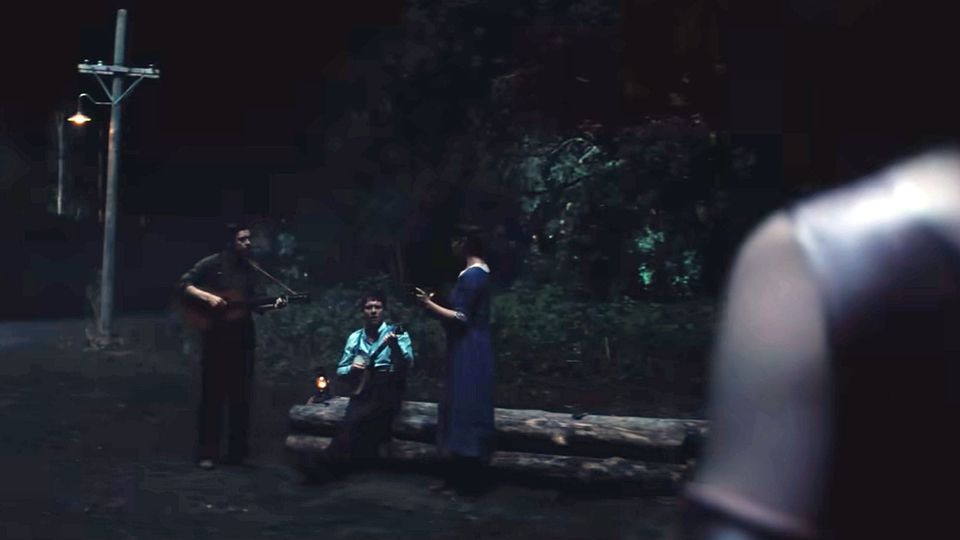
In one of my favorite scenes from Ryan Coogler’s Sinners, three white vampires show up with their instruments at a Black juke joint, wanting to come inside and jam with the blues musicians. (Of course, they also want to come inside so they can suck the blood out of everybody and turn them all into the undead, but they keep that part to themselves.) The club’s owners Smoke and Stack (played by Michael B. Jordan) are doubtful, and ask them to audition, whereupon the vampires play a squeaky-clean rendition of a traditional blues tune called “Pick Poor Robin Clean,” sounding as haplessly whitebread as Pat Boone covering a Little Richard song. Smoke turns them away, even when master vampire Remmick objects that their version was “damn near perfect.”
Both times I saw the film in theaters, the scene got big laughs. In fact, the person sitting next to me started belly-laughing as soon as pasty-white Remmick took out his banjo, an instrument U.S. moviegoers may associate more with Deliverance than with its African roots. Though Smoke and Stack have to acknowledge that the vampires have some chops, their rendition is too tidy and too perfectly synchronized. It’s missing the brassiness, the down-and-out chutzpah, of the real thing. (Interestingly, as Natalie Weiner pointed out in her review, it’s also missing the racial slurs from the earliest known recording, which is by a Black blues singer named Geeshie Wiley.)
Shortly thereafter Mary, a mixed race woman who thinks her light skin will help her connect with the white vampires, goes outside the juke joint to investigate them more closely. When my fellow audience members saw that the vampires were about to start playing music again, a low anticipatory laugh rumbled in the seats around me. But when Mary got close enough to hear them, they were no longer playing too-hygienic covers of old blues songs. Instead, they’re playing an Irish folk tune called “Will Ye Go, Lassie, Go,” in a bewitchingly haunting rendition that visibly mesmerizes Mary.
The laughter trickled to a stop in the theater. Give any fool a month of guitar lessons and he too might turn out a passable rendition of “Pick Poor Robin Clean.” But with his native music, an Irish folk melody, Remmick has ramped up the stakes. All along, we realized with a sinking feeling, he’s had something real to offer.
I call it a “sinking feeling” because this is a vampire movie, which means there are monsters and there are heroes who must defeat the monsters, and the two groups’ interests are diametrically opposed. If the vampires’ Irish folk tunes win the day, according to the genre’s logic, the Black musicians’ delta blues will lose. But in reality, Coogler is making a more exciting case than “blues music good, folk music bad.”
Master vampire Remmick wants to gorge himself on the blood of the blues, yes, but he also wants to infect his monsters with his Irish folk gospel. When he leads his horde of newly turned Black vampires in a dance to the rollicking “Rocky Road to Dublin,” we in the audience may hope that he doesn’t get his hands on our heroes, but there can be no doubt that the villains are having a hell of a party.
It’s a cliché among music lovers that the genres we now call “blues” and “folk” and “country” have all been deep in conversation ever since Black music first met white, long before any of these genres had names or rules. Before the existence of recordings, that conversation was literal: traditional tunes were passed from one player to the next, in Homeric fashion, with each new permutation taking on an extra verse or tinkering with a melodic line, until a single song might have dozens of equally “correct” versions. And in the Jim Crow South, where Black and white people lived in close proximity but under different laws, the musical conversation could get ugly, because musical equality didn’t translate into any other kind.
In the late 1920s, a few years before Sinners takes place, the white A.P. Carter and his Black comrade Lesley Riddle drove all over the Blue Ridge Mountains gathering traditional folk songs. Both men loved these traditional tunes and devoted their lives to playing them, but only the white one, along with his band the Carter Family, will have his name on them forever.
Coogler understands this tension intimately and renders its complexities with care. Vampire movies have to be able to make a case for the monstrous half-life their villains offer, where you’ll never be allowed to see the sun or die, but you will get something irresistible in return. In Sinners the case is easy to make: these white vampires don’t hate you for being Black, they won’t call the cops on you, they love your music, and they want to join you in “fellowship,” a word they’ll repeat to eerie effect more than once. The culture they offer, with its jigs and reels and ballads, is full and thrilling in its own way. Even after turning most of the juke joint’s visitors into monsters, Remmick will still warn the remaining humans that the Klan are after them. His proposal for them may be evil, but in the Jim Crow Delta, avoiding evil is not as simple as merely avoiding the vampires, and staying safe is not as simple as clinging to your humanity.
Early in the movie, an older bluesman named Delta Slim laughs at young Sammie, a Black preacher’s son who wants to play music with him. “I’ve got socks older than this boy,” he says—meaning, what can he possibly know about the blues? The questions Coogler raises here about authenticity aren’t just about Black versus white, though the questions are liveliest along that axis. The blues, in his telling, is about experience. Some musicians have it, either through instinct or knowledge, and some don’t. Some are old enough for it, or downtrodden enough, or weary enough, and others aren’t.
In the film’s post-credits scene starring two of the Black vampires Remmick turned at the juke joint that night, the half-life of the undead doesn’t seem so bad. The vampires still love music; their souls, what’s left of them, are still stirred by the blues.