
Robert Redford, Reporter
by Diana Moskovitz
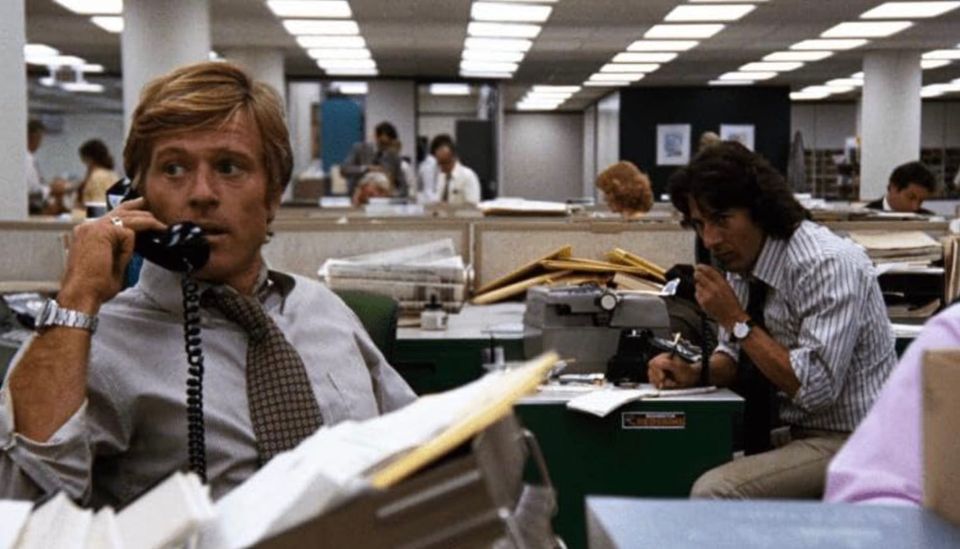
All the President’s Men is widely reckoned to be not just a journalism movie but the story of one of the biggest and most consequential stories ever broken by newspaper reporters in the history of the United States. It gave us the phrase “follow the money” and helped establish a longstanding mythology around The Washington Post and the power of investigative journalism. It helped turn journalism into a profession for “sharp-elbowed, Ivy League white guys.” It made us believe that we too might one day meet a fellow newspaper reporter who looked like Robert Redford.
Okay fine, I made up the last part. But the rest? It’s all true. There is journalism before and after Watergate, and there’s also journalism before and after All the President’s Men.
The dirty secret of this film is that it isn’t so much about traditional journalism as it is about leaking. It’s a classic 1970s post–studio system paranoia-fest that just happens to take place in a newsroom. It’s about having real reasons for suspecting your phone is tapped or your car is being followed or someone is out to get you, set to dramatic music and filmed with long shadows and complex dual-focus shots. Director Alan J. Pakula’s previous film, The Parallax View, is also a classic in the conspiracy-thriller genre. Real-world reporting is rarely that dramatic.
For these and other reasons I’ve struggled to appreciate this movie. But I watched it again recently, partly moved by Redford’s recent death, and partly out of a genuine curiosity to learn whether I would feel differently about it now, in this brave new world where our phones track us, our cars are computers on wheels, and the government, or any random person, really might be recording your conversation.
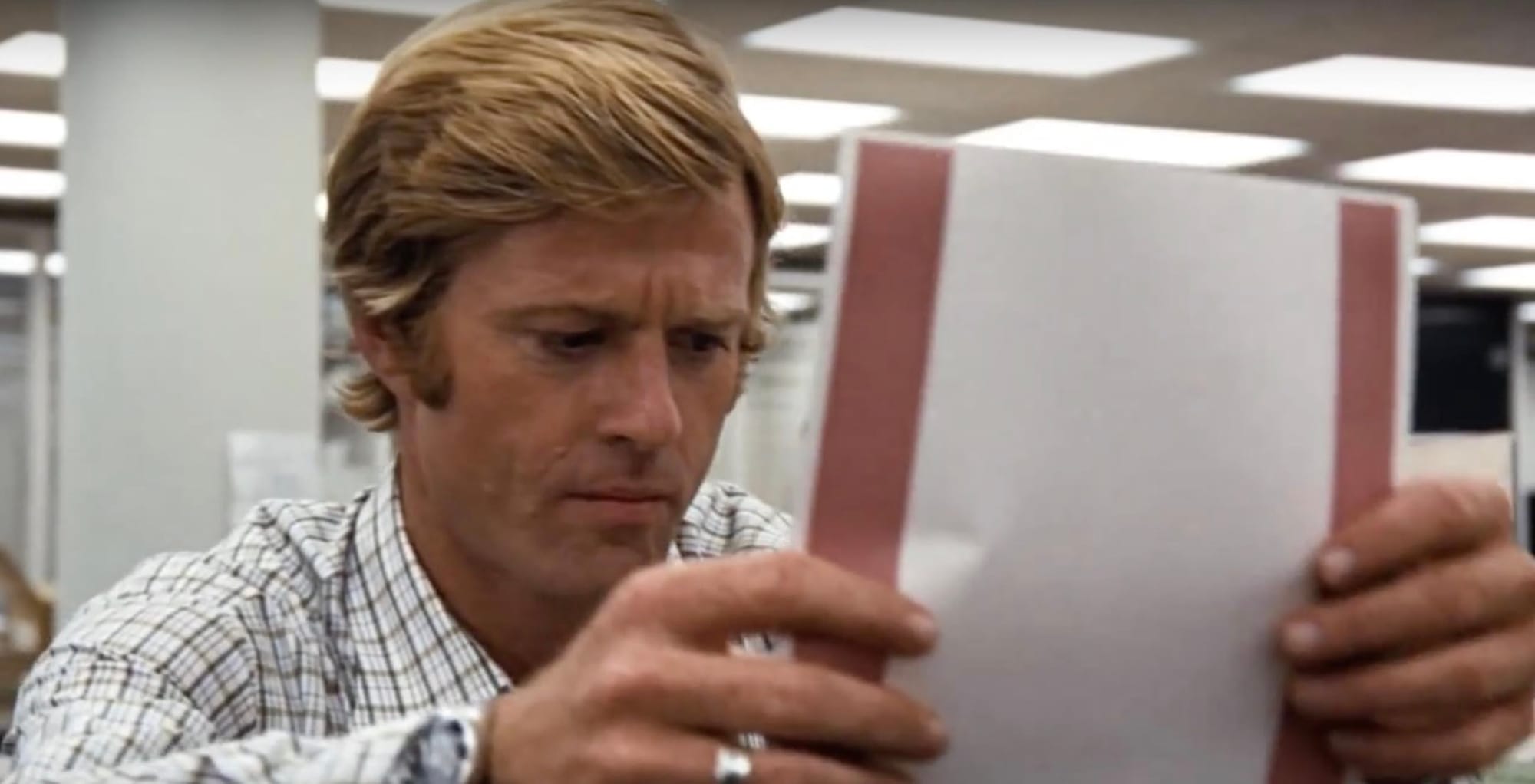
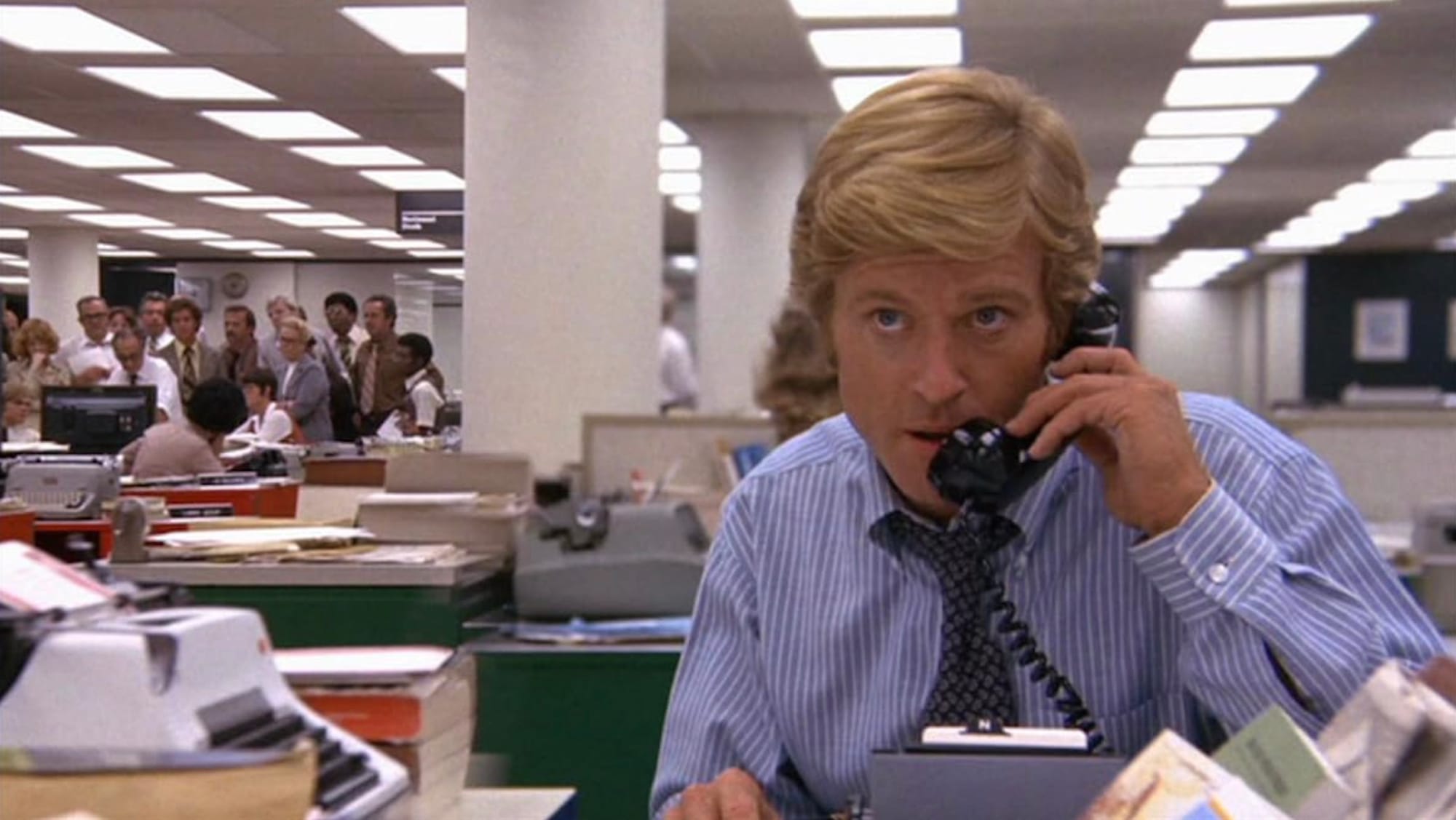
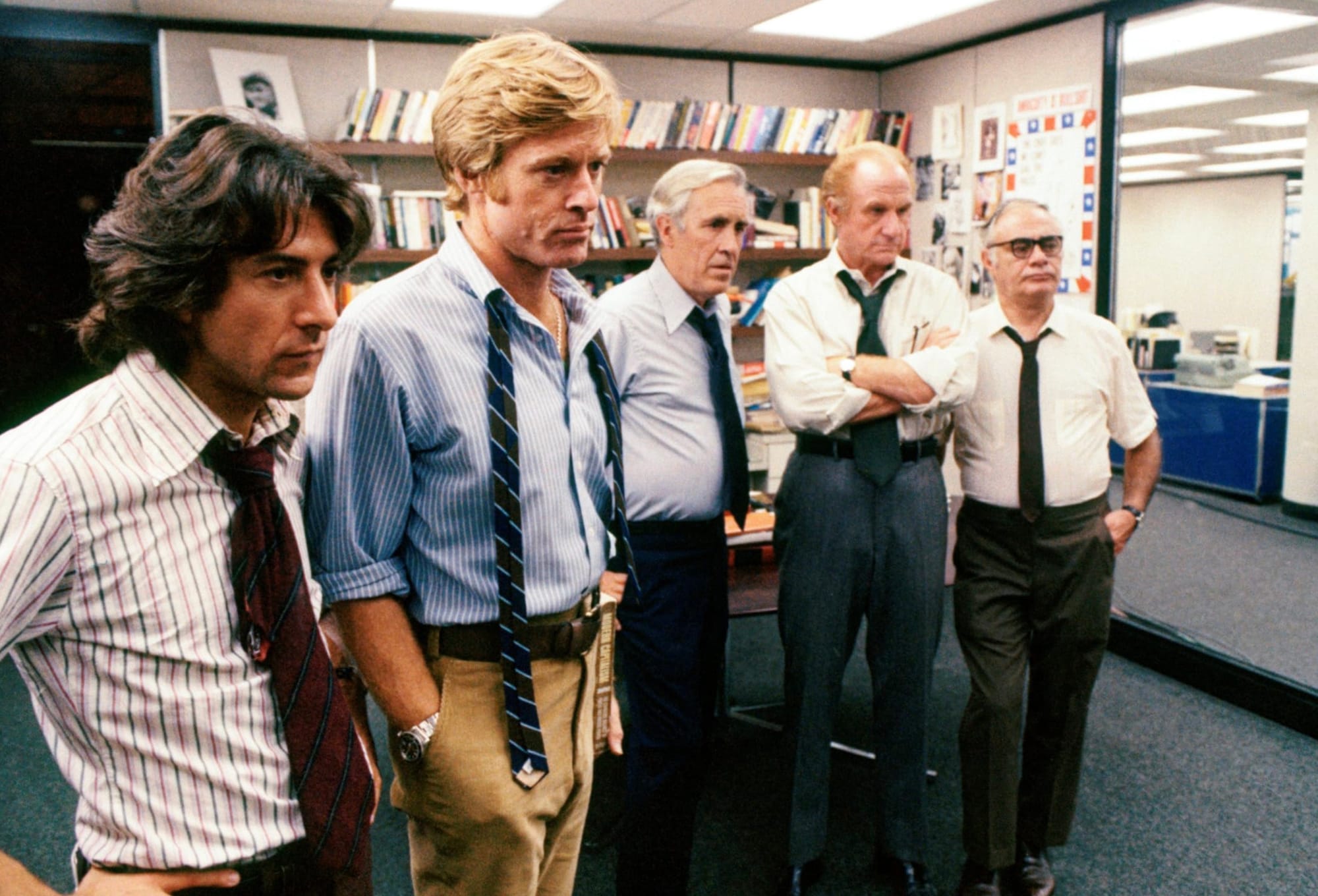
Immediately I found there was more reporting in All the President’s Men than I’d remembered. Our story opens with Bob Woodward (played by Redford) having the bad luck of getting an early-morning assignment to cover the court in which the Watergate burglars are arraigned. Then as now, this is the kind of irritating assignment typically given to a young, low-ranking reporter like Woodward. But when the men have the help of a swanky country-club lawyer, and one of them identifies himself as ex-CIA, Woodward suspects something is up. Pretty soon he is joined by his colleague Carl Bernstein (played by Dustin Hoffman), doing his own reporting and also rewriting Woodward’s, shall we say, less-than-sparkling copy. They work every possible lead, at one point even trawling their way through hundreds of tiny index cards at a local library. What do they have to show for all this? Not much. In reality this is where most reporting concludes, in dead ends and shattered dreams.
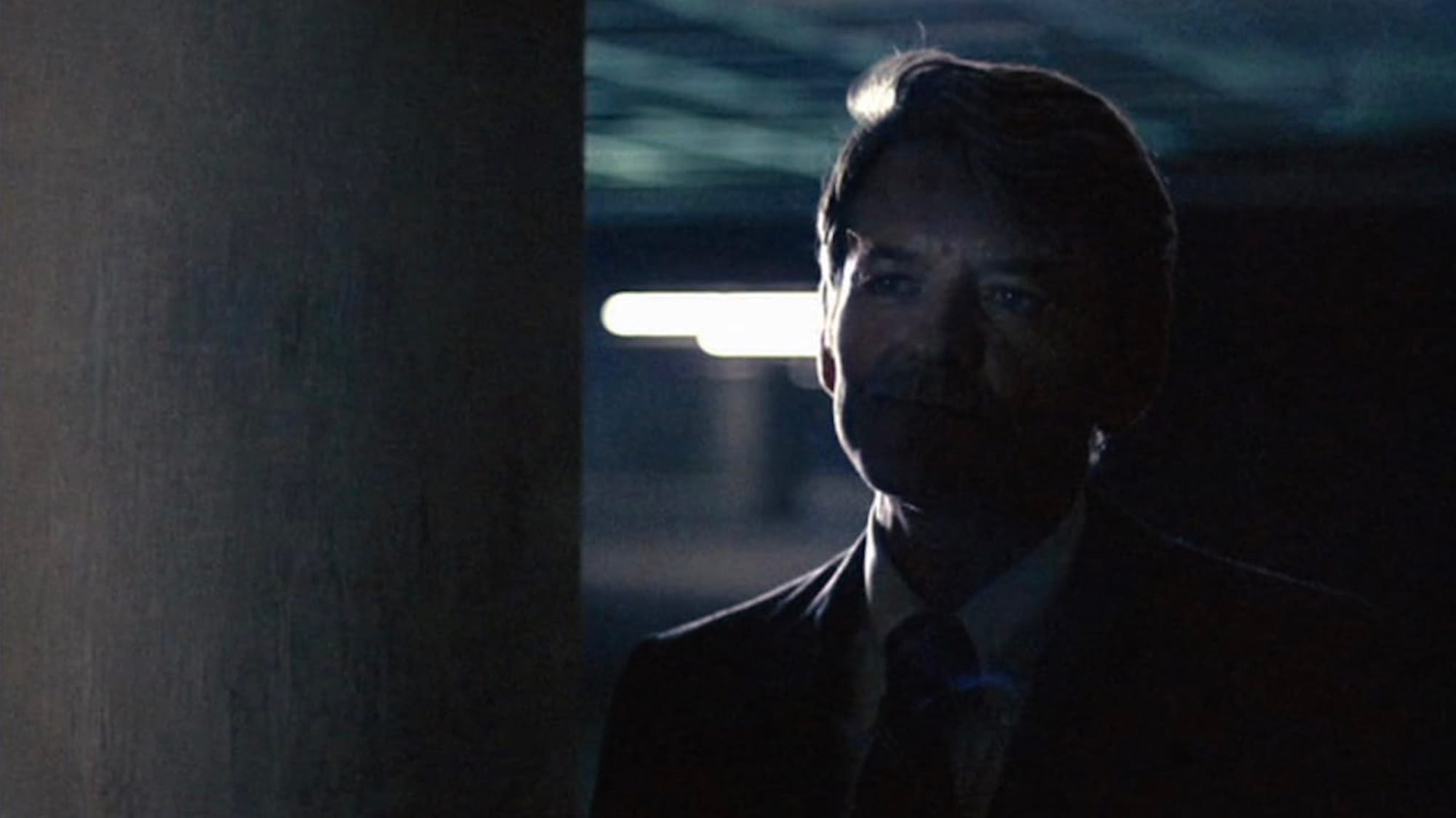
But then Woodward meets with Deep Throat, a highly-placed government source who tells him to follow the money. (The real-life Deep Throat, deputy FBI director Mark Felt, never said that. Real life is rarely as punchy as Hollywood—though the secret Felt successfully kept for 30 years, revealed only at the age of 91 at the behest of his daughter, was admittedly pretty dramatic.)
They keep going because they have to: Woodward and Bernstein might be the only two people on Earth who think there’s a bigger story to be told. (In reality they were championed by their editor—city editor Barry Sussman—whom they eventually and disgracefully threw under the bus, and who doesn’t appear in the movie at all.)
When Woodward and Bernstein finally do prove their case in the movie, what is their reward? The national desk trying to steal their story! Their editor fends off national, but now they must contend with the withering contempt of the paper’s executive editor, Ben Bradlee, who makes it clear that he has high standards for 1A and these two, now dubbed Woodstein, aren’t cutting it.
The somewhat-well-intentioned ball busting, and the less-well-intentioned territorial bickering of a daily newspaper? The movie nails all of it. Is every editor at the Post a white man? Yup, and that was standard at the time. The way Woodward and Bernstein get a lot of help from their female colleagues, who don’t get nearly as much credit? Not exactly shocking, either.
With our great journalism problems resolved—Woodstein are now on the story full-time and answering directly to Bradlee—the movie pivots to a sequence of knocking on people’s doors, people inside saying no, either Bernstein and/or Woodward asking them really nicely a second time and poof all of a sudden cigarettes are smoked, coffee is drunk, and secrets are spilled. When they doubt themselves, poof some more, Deep Throat appears to show them the way. When they get a new tip, poof, Bernstein is on a plane to conduct in-person interviews, no questions asked. When insuperable obstacles arise, poof! Bradlee appears with words of wisdom.
Maybe things were indeed more like this for reporters in the early 1970s, near the end of the golden age of U.S. newspapers, but in the past couple of decades most reporting has involved even more yelling and a lot more failure.
One scene in the film stood out to me glaringly this time. It’s when Bernstein goes to interview Judy Hoback Miller, a bookkeeper for Nixon’s re-election campaign (she goes unnamed in the movie; the screenplay refers to her only as “bookkeeper.”) What surprised me was her obvious fear. Bernstein slithers in by asking her sister to bum a cigarette; Hoback tells him to leave; he sits down, and she insists on telling him nothing. He asks her questions anyway, and all she says in response is, “A lot of people are watching me. They know I know a lot.”
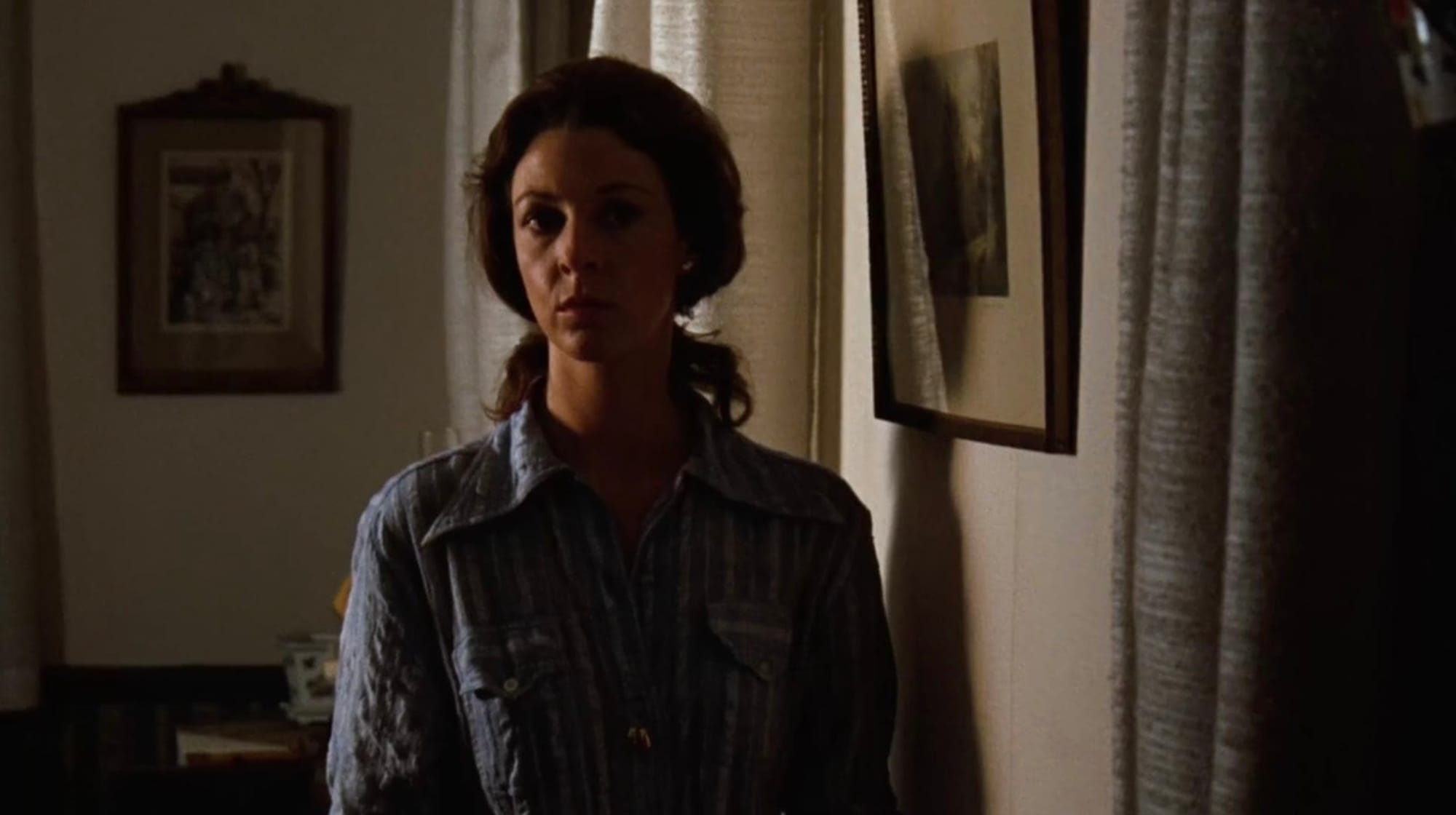
Even when, finally, she starts to give some answers, they’re vague and clipped. She wants to talk, but she also isn’t sure if the risk of talking will result in anything other than her own punishment. The real Woodward and Bernstein would later say she was more important than Deep Throat to breaking their stories.
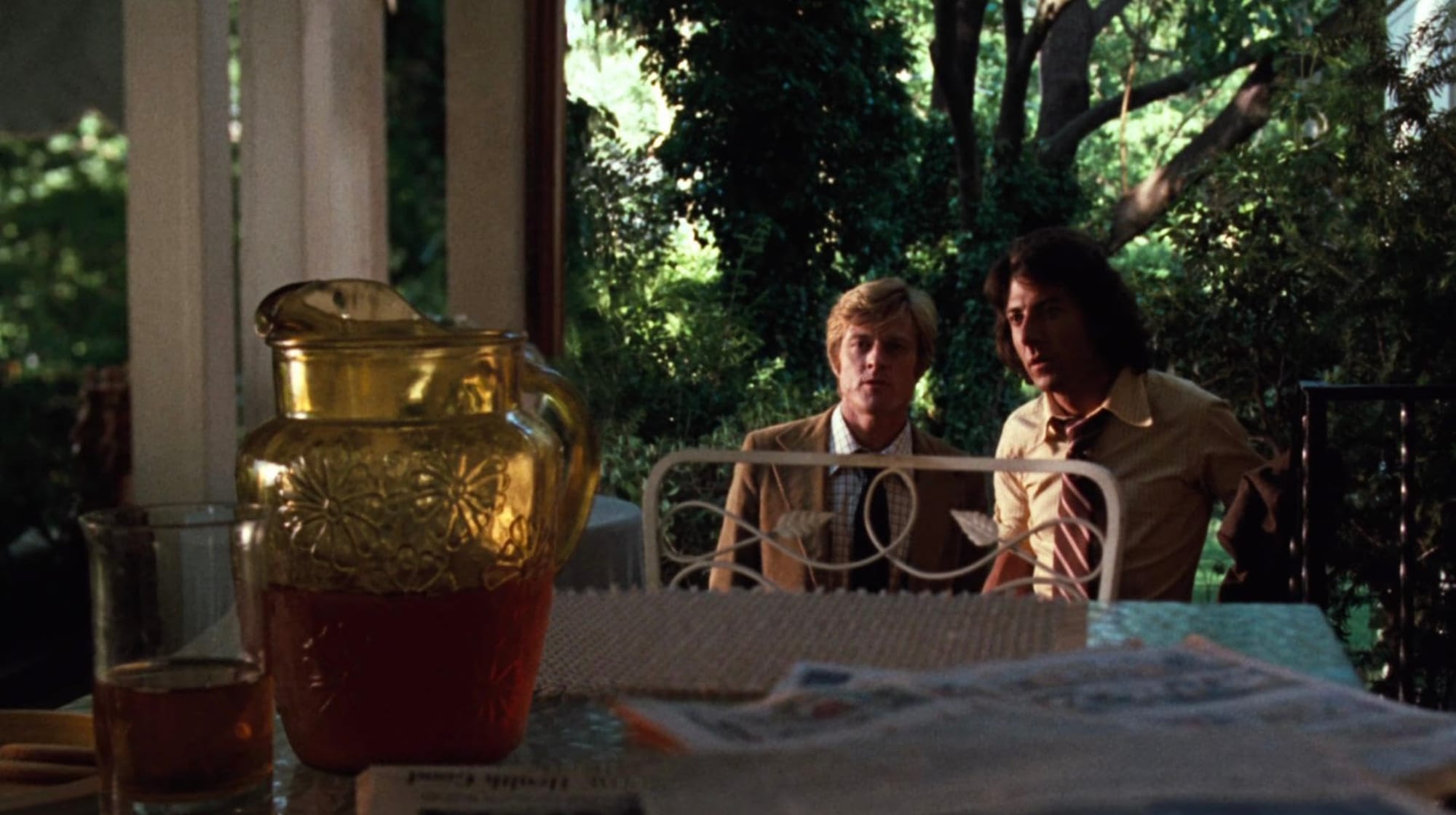
The figure of Judy Hoback Miller reminded me of a lot of people I talk to nowadays; frightened, scared, paranoid. This is one of the trickier aspects of reporting in our current era. You can’t make many promises anymore. You can’t promise a person won’t get doxxed, or that your text messages are always 100 percent secure. A reporter’s privilege applies only to the reporter, not the source. You can’t promise their story will change the world because even when they should, they often don’t. One of the few times I did relate to a reporter in this movie was when Bernstein stood on that porch, trying to say something that would get him inside, while also making sure not to make a promise he couldn’t keep.
All the President’s Men concludes not with Woodward and Bernstein triumphant, but with them realizing their own homes might be bugged. Woodward delivers this news to Bernstein over loud music, typing the message on a typewriter. Oh how quaint, I thought. Today I’m writing this on a web browser clogged with anti-tracking extensions that probably still don’t block everything, sitting by a cell phone that might not be listening in on me, but sure feels like it is, with a TV screen off in the distance that sometimes still asks me for voice commands. Maybe my next refrigerator will have targeted ads!
A fitting end to the movie, reviewed in the year 2025. For the first time I felt like I really understood all its long shadows, suspicious glances, and ominous framings. The big reveal is that we all should be a little paranoid. Someone might be watching you, and there’s almost nothing you can do about it.
p.s. For a more accurate portrayal of the modern daily grind of the reporting process, but one that still ends in the journalists getting a world-changing story, the best movie remains Spotlight.