
Rushing Right Past It
by Yemisi Aribisala
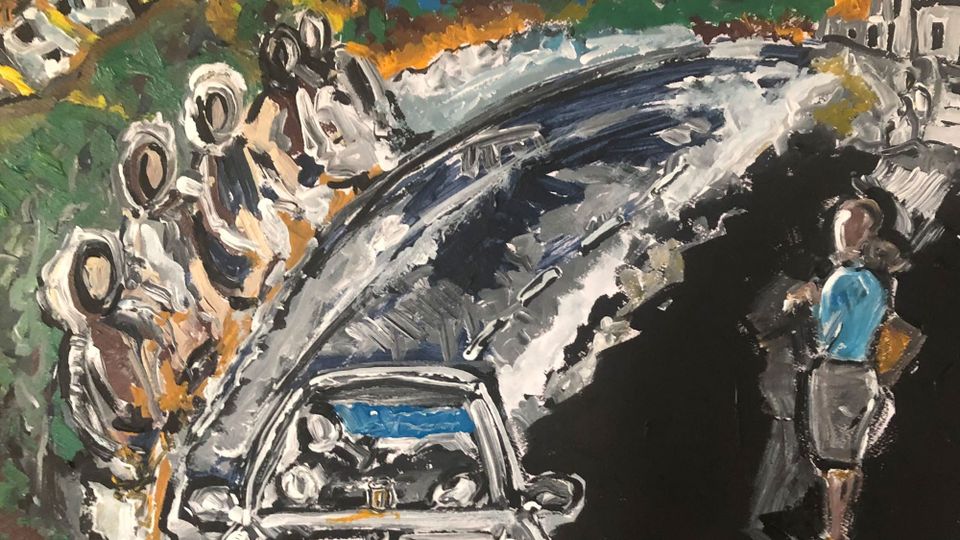
I was in the back of a car going way over the speed limit on the Lagos Benin Expressway, headed in the direction of my secondary school, Federal Government Girls College in Benin City. I attended that school for three years before my parents decided to move me to a school closer to home in Lagos. During that time I would usually fly in a neat one hour on my own on some local airline, but this time I was traveling with a school friend whose parents had provided the sleek fast car and driver. A parent in the car would have forced the driver to go slower but it was just two 11- or 12-year-olds (I cannot remember) who had no say over the actions of the man at the wheel. Though he was obviously a trusted employee, otherwise we would not have been left on our own with him.
Even at that time, over four decades ago, a journey of 321 kilometres could take five or more hours, if one were to run into some obstacle at notorious points such as Ọrẹ̀, a town that served as an informal border between south-western and south-eastern Nigeria. There, one might find a car crash or large potholes in the highway that cars had to slow down to navigate; a toppled trailer with its contents strewn all over the expressway; flooding from rain; a mangled motorcycle that one had to avert one’s eyes from. Something was always amiss at that town aptly nicknamed theatre of war from the time of the Nigerian civil war…or else it was traffic slowed for the sheer exasperation of it.
Once past the town you could nod off, with the hope of sleep ferrying you efficiently to the gates of the school. It was an unexceptional journey with nothing to see along the expressway except trees, thick green bush, and homes that saddened you for no other reason than their solemn aloofness and impenetrable windows.
At some indistinct point in this particular journey, I woke up groggy and dehydrated out of a neck-contorting nap just in time to catch a line of genuflecting bodies flying past on the left-hand side of the car. No, I hadn’t imagined it. I was capable of imagining it but a snap of my head and neck backwards showed the bodies being swallowed up in the thirsty shimmering tarmac behind us, disappearing as swiftly as they had appeared. Sometimes watching the road closely with rays of sun flashing through trees and highway mirages slithering across the melting tarmac could give you a splitting headache. Just a few kilometres ahead, more people appeared with hands held out. Knees bending urgently, lowered heads, as if begging for something. Surely not a ride. Not in the way the bodies were positioned. Not in the tattered clothes caught in the wind draft behind us.
What made these people more dreamlike was their rootedness in defiance to the cars hurtling past at such terrific speed. Trees leaned in obedience, dense green bush shivered, but these people seemed surer in their poses than trees, rising rocks, or undulating highway shoulders. As solid as mirages that had swum from under the car wheels to form statues at the side of the expressway. Someone in a car ahead had thrown something out of a wound-down window in their direction. I thought it was a cigarette stub or trash. It turned out to be crumpled Naira notes, scrunched up for momentum. This I learnt from the driver.
“Are they asking for a lift to somewhere?” I said to him, straightening up to raise my voice above the car radio and the whistling of wind and tyres. The driver was surely going too fast. Part of the reason I had willed myself to sleep was that I hated the repetition of the car radio jingles blaring out at high volume. Chewing kola and loud radio was this driver’s modus operandi for keeping awake.
“No they are lepers,” the driver said abruptly, as if insisting on the instruction we had been given—not to engage the driver when his focus should be on the road.
“Lepers!”
“Yes lepers. There is a colony out here somewhere and the members of the community sometimes come out to the expressway to beg for money. Not sometimes. Often…”
I had heard of leprosy, first from Sunday school and the bible. That book that could sometimes be nonchalant about death and rape and genocide, but could never-ever-ever look away from the devastation of leprosy. Secondly from the 1959 Oscar-encumbered Ben-Hur movie that we had in two-tape-set betamax, in which the progression and the anguish of the disease were highlighted.
I shouldn’t have asked for more from the driver, knowing I wouldn’t be able to leave the matter alone. My parents from an early age had come up with an unsentimental approach for dealing with my sensitivity, not out of hard-heartedness, but rather panic that I would not be able to cope with life as I grew. If I said I was feeling ill, they said Sleep for a while you’ll feel better. Sleep cured most things, they were right about that, but it didn’t cure the sensitivity and the terrible boundaries between other people’s pain and mine. On my 40th birthday a family member who will remain unnamed was saying a prayer for me and brought up the matter of an unclean spirit that was following me around.
This might conceivably have been related to a peculiar phenomenon in my youth, during which mad people seemed to end up chasing me in public. It got to the point where, when I was with my family at the very least, I hoped no one with a mental health condition would turn up. This particular prayer was not answered and at least twice I was with my siblings and my mother when a person obviously out of their normal senses made a beeline for me. One of them hit me over the head with a stick for goodness sake. On a train headed to Wolverhampton in the United Kingdom, I was waylaid in a very direct manner even though I was sitting at a table with other people. In a McDonald’s in Victoria Station I had to flee to the back of the restaurant before the person turned around and left…etc. This prayer about unclean spirits wounded me, however. I opened my eyes and formed words of protest that I had to swallow—you know how these prayer sessions go—if you protest then it is the unclean spirit that has spoken and confirmed you are indeed being followed or worse, possessed. Damned if you do protest. Damned if you don’t.
“Wasn’t a colony meant to care for its residents?” I said. I can’t remember the driver’s response. But I do remember that he wasn’t interested in discussing the people we had just flown past. Not for lack of empathy but because he was familiar with the expressway and had probably driven it dozens of times and had learned to put away that which he had no power to change.
The bending of knees, lowered heads, and outstretched hands were unforgettable, pointing to a loss of dignity so deep and otherworldly it registered in my gut. It is now possible to google this settlement and to identify it as Ossiomo leper settlement at Orhionmwon in Edo State, Nigeria. Whereas in 1983 or 1984 there was no way for me to learn anything at all about this place that we had driven through, so that for many years its ambiguity in and of itself haunted me.
In biblical times, people with leprosy had to ring bells they carried around, announcing at the top of their voices so that others could move away,
“Unclean.”
“Unclean.”
Not in my wildest dreams did I imagine that leprosy could be found in Nigeria. The prayer over an unclean spirit reminded me of those people, who’d had to depend on charity that was moving at a parallel high speed. It was both brilliant and tragic to position yourself in a place where people were going past so quickly they had no danger of contact. And to create an impression that prepared people ahead of time—notes crumpled in preparation, ready to fling out, to escape your world.
I didn’t discuss what I had seen with my family because it would just have reminded them that I had an inability to move on and away as fast as possible like good, sensible Nigerians. The driver and my friend seemed untouched. I felt infected but kept it to myself.
I don’t believe that Nigerians carry a ‘“default nonchalance”’ to shocking and traumatic things and events: that is a simplistic, generalised, and unfair description of a more complicated response. Instead I think we often redefine dignity when the most undignified equations present themselves. This need not be heartlessness or even nonchalance, it might be creativity. Sometimes that redefinition is laughter, sometimes rage, sometimes corruption, sometimes brashness, often sparkling brilliance and innovation, or as I have written elsewhere, a homeless person will claim a place outside your mansion in Lagos as his home and you would not dare contradict him.
We have candles for when PHCN snatches away the electricity on a humid hot evening. Just like an arc to a good story where the point at the end is light no matter how feeble. I only found my arc for that speedy passage past the leper settlement 30 years later, when an old justice of the supreme court in Nigeria put up his mistress, named for a European flower, in a luxurious apartment in Ikoyi, Lagos.
His first wife had died and the old justice had settled his rickety virility on a sophisticated Nigerian woman in her thirties. He had to settle her in a beautifully furnished home that matched her presentation because her family was taken aback that she had decided on the old justice rather than a man closer to her age. They were a prominent family and had spent all this money sending her to school abroad. Then there was a kind of family resignation: if she had chosen a disadvantageous partner with one foot in the grave she must be compensated with money and plane tickets and a beautiful home and the kind of lifestyle that allowed her lavish, hours-long manicures and pedicures and salon visits. Otherwise what was the point of the old man? But there was a problem with the beautiful apartment she was put up in. It did not belong to the old justice, but was a perk he was sometimes allowed to use when he came to Lagos for board meetings; he was the chairman of the company that owned the apartment. And the company had spared no cost in creating an environment they were sure would make every guest, whether Nigerian or expatriate, feel exquisitely comfortable and pampered.
The Nigerian woman named for a foreign flower pushed roots down in this apartment where there was constant everything—electricity, water, chefs, gardeners, houseboys and housegirls, groceries, everything paid for by the company that owned the apartment. She refused to leave and was in fact encouraged by the old justice to stay. He paid her visits there, leaving his own residence for what he considered more respectable and Christian entertaining.
The company wanted its apartment back but wasn’t able to ask the old justice for it, either directly or indirectly. The old justice’s body language indicated there would be drama, and offence taken, if he were to be asked to remove his girlfriend from the guesthouse. This would be an insult the company would pay for. There were obviously some significant legal strings the old justice was pulling on the company’s behalf that warranted a diplomatic and original solution to the problem.
The company turned to an unregistered organisation in Lagos with expertise in persuading stubborn tenants to vacate a property when the landlord had tried absolutely everything up to and including removing the roof of the house.
This organisation was made up of people with leprosy and the narrative arc consisted in paying them to seat a few of its members on the front porch of the house in question, or sidle up to the stubborn tenant when she was coming home from her mani-pedi. Not touch her but get close enough. Greet her and smile at her. Show some missing fingers or teeth. Offer to carry her shopping bags. Say some passive aggressive prayers for her health as she comes down the stairs leading to the front door. Turn up first thing in the morning and just around the time she is coming back from midweek church service at night. Pull back if she becomes hysterical but offer a flaky hand if she should collapse from shock and needs help standing up.
The group charged handsomely even if there was no guarantee that the workers were paid well. They were paid something and it wasn’t scrunched up and thrown out the window. Their families considered them useful and respected the income they provided even if they had to live far away. They could perhaps leave something to their children. They could afford necessary drugs and painkillers and ice cream. They could buy clothes and a television. Pay for cable. Watch other people’s misfortunes for entertainment if they wished. The world slowed down and saw and listened. Slowed down enough to register fear. The kind of fear that in a unique trajectory turns to something like power.

If you liked this free article from Flaming Hydra, why not subscribe?
Enjoy quality media. Support the journalist-owned press.