
Taking the Measure of Philip Bump
by Maria Bustillos

Philip Bump’s column was one of the main reasons I’ve kept subscribing to the Washington Post, even as the paper has continued its depressing slide into capitulation to the Trump administration. But a few days ago, Bump was offered, and took, a buyout; his final column appeared on July 17th. This news came as a ghastly shock to many who, like me, had long viewed his steady presence at the Post as a reminder that there are still cool and professional journalists working at the few national papers still standing.
A data journalist with a tech background—he once worked as a designer for Adobe Systems—Bump drew attention to political issues in a distinctively droll and comradely way. Like the time he published a chart showing the sudden surge of Trump’s weird signoff phrase, “Thank you for your attention to this matter!”
“[Trump]’s used this formulation sporadically over the years, but has really ramped it up in recent months,” Bump wrote. “Last month, for example, he used it on 17 occasions, up from 14 in May and 14 over the three months before that.”
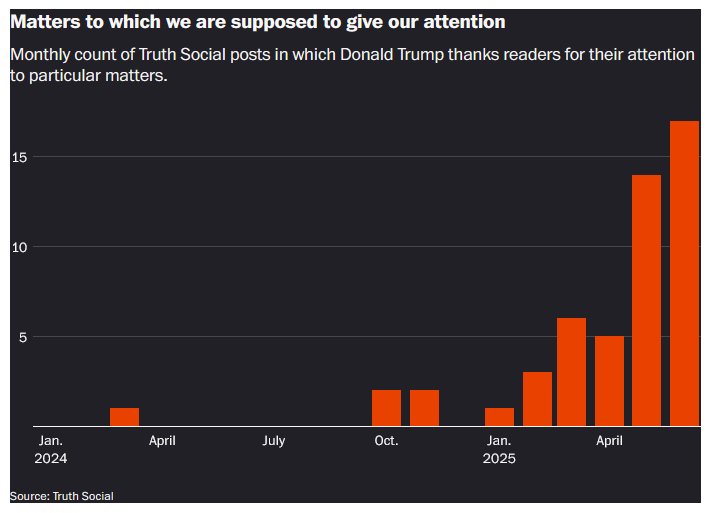
“In other words,” he concluded dryly, “the rate at which we are meant to be giving different matters our attention is increasing.”
“I will read the news and think ‘Oh, I wonder what the numbers are behind that,’” Bump once told a student journalist at NYU. He compiles his own data from a myriad of sources, and has said that he considers even social media an integral tool.
“If someone sends me ‘You’ve got this thing wrong.’ Like yeah, tell me. Help me figure out what happened.”
Trustworthy news is hard to come by in times of political upheaval, and the rising tide of AI slop behooves everyone to consider the sourcing, verification and sharing of news ever more urgently. Bump’s methods provide receipts and lines of thought and calculation that are clear and traceable.
I spoke with him about his newsgathering techniques, focusing especially on those that lay readers can use for “doing their own research.”
Our conversation has been edited for brevity and clarity.
Maria Bustillos: The Internet Archive offers an enormous trove of resources, to writers and researchers in particular. You’re one of the only journalists I’ve seen who makes frequent and impressive use of GDELT (the Global Database of Events, Language, and Tone, a valuable tool that people should know about: it’s a sleepless eye on global news that “monitors print, broadcast, and web news media in over 100 languages... to keep continually updated on breaking developments anywhere on the planet. Its historical archives stretch back to January 1, 1979 and update every 15 minutes.”)
So maybe you could just tell me about how you found GDELT, your history with it.
Philip Bump: I’ve been using it long enough that the origin story’s sort of been lost. I likely was pointed at it by folks at the Internet Archive, Roger McDonald [founder of the TV News Archive], for example—he probably gave me a heads-up on it.
The Internet Archive’s closed captioning database is itself a remarkable tool. Between that and GDELT analysis—they use the same pool of data in different ways, and you can use them for different things.
Basically the Internet Archive has a TV setup in San Francisco, and they are playing cable news all day; they just pull the closed caption feed that comes off the cable news and they throw that in a database, and they throw clips of the video in too. And this is a really, really useful tool, because it allows you to see what people are talking about on cable news, which is something that drives a lot of the conversation.
The search tool’s clunky and not super easy to use, but you can search, for example, mentions of Donald Trump, and you can see the 18 bajillion results that are returned for that. Or if this morning someone talked about inciting a revolution on Fox & Friends, you can go to the Internet Archive, limit the date to today and search for “revolution,” and it’ll pop up this Fox & Friends clip. And you can play it, you can watch it, and you can extract the actual quote. It’s a really good real-time tool for being able to quote what was said on television. I use it a lot for that purpose, when something breaks in the news and something noteworthy is said, and I need an exact quote.
Again, the search interface is kind of clunky; you have all these knobs and switches, and you’re like, “What on earth does this do?” As you get attuned to it you’re like, “Oh, this allows me to do a lot of stuff.” It doesn’t quite work as easily as you might expect, but still it’s very powerful.
Then there’s GDELT—a tool that allows you to track use over time—which is very, very useful. It breaks up the closed captioning into 15-second chunks, and counts how many times a given term appears in those 15 seconds.
If someone has said the word “dog” three times within fifteen minutes on cable news, GDELT can tell you that. It’s sort of an imperfect measure of how often something’s being talked about, but it does allow you to see, particularly on a day-by-day or a month-by month-basis, a credible estimate of the extent to which a term is being brought up on particular cable news stations.
Before the 2022 election, for example, GDELT allowed me to go back and see, okay, well how much are the major cable news channels really talking about crime? And I noticed that as the election approached, Fox News saw this huge surge in talk of crime—obviously, because they’re trying to influence voters, and make them think that crime’s this giant problem. And so I wrote about that, which triggered this whole back and forth with me and Fox News. That was only possible because GDELT allowed me to see how often these networks were talking about crime, and then do a comparison over time.
It’s very difficult to get lay readers to understand how revolutionary that is, and what the receipts actually mean.
Yeah, I think that’s true. Look, I have mixed feelings on the internet’s allowing people to parse large amounts of data, because that also means that people can go through big sets of data and cherry-pick the arguments they want to make. We saw this with the Twitter Files, we saw it with QAnon. Anyone can just go searching for things that support their narrative. We see this with all these different things where people just go searching for something that supports their narrative and then present it to the world. And there’s a great article that I come back to over and over and over again by Lawrence Lessig back in 2009, called “Against Transparency,” which really anticipated this problem.
That said, this particular tool does allow you to pick out information that otherwise would be inaccessible, or would mandate that you be like one of these poor Media Matters people who have to sit there and watch Fox News every night. God bless them. It allows you to get a sense of what a large chunk of the United States is consuming, and to share that with people.
At a time when AI is being trumpeted everywhere, bulletproof receipts are critical. What you’re saying about a verbatim quote—this kind of rigor is going to become increasingly important, to show that we know for a fact where something came from, and who wrote it.
I fear we’re at risk of losing that kind of rigor, of readers losing respect for what it means to the quality of the information they’re getting. But it’s really boring for people to look at bunches of numbers, to do detailed analysis, to make it interesting to fully understand that this happened on that day, and this happened on the next… though that is our big job.
Speak for yourself. Maybe you think it’s boring. I love it, man. You’re right…
I mean, look, I think the challenge isn’t that we lose rigor. I think the challenge is that rigor gets drowned out. That the people who stop and take the time—that still exists, there still will be people who do that—academics, real journalists, et cetera. But the problem is that “the lie is halfway around the world before the truth gets its boots on.”
So these are great tools for ensuring that sort of rigor, to enable you to do that sort of analysis. But that doesn’t solve by itself the problem of people acting in bad faith.
So what’s your prescription for addressing that, for us, as journalists?

Oh my God. I mean, I am very content to be in a place where I admit I have no idea how journalism moves forward. I don’t. I wrote a piece for Nieman Lab arguing that we need to do a better job of defending ourselves in presenting the work that we do, and having people understand it. But I don’t know that there is a solution. You can’t turn off the internet. The bell has been rung for a long time now, and I don’t know.
Unless we can somehow instill in people a sense of obligation to others that isn’t driven by interest in social media clout… I don’t know what that looks like.