
The Gendered Madness of Language
by Kọ́lá Túbọ̀sún
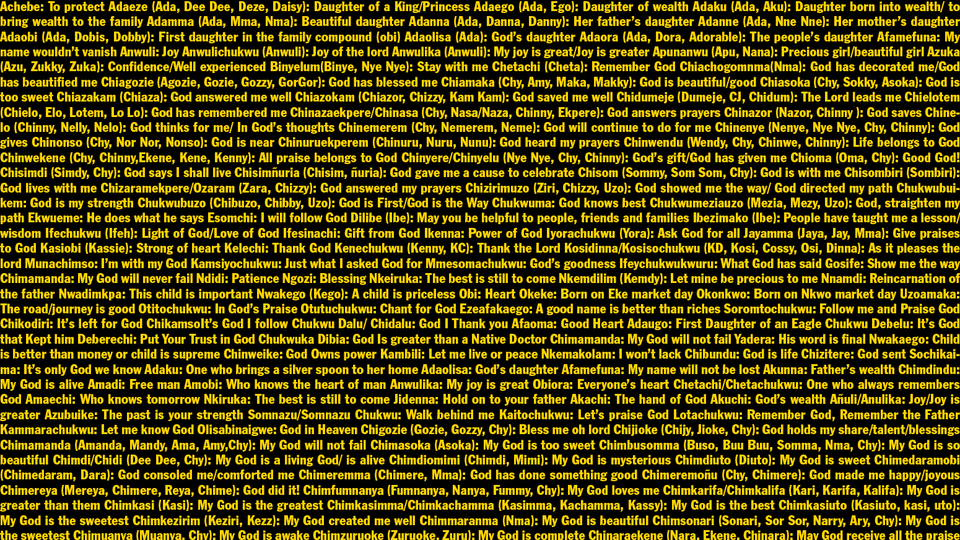
I have just replied to an email from a colleague whose gender I did not know. Her name, Olúbùnmi, is ambiguous. It's a Yorùbá name meaning “God gave him/her to me.”
The gender is implied because Yorùbá names aren't inherently gendered. In fact, Yorùbá is notorious for having no single word for the gendered form of “sibling,” e.g. “brother” or “sister”. The filial part, yes, or the age differential, but not the gender. In Yorùbá, “So-and-so is my ẹ̀gbọ́n” (elder sibling) or “So-and-so is my àbúrò” (a younger sibling) are more common expressions than “So-and-so is my female-sibling.”
So “sister,” as one-word equivalent, doesn’t exist in the language.
Native speakers of a language take such forms and conventions for granted. In more modern conversations, especially when Twitter became a thing in the early 2010s, the uniqueness of Yorùbá became an interesting topic of conversation among young Nigerians sharing their language’s particular features in the discourse around gender then in vogue.
Some would have us believe that pronouns are a modern invention to excuse (or, as they say, encourage) gender dysphoria. Not, as most Yorùbá people conceive of them, a way to describe a person whose gender you don’t know, or couldn’t otherwise refer to because of the peculiarities of our language.
To refer to an elder in Yorùbá, you say “ẹ” which is the same pronoun used for plenteous materials. In other words, “they.” It’s as if we assume inherently that elders in their individual capacity are more than one person. The honorific “ẹ” accompanies every reference to an elderly, or formal, acquaintance. Ẹ jọ̀ọ́ (please), when addressing my mother; and “jọ̀ọ́” when I’m addressing my son. “Kí ni wọ́n fẹ́?” What do they want? Even when “they” is the neighbour, a woman in her fifties who had come to borrow a pinch of salt. Even the non-honorific version is genderless: kí ni ó fẹ́?
When I’m translating a book into English where the phrase exists, I might use an English pronoun, for clarity—“What does he want?” or “What does she want?” But the Yorùbá reader would know that the pronoun ó in the source material has no gender. The gender has to be derived from context.
In literary translation, this quirk is not always pleasant to deal with. My Yorùbá competence ran into a real-life challenge when in December 2019, I translated a short story by Nigerian novelist Chimamanda Adichie, whose story “The Shivering” is about a distraught Nigerian woman who has fallen in love with a Nigerian man she met on a New England campus. At the story’s crescendo, in which a big secret is revealed, there was a lot of back and forth between the two characters, which required pronouns to express reported speech. He said… She replied. He said… She said…
In Yorùbá, that was a nightmare.
Keep us breathing fire!







For $3/month you can read this whole post and get our weekdaily newsletter too!