
The Naira Redrawn
by Yemisi Aribisala
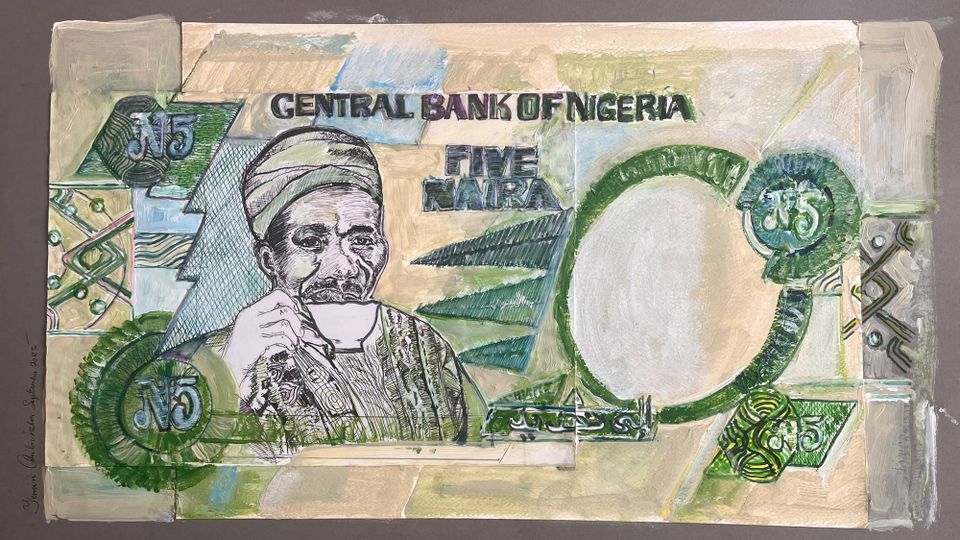
إلى تجديد
(trans. 'iilaa tajdid: “to renew”)
It’s noteworthy that we’ve never had a Nigerian woman—dead or alive—on front face of the Nigerian legal tender, on the Naira note; there’s been only one woman historical figure on our legal tender, that is Ladi Kwali the potter, on the back of the 20 Naira note. Nigerians, in the first instance, don’t have a say or veto on whose image will appear on our currency. Not like the British public, for example, who are consulted on possible banknote themes, with the proviso that the British monarch will feature on all notes, whatever the chosen theme. The Nigerian government has forgotten that the Naira belongs to us: to the woman on the street, and especially to the almost-obliterated Nigerian middle class, who are toiling for and exchanging the physical note every day. The Carnegie Endowment reported in 2024 that the economy’s informal sector accounts for 65 percent of Nigeria’s GDP and 93 percent of employment, and that 90 percent of transactions in the informal economy are in cash.
In 2022, the Central Bank of Nigeria declared that there was a scarcity of Naira because politicians were hoarding it. It was under their beds and in secret vaults, and buried in the village, yet still the Naira remains more ours than theirs, more legitimately the possession of those who are passing it from hand to hand than of those who keep it in the bank and spend it via plastic.
The Naira replaced the British pound sterling in January 1973, and for 52 years, we’ve showcased exclusively, on the front of each note, dead politicians and distinguished statesmen. Money should connect with our aspirations: we break our backs to earn it. It should feature historical details and people but also people familiar and contemporary to the spenders, whom they know and admire. It really shouldn’t feature the same faces for 52 years. Perhaps people in the arts like veteran filmmaker Tunde Kelani, or Nigerian playwright and dramatist Nwazuluwa Onuekwuke “Zulu” Sofola. Or historically significant places, like the Obudu Cattle Ranch in South Eastern Nigeria and the Cathedral Church of Christ on the Marina in Lagos.
“The Language of Nigerian Money” is a 2015 piece in The New Yorker by Caelainn Hogan describing the protest of Muslim clerics at the removal of Arabic from the Naira note in 2014. This had been done previously and with the same result in 2007; both times the decision to remove the Arabic script from the currency was made under the administration of Christian presidents—Olusegun Obasanjo in 2007, and Jonathan Goodluck in 2014—both times in response to rising anxieties about the jihadist militant group Boko Haram and the Islamisation of Nigeria.
Keep us breathing fire!





For $3/month you can read this whole post and get our weekdaily newsletter too!