
The Wrong Side of History
by Tom Scocca and Maria Bustillos
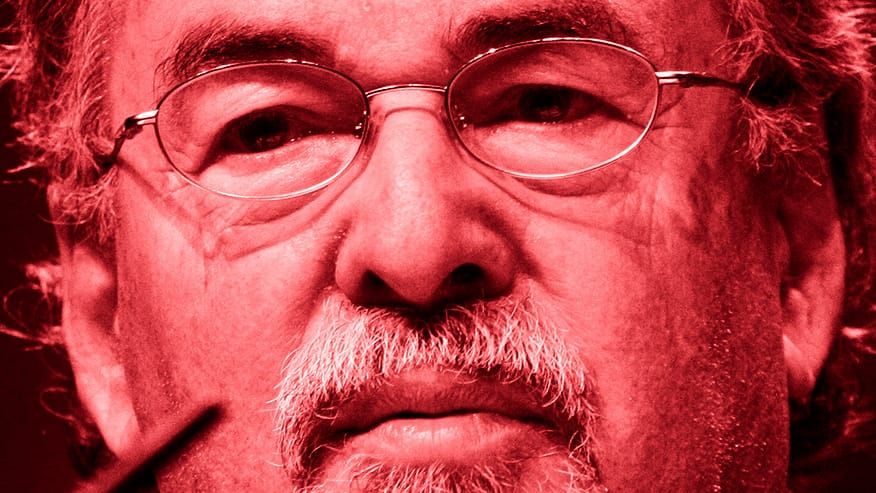

TOM SCOCCA: Well, Maria, there aren’t many things you can point to on any given day lately and say that the world became a better place, but I woke up yesterday morning and I saw that David Horowitz is dead.
MARIA BUSTILLOS: Where did you see it?? The Times obit only just came out.
TS: I saw someone posting about the announcement, and then Fox News had it.
MB: So… here is a guy of whom David Streitfeld wrote, in a Times profile in 2017, “If the Trump administration has an intellectual godfather, it’s David Horowitz.”
TS: As that Streitfeld quote suggests, he was an important part of the process of bringing the country to where it is today. “Intellectual” is not exactly the word, but the overall concept is right. He provided the structure of irritable gestures that have flourished into a Nazi salute.
A self-important jackass who deformed the world around his ego and left it a worse place for everyone.
MB: He didn’t end his public life as an intellectual, but he began it as one, with a well-regarded book on U.S. imperialism. For those too young to remember, David Horowitz was a “red-diaper baby,” born to Communist Russian emigrés in 1939.
His book Radical Son caused quite a stir in 1996—the tale of his revealing journey from editor of Ramparts to Reagan Republican. It’s interesting, absorbing—he was a good writer, early on, but even back then quite weird. A self-serving and grandstanding book, with one memorable detail so horrible I had to look it up to make sure I hadn’t dreamt it.
We had acquired a white cat with tiger markings whom we named Minnelouche, after a poem by Yeats… when kittens arrived, it was difficult to get them “adopted” and we began to accumulate a sizable menagerie. At one point I counted twenty-seven cats and three litters in our tiny household. But nature quickly asserted itself as the rival mothers drove each other out, killing their newborns and even eating their own.
TS: JESUS.
MB: Nothing in there is anywhere near as unhinged, though, as the wild-eyed nutcase Islamophobe he would in time become. Just pernicious in all kinds of ways. A leftist who had turned hard right was just solid gold for what would become the Tea Party. A credible intellectual who’d “seen the light.” (In a 2015 piece in National Review, Jay Nordlinger referred to this phenomenon as “a full Horowitz.”)
They were always few and far between but that sort of person no longer exists, to my knowledge. Not even the Matt Taibbis of the world have gone over to the right quite so full-throatedly.
TS: What was striking about his journey from ’60s radical to right-wing grievance entrepreneur was how little he’d moved. When he was hanging out with the Panthers, he believed he was in the thick of a Manichaean conflict between the forces that would save the world and those that would destroy it. When that cause looked like a losing one, he just switched sides and declared that now the existential struggle between good and evil went the other way.
The unifying theme was that David Horowitz was a very important person.
MB: That’s correct I think.
TS: He never gave up his high dramatic pitch, even as his chosen enemies changed from the FBI to student newspaper editors.
MB: The turning point for him as related in Radical Son was the murder of Betty Van Patter, a bookkeeper for Ramparts whom Horowitz had sent to work for the Panthers. Here’s the thing, that is a real unsolved murder. I’ve always wondered whether he didn’t just go plumb loco as the direct result of that.
Another thing, he was a key figure in the decline of political journalism into pure theater with no real stakes or consequences.
TS: Yes, earlier you sent along this piece in Salon, where Joan Walsh throws her weight behind his campus race-baiting because “for too many years campuses have been places where ideological bullies, usually on the left, have been devoted to blocking political debate, rather than engaging in it.”
There’s a straight line from that posturing by a grown adult in a publication for grown-up readers to the White House’s ideological warfare against campuses today.
I wish I could remember who said it, long ago, but David Horowitz basically made a career out of the discovery that an adult man could successfully pick fights with college kids.
MB: He was running a stunt ad campaign “blasting reparations for slavery,” according to Walsh’s headline. “Cringing campus journalists are giving the racial provocateur publicity that money can’t buy.” Just not great news judgement here, not least because Horowitz was a columnist for Salon. “Giving him publicity,” are you fuckin’ kidding me lol.
TS: Right, OK, Joan Walsh, if the kids are giving him publicity for his troublemaking, what are you doing right there, publicitywise, by writing about it?
MB: Hello! “We received hundreds of letters about the column. The debate was lively, arguments on all sides got thoroughly aired, a good time was had by all.” “A good time was had by all,” sure, a rollicking exchange of ideas on whether or not to attempt to repair the harm caused to generations of enslaved Black families and their descendants. The whole thing is so eye-crossing; note too that Horowitz was buying ads in dozens of college papers, this would have cost tens of thousands of dollars, and no word on who was footing the bill.
TS: Yeah she’s actually describing the scam without properly naming it: when he wrote his provocations in an online magazine, people just wrote some letters and moved on; when he tried to put his provocations in college newspapers, the college kids got mad.
Why are you choosing to steer the discourse toward a fight with college kids?
MB: I called Daniel Hernandez last night to ask him about this experience. He is mentioned in the Walsh piece as editor in chief of the Daily Cal. This is 2001, and he’d been elected to this annual gig by the staff, the first Latino editor since the ’80s. Berkeley, famously a hotbed of left politics, was by then host to one of the country’s largest Young Republican groups, having become a fertile place to become a right-wing provocateur—a great place to go if you wanted rabble-rouse against the left, Hernandez told me. The Daily Cal had even come out in favor of Prop 209 in 1996, the California ballot initiative that eliminated race-based admissions.
“The ad was clearly a provocation, him buying his way, bullying his way into the discourse on this topic, which I actually knew very little about, and the ad was not reviewed beyond our standard norms,” he said.
My big mistake, our mistake in the newsroom, was that we did not go through it line by line. We had all kinds of crazy advertisements, religious advertisements, we had ads of every stripe, political ads—from the Spartacus League to anti-abortion ads—so it didn’t seem out of the norm. And then we realized that Horowitz was doing this in the most liberal places in order to create a gotcha situation, to throw all these young people into a political question that they maybe knew next to nothing about… so we apologized for it...
We as a group of 14 student editors decided to collectively apologize for the publication and lack of review of the ad. Next thing I know, that apology turned into the editor’s apology, this young Latino guy’s apology, Daniel Hernandez’s apology, when it had been the collective decision of our editorial staff. So yeah, I got raked over the coals, people told me that I would never work in journalism, my name was gonna be marked forever… I was 21 years old.
I’m a student journalist here, guys, I’m editing articles about robberies at the frat house, about a professor accused of plagiarism…
“I read every email. ‘You’ll never get a job,’ and then from the left, ‘Fuck you forever, you’re a sellout,’” he laughed, still a bit incredulously.
“But even at that time, even with my mistakes and the mistakes of the organization, I maintained professional decorum and tried to decenter myself as much as possible. I knew even then that the capacity of people to hold onto these grudges gets smaller and smaller, and within a year it would be forgotten, and for the most part it was.”
TS: The individual petty controversies blow away like smoke, but the cumulative effect builds up into a stain on the upholstery of the liberal mind: these kids are out of control. The sort of coordinated campaign that Horowitz waged against the students produces the impression that the students must be in a coordinated campaign, too. And since the students are young, and the young will inherit the future, the only appropriate response is to try to stop the future.
MB: To your earlier point it seems pretty simple; Radical Son is full of hate for his younger self, he is the subject of his own indictment. This is a wildly self-centered guy.
His own not-very-radical son, Marc Andreessen’s business partner, Ben Horowitz, published a long, strange eulogy on Twitter, which omitted any mention of political differences with his father (he and his wife are Democratic megadonors). Nor did he mention his dad’s divorce from his mom, nor his dad’s two other divorces after that.
TS: And this was the same week that Ben Smith opened the curtain on what everyone pretty much knew had to be behind that curtain, namely the group chats Andreessen organized for billionaires to radicalize themselves around the story of their own victimization. Notably, this demonology of liberals and the left did not encompass his own business partner, any more than Ben Horowitz’s anti-Trump gestures carried any condemnation of his pro-Trump business partner and other Silicon Valley peers.
David Horowitz understood how deeply offensive the feelings and beliefs of young people are to the old, and how to make the young people look bad in a way that would allow the older, more powerful people to feel persecuted.
MB: Both Horowitzes seem to represent the solid throughline from the right’s denunciation of “PC” through to “woke.” The Closing of the American Mind to... what?
TS: The Woke Mind Virus.
MB: Yes. Literally the same argument and the same tangle at the root of it. Bigotry, “masculinity,” and then David Horowitz’s life shows evidence of more complicated ingredients in that unholy stew. The commercialization of the Fourth Estate, the disillusionment of young radicals whose revolutions stubbornly refuse to go as planned, the vulnerability of honest discourse to clowns and grandstanders waving some shiny monstrosity around.
TS: Every movement is cursed with the fact that some portion of the people most eager to get out there and change the world are just doing it out of sheer personal maladjustedness, not some real sense that the world needs to be changed to align with some particular values.
MB: Yes! Yes. To reduce this to “for the clicks,” no, that doesn’t begin to address the problem, which is that the true things, the things that it would benefit an intelligent and informed public to know, literally go unsaid.
This Walsh piece, dayum.
In the end it’s probably condescending to protect these student journalists and activists from themselves, especially when they so desperately need serious intellectual engagement. The reaction to Horowitz’s ad proves at least one of the points he makes in it: A morbid attraction to the role of victim, and an unhealthy fear of disagreeable ideas, are all too common in campus politics, and they seem to afflict left-liberal students of color disproportionately.
TS: “Serious intellectual engagement” comes in the form of a right-wing pundit making a show of trying to put an ad complaining about reparations in the student newspaper.
MB: The column is so entirely lacking in the slightest shred of serious intellectual engagement that the effect is downright burlesque.
TS: Again, like Chris Rufo bragging in the Semafor piece about how he steered Andreessen and the other techlords to the far right, what Horowitz understood is that many people who identify socially as “liberal” or “moderate” have the same bigoted specters in their brains that the fascists do, and if he could create a drama with younger nonwhite people yelling at an older white man, they would reflexively go to the side where they felt more comfortable.
MB: Yeah and also, the same obsession with what the left thinks about them every moment of the day and night, this completely meaningless, rudderless politics, lost without Opposition to the Radical Left. No policy, no position, no offer to improve anyone’s lives or reckon seriously with history, no anything but... THE COMMIES.
TS: Horowitz knew that his apocalyptic story of going from the vanguard of the revolutionary Left to the vanguard of the embattled civilization-defenders of the right would perversely bracket the complacency of his target audience.
Whatever degree of sympathy they may have felt for the left when they were young was a sentimental mistake.
MB: My late brother, a Rush Limbaugh-to-Trump guy, used to say he didn’t like coming to California because there were “too many liberals” and I was like… how can you make this the centerpiece of your existence, it’s so fuckin’ weird, I literally do not think about you or your politics ever, aside from passing irritation. (Which became just total vaccine-related sadness, in the fullness of time.)
Anyways… David Horowitz also blamed his misguided parents. The basic premise of Radical Son is that the author was bummed out to find his parents on the radical left really did literally mean to overthrow the government of the U.S.
Guess who did that!
Instead!
Not his parents!
TS: Destroying the system in order to save it.
He was a red-diaper baby who grew up to be a regular old diaper baby.
And now the diaper babies rule us all.