
Blindered faith / Giddy vision

Today: Miles Klee, culture writer at Rolling Stone, author of the novel Ivyland, and co-author, with Mads Gobbo, of the story collection Double Black Diamond; Julianne Escobedo Shepherd, writer, editor, and author of the forthcoming book Vaquera; and Jennie Rose Halperin, digital strategist and librarian at NYU's Engelberg Center on Innovation Law and Policy.
Issue No. 428
The Presumption of Innocence
Miles Klee
Yakkin’ About ‘Party Girl’
Julianne Escobedo Shepherd and Jennie Rose Halperin
HYDRANYM No. 22
The Editors
The Presumption of Innocence
by Miles Klee
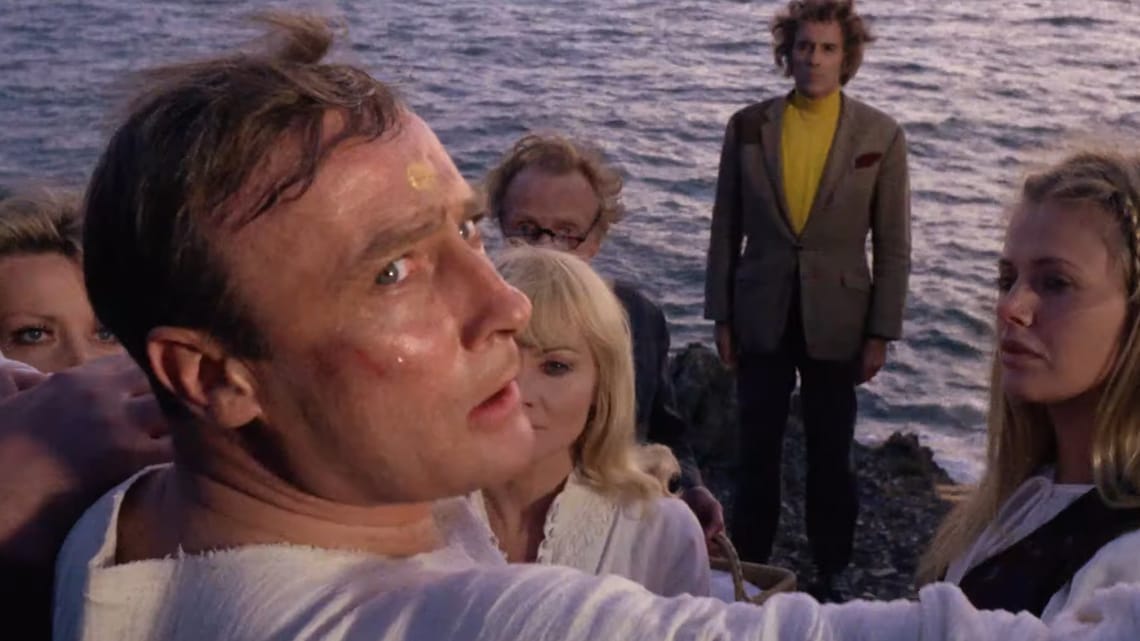
The Wicker Man (1973) has a shocking twist ending, but knowing it in advance doesn’t diminish its terrifying power or scale. The film culminates in a singular, unforgettable vision of the new world sacrificed to the old, whose long shadow extends through and beyond the present. The familiar contours of Gothic fiction shape a story in which the skepticism and rationality of the Enlightenment are annihilated by folkloric superstitions that refuse to die, rising up instead in an engulfing, stupendous blaze.
But this time around things aren’t quite so simple, because Sergeant Neil Howie isn’t some secularized philosopher or man of science, and he’s not up against an explicitly supernatural force. He is a prudishly devout Christian who is blind to the fact that his legal and moral authority means nothing to people who don’t believe in it. The film suggests that Howie is the one deluded by outlandish myths, seeing demonic forces at work when he should—as a more successful detective might—be paying much closer attention to the human motives surrounding him. Meanwhile, the villagers are deeply attuned to their own practical needs for ritual, revelry, and care for their land, and they seem to understand exactly how their guest can be artfully manipulated.
The late 1960s and early 1970s brought a wave of movies concerned with an intrusion of devilry and supernatural terror into the godless modern world, from Rosemary’s Baby (1968) to The Exorcist, which came out in 1973, the same year as The Wicker Man. The so-called “Satanic Panic,” with thousands of unfounded reports of occult ritual abuse, followed in the 1980s and 1990s: children were systematically coerced to “recover” repressed traumatic memories of having been harmed by adults, who were then falsely targeted as sexual predators. These lurid fantasies, fueled by fringe evangelical groups, would later give way to the Pizzagate conspiracy theory and QAnon movement, increasingly politicized versions of the story that cast well-known Democrats and liberal elites as the architects of a vast human trafficking network that was secretly killing or harvesting the bodily fluids of victims while enjoying the protections of wealth and influence.
Keep us breathing fire!








For $3/month you can read this whole post and get our weekdaily newsletter too!