
Poisonous paradise
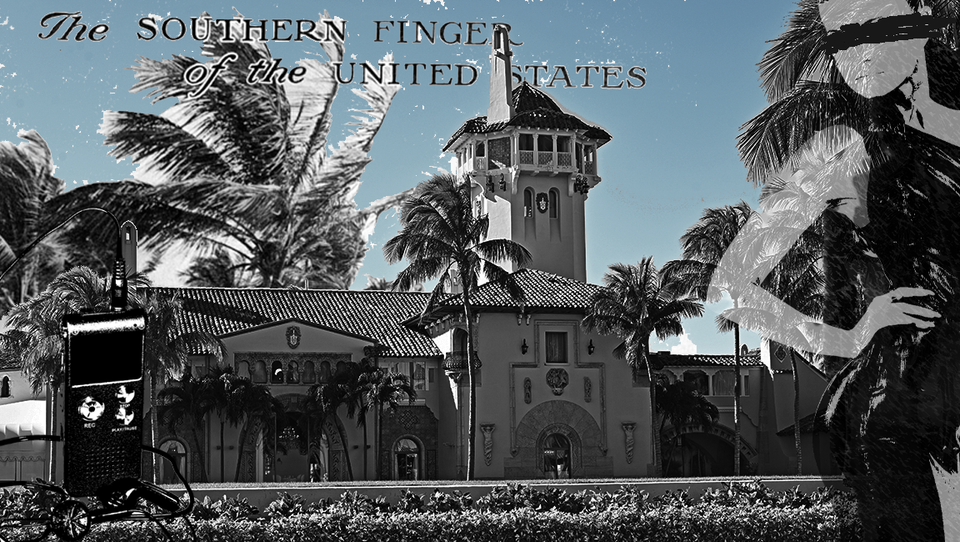
Today: New fiction from Tal Lavin, author of Wild Faith.
Issue No. 518
The Submarine of Czechia
Tal Lavin
The Submarine of Czechia
by Tal Lavin
Adéla adjusts her gown just a little bit lower so that the peaks of her nipples—artificially enhanced, along with the rest of her bosom, neck, legs, hairline and buccal fat—tease at the gauzy fabric. The dress is a carefully-judged shade of silver, adorned with spangles. In her area of assignment, one way to fade into the background is to conceal herself as just one more shiny object, designed to catch the attention only for a moment. The Florida mansion where the American president makes wars, and deals, and spends his leisure time has rooms that are very shiny; its denizens are as shiny as inbred koi; and so for her own purposes is she, though her purposes are not really her own at all.
She wears glistening jewelry, too, a long pendant with a teardrop emerald that dangles between aforesaid augmented breasts, a platinum bracelet in the form of a snake with emerald eyes that clasps the whole of one forearm, a thick silver cuff on the other. Only the pendant, which contains a microcamera, and her earrings, which house miniature microphones, and are dreadfully uncomfortable, are concrete pieces of her tradecraft. Hardware, straight from Czechia, like Adéla herself, handed over along with the rest of the couture wardrobe attached to this identity (and to several others), with great solemnity, in a little grey backroom of BIS headquarters on Nárožní Street on a rainy grey day in Prague. The little technician Ivo had shown her the microphones in the faked-up gems with a craftsman’s pride; Jaromir, her handler of several years, had been nearly in tears, so moved was he by the importance of the assignment, by the gravity of her duties, by the opportunities the operation represented for Czechia, for her, and of course, by extension, for himself and his service.
The woman she was then, a year ago, had been proud of speaking seven languages; as an undergraduate studying theatre, she had read through Kundera and Nesvadba, Dyk and Holub and Topol. Though Adéla was not a product of the Cold War itself but the first generation beyond the shadow of the Curtain, the memory of those times was vivid in her, absorbed through the words of playwrights and the memories of her parents and grandparents, of her country as the small and hapless chew-toy of reckless imperial hounds. A BIS recruiter had approached her after her college-drama turn as Maria in Vaclav Havel’s black comedy The Memorandum; she’d played a bureaucrat who fell victim to spycraft, and, in turn, had been recruited to be a real-life spy. She’d appreciated the irony of it, and was also rather thrilled to engage in this subtler sort of theater, with its far higher stakes and no audience, or an audience of gulls or fools or outright enemies. She had spent the scant few years of her adult life thus far in the service, helping in a small way to flush the FSB out of Prague by means, for example, of a few dates with a cash-flashing ass named Gleb eager to woo the shy, delicate shopgirl she’d played. She had a keen talent for mimicry, and had easily taken on seven or eight new identities a year. A secretary in Brno, a student in Ostrava; once she had been three different girls in Prague in three months. Jaromir said she was the best agent he’d ever worked with, and he’d been around since Czechia was still Czechoslovakia, an old man who refused to stop smoking inside the building, or to retire.
Keep us breathing fire!




For $3/month you can read this whole post and get our weekdaily newsletter too!